Remembering Joyce Echaquan

File Photo
On September 28, 2025, communities across Quebec marked five years since the death of Joyce Echaquan, an Atikamekw mother who died in a Joliette hospital in 2020 while live-streaming the racist abuse she faced from medical staff. Her final moments sparked national outrage and forced public attention on systemic racism in Quebec’s health care system.
In Trois‑Rivieres, a two-day event on September 27–28, titled “Joyce 5 years later: What is the status with reconciliation with public institutions?” brought together Indigenous leaders, health professionals, scholars, activists, and community members.
Held at the Delta Hotel, the gathering featured panels, workshops, roundtable dialogues focused on progress made and the work still needed to ensure equitable, culturally-safe public services for Indigenous peoples.
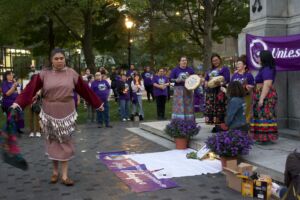
The evening of September 28 also featured a public homage open to all, during which people gathered to remember Joyce’s life, share reflections, and press for accountability and transformation. The tribute framed its mission around a theme drawn from memory and resilience.

A central legacy of Joyce Echaquan’s death has been the (Joyce’s Principle). This framework, developed by Indigenous and Atikamekw leaders, outlines a set of measures to ensure the right of Indigenous people receive health and social services free from discrimination, to have their traditional practices respected, and to experience cultural safety in institutional settings in line with Article 24 of the UN Declaration on the Rights of Indigenous Peoples.
The conference in Trois‑Rivieres intended not only to assess implementation over the past five years, but to press institutions and governments to move from symbolic recognition toward concrete structural change.
Alex M. McComber, Assistant Professor in McGill’s Department of Family Medicine and Indigenous health advocate, spoke of what he called Joyce’s principle, a call to action. “Asking governments, agencies and people to change, to transform the system, and it’s something that needs to be done collectively and collaboratively.”
He cautioned that the goal is not to let her death be another tragic turning point, but to convert it into momentum for change, “The province refuses to acknowledge systemic racism and that speaks volumes. That tells us they know what they’re doing is wrong and have no desire to truly make any change in collaboration with Indigenous Peoples.”



McComber also stressed the uneven nature of progress. He noted that within McGill’s faculty, departments such as Family Medicine have formally adopted Joyce’s Principle into curricula, and that they are working to integrate its teaching across undergraduate, graduate, and residency training. But he lamented that many provincial institutions have not embraced it, often refusing even to acknowledge systemic racism.
“It would be ideal if Indigenous Studies were required throughout medical training not just workshops or electives, but real courses that build understanding, skill, and reflection. That’s my challenge to McGill,” he said.
“Universities produce the administrators, the managers, the professionals who shape these systems. So, our job is to plant the seeds to ensure they understand systemic issues, reflect, and understand those principles before they enter those roles.”
Sign up for email updates from The Eastern Door