Scale beam project to commemorate 9/11
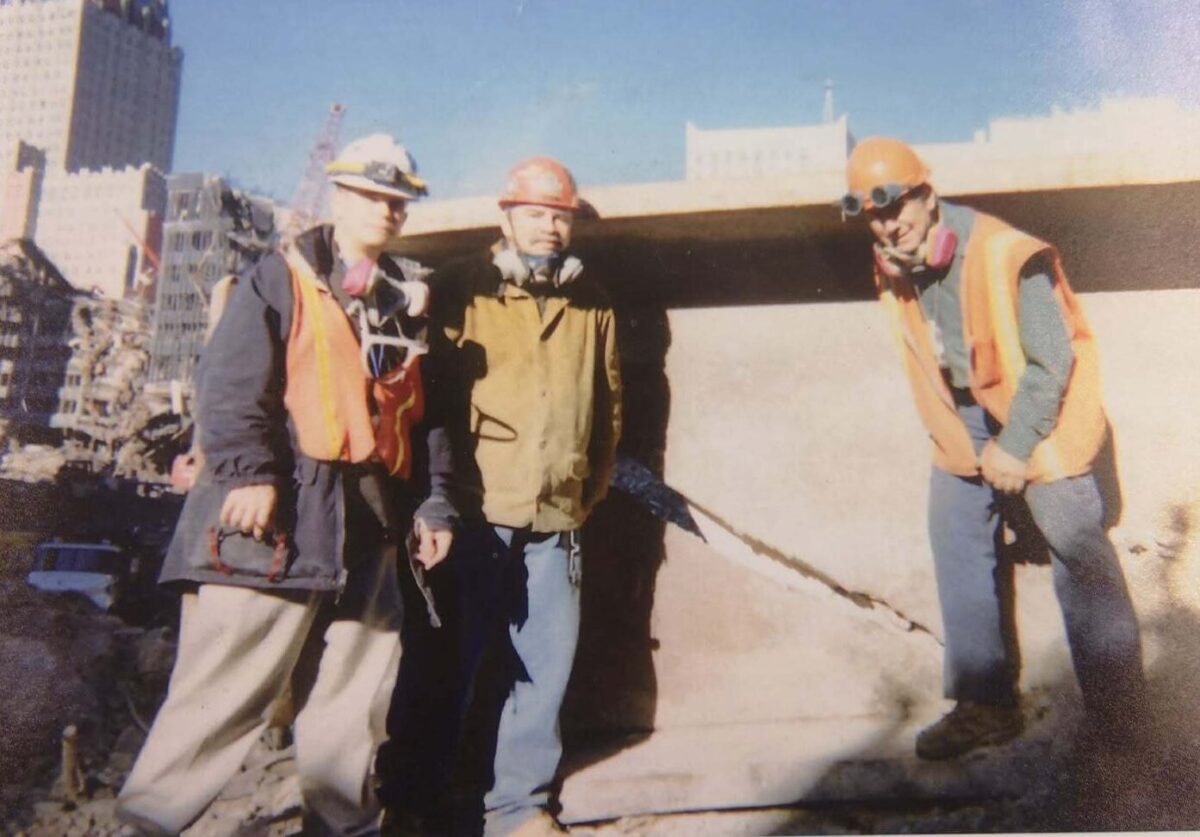
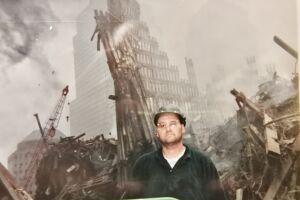
A photo of Donald Angus (middle) at Ground Zero as part of the cleanup crew a few days after 9/11, next to the cracked metal beam that would stick with him for the next 25 years. Courtesy Donald Angus
Listening to Donald Angus talk about his time as part of the cleanup crew at Ground Zero in New York City in the days and weeks following 9/11, it almost feels like it happened yesterday, not almost a quarter of a century ago.
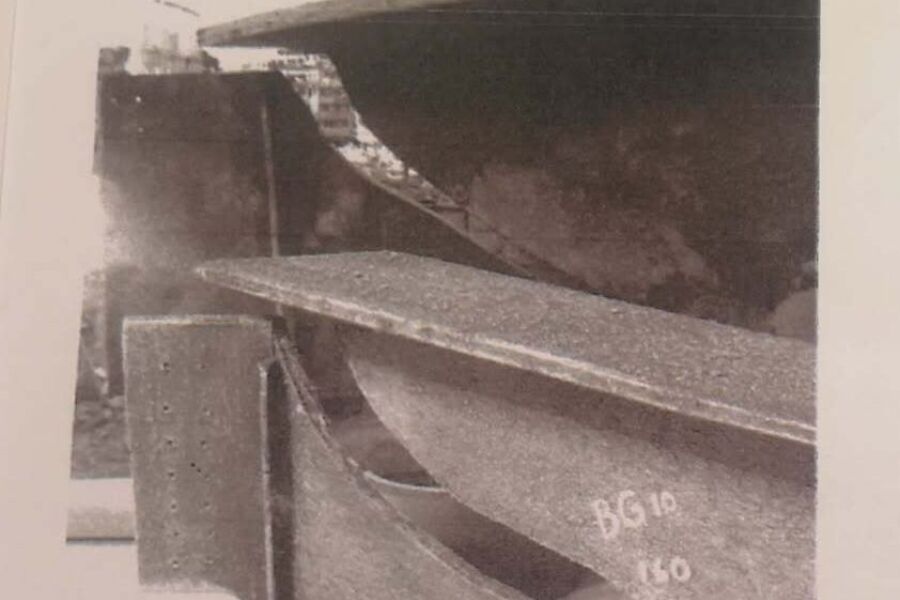
But of all the things he saw while he worked there cutting away debris when he was an ironworker in New York City, one thing has stayed with him all this time: a 55-and-a-half-ton steel beam, with an almost eight-foot-long, nine-and-a-half inch wide crack in it.
“You can’t get anything to make that kind of crack. That’s one beam that showed the true extent of the damage,” said Angus.
Angus said the beam came from the PATH train station under the World Trade Center and was being used as a retaining wall on the dumping site while wreckage was being cleared.
Noticing the crack, Angus and another worker cleaned up the beam and took the measurements. Angus also took photos - before cameras started to be confiscated by police because of the investigation, he said.

Angus asked a structural engineer who was on site what kind of force would be needed to do that kind of damage.

“He had a calculator, and he said, ‘just roughly 3,000 cars piled one on top of each other,’” said Angus.
“The PATH train was down below the buildings, so when they collapsed, the pressure made that happen.”
His stepson, sculptor and fellow ironworker Walter Jacobs, brought the photos Angus took back home to Kahnawake.
Three weeks later, he returned with a small wooden model, using the measurements Angus took down as reference.
“I never thought that they could be arranged like that, made out of wood,” said Angus.
Almost 25 years after making that first model, Jacobs is now making two more of the same beam. But this time, they’ll be the same size as the real thing was.
The first will be in the Kanatahkwèn:ke Cultural Arts Center museum, while the second will, hopefully, be a part of the 9/11 museum in New York City.
“We needed some for ourselves here, for the town, and there, because of our connection to the city,” said Angus.




“I think it’s good to have it here, but I think it’s also good to have that piece in New York because number one, that’s where the event happened,” said Lisa Phillips, executive director of the Kanien’kehá:ka Onkwawén:na Raotitióhkwa Language and Cultural Center (KOR).
“But two, I’m the daughter of an ironworker, and my dad was part of Local 361 from New York. Most men, that was their other home.”
Phillips said she and Angus had been talking about this project for three years, and with the museum officially opening in September, things have been speeding up now.
Jacobs finished the first beam already, Angus said, and the second is being worked on now.
Angus is hoping the beam will be a part of the museum in New York to show that Kahnawake was there, too. He’s also hoping to be able to bring the museum’s director to Kahnawake to show what the community is all about.
It is particularly important for this project to get done for them, as those who were there grow older and sometimes get very sick because they worked there; their experiences at risk of being forgotten.
“There’s a lot of stuff that they don’t want to talk about,” said Angus. “And you can’t blame them for that. It affected a lot of people, and it still does. And now they’re passing away.”
At the Echoes of a Proud Nation Pow-Wow, Angus spoke to people about the project at KOR’s booth, being the biggest draw, according to Phillips.
Sign up for email updates from The Eastern Door
“It’s his passion. It’s his baby,” said Phillips.
Another related project being worked on is Pat Goodleaf trying to find where ironworkers have travelled to work, taking trips to different Locals to see their records. That too will be a part of the museum.
Now, they are looking for sponsors to help finance the project with advertising spots available in the booklet that will accompany the projects.
Those interested in supporting the projects can contact Phillips or Goodleaf directly.