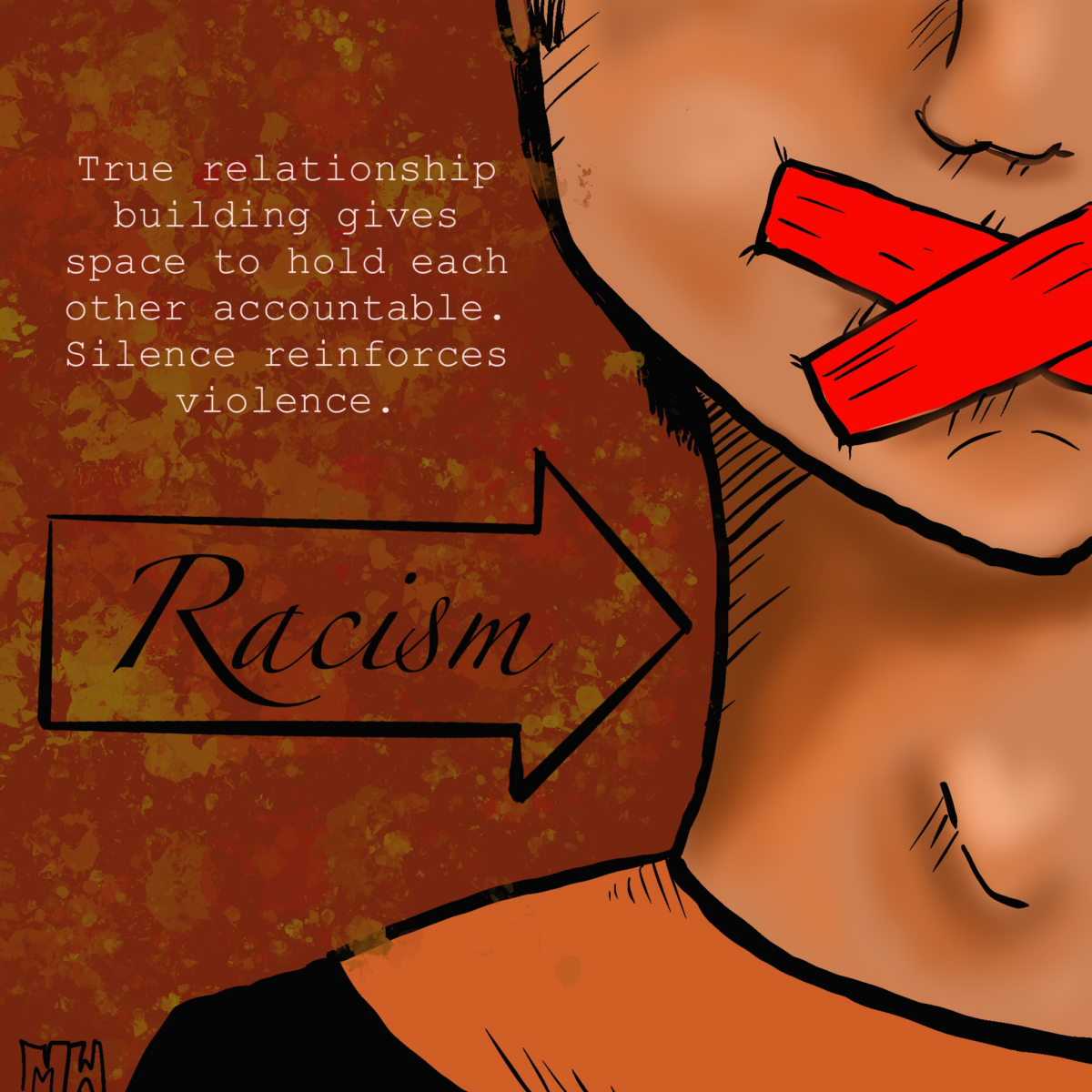
Racism needs to be called out
Megan Kanerahtenha:wi Whyte The Eastern Door
“Stop drinking, Wab.”
These words were uttered in the chamber of the Manitoba Legislative Assembly to Wab Kinew, who is the only First Nations premier in the history of the country.
What would you call this comment? If your first answer is racist, well, yeah. You could pretty much get Webster’s on the phone for this one: it’s a candidate for the dictionary definition.
The disrespect exhibited by the member (MLA) who said it, Progressive Conservative (as the oxymoron goes) Wayne Ewasko, was only compounded as he stayed silent when the speaker, Tom Lindsey, instructed him to say sorry.
Asked for a second time, Ewasko finally “apologized,” and by that we mean he said everyone should be more respectful, including the other side. Eventually these shenanigans got him ejected from the chamber, and rightfully so.
But to Kinew’s surprise, when Lindsey decided something had to be done about a Legislative Assembly increasingly lacking in decorum, he unveiled five words that would be banned, at least when applied to individuals in the chamber.
Unlike the famous Carlin bit, you can say all these ones on TV - just not in the Legislative Assembly, apparently: racist, transphobe, homophobe, misogynist, and bigot, terms that are now officially deemed unparliamentary.
Lindsey said these changes can help promote conducting the people’s business in a “civil, orderly manner.”

Civil and orderly work great for the oppressor, but rarely are they avenues to justice for groups that have been marginalized or disenfranchised. Limits on calling out racism, transphobia, homophobia, misogynism, and other kinds of bigotry are not the way to get political discourse back on the rails.
One of Kinew’s colleagues pointed out that their party, the provincial NDP, is the only caucus in the legislature that includes trans and gender non-conforming members, Black or Sikh members, Indigenous women, and people of certain other groups.
What are these members to do when demeaning comments are made? Say excuse me, but those comments are unbecoming of an MLA - even as thousands of voters keep them in office? What does that say to young eyes, gleaming with dreams of one day rising to power and making change?
Apparently children visiting the Legislative Assembly were heard repeating an “unkind heckle.” Kinew suggested in response that the most important lesson for children who have experienced racism is to call it out.
Lest you think we’re just writing about Manitoba this week, that’s not the case. Lindsey pointed out, correctly, that he was simply following suit.
It might surprise some people to learn that “racist” is already part of the lengthy lexicon of banned speech in the National Assembly of Quebec - but then again, it might not. After all, when has anyone understood calling out racism to be among Quebec’s priorities?
In fact, as we have seen time and time again, the Quebec government does not even want to acknowledge the existence of systemic racism in the province.
We’ve brought this up a lot of times, and for good reason.



Changing something starts with naming it, and of all the stains on Legault’s tenure as premier, refusing to say what happened to Atikamekw woman Joyce Echaquan - mercilessly mocked in French by nurses meant to be saving her life as she lay dying - was emblematic of systemic racism, has got to be among the worst.
(In this tirade, Echaquan was called stupid, good for sex, a drain on the health system, and better off dead.)
The coroner made waves when she concluded Echaquan’s death was an example of racism and prejudice, and said Quebec must acknowledge the existence of systemic racism in the province.
Legault was free to make further laws extending systemic racism, but if a rival politician called him racist for doing so, they would have been the ones censured.
That’s just backwards, and it’s one reason that in a city with a giant metal cross that it is literally illegal to build anything higher than, a woman who chooses to wear a hijab is effectively banned from teaching children, whose horizons might be expanded by exposure to people with different points of view, under the guise of secularism.
It’s not just inside parliamentary chambers that people get uptight about being called out - Quebec Solidaire MNA Haroun Bouazzi caused a firestorm by saying in a speech, essentially, that he sees minority groups like Indigenous people being “othered” every day at the National Assembly. Cue the cross-partisan outcry: how dare he suggest Quebec’s MNAs are being racist?
Don’t count on that kind of outrage on behalf of the people of colour who are blamed for a purported erosion of French, or the Kahnawa’kehró:non who were suddenly faced with new obstacles in obtaining healthcare or an education, as they instead spend their linguistic energies on revitalizing a language that was almost extinguished by colonial interference.
It’s time for settlers and their politicians to accept that being called out on racism isn’t an insult, it’s a challenge to examine one’s own prejudices and grow.
Sign up for email updates from The Eastern Door
Oh, by the way, that colleague of Kinew who invoked the minority members of their caucus? Her name is Nahanni Fontaine, and she too has been ejected from the legislature, back in 2021.
Her transgression? She’d said the Manitoba government, at that time run by the Progressive Conservatives (PCs), “did not give a crap” about Indigenous women (the offending word: crap).
That government, prior to Kinew’s election, went on to spend years refusing to search a Winnipeg-area landfill for the remains of Indigenous women murdered by serial killer Jeremy Skibicki in 2022.
The remains of Morgan Harris and Marcedes Myran were eventually found in 2025 - within months of Kinew’s government launching a search, one the PCs had dismissed as too dangerous, too costly, too imprudent.
In 2023, the PCs even ran on their vow not to search the landfill, as though it were a badge of honour.
What’s worthy of censure, an attitude like that, or calling it out for what it is?
Marcus Bankuti, Managing Editor
Steve Bonspiel, Editor/Publisher