Joyce Echaquan honoured at vigil
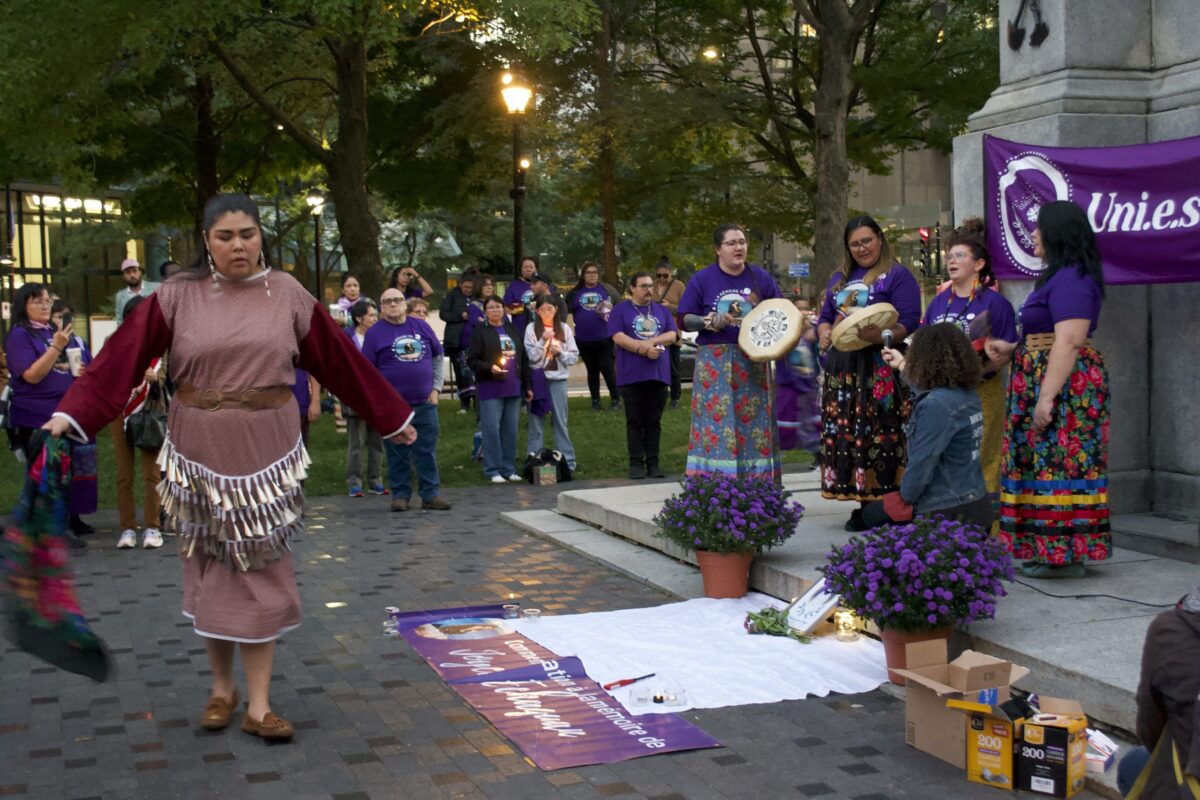
Over a hundred gathered in downtown Montreal last weekend to honour the life of Joyce Echaquan - an Atikamekw woman who tragically died in a Joliette hospital in 2020 after being denied basic medical care. Many came all the way from Manawan, the home community of the mother of seven.
“Joyce isn’t just a symbol or just a victim, she’s a rallying cry,” said Sipi Flamand, a band chief from Manawan. “What Joyce suffered was unacceptable. It was not an accident or an anomaly, it was the direct result of systemic racism.”
Echaquan was thrust into the limelight after taking her cell phone out to livestream racist taunts being thrown at her by a nurse at the hospital.
She was live for seven minutes before the employee grabbed her phone, and she died later that day. The nursing staff involved were dismissed after the incident.
Not enough has changed in the four years since her death, Flamand said. In hospitals and clinics, Indigenous people in Quebec are treated like second class citizens.
“Systemic racism is real. It kills and it continues to kill,” he said. “How many more Joyce Echaquans does there need to be before Quebec takes responsibility?”

Joyce’s Principle - a framework aimed at ensuring Indigenous people can access to health and social services free from discrimination - has yet to be adopted by Quebec.
Bill 32, a proposed cultural security law aimed at healthcare institutions only supports fragments of the principle, reiterated Ghislain Picard, chief of the Assembly of First Nations of Quebec and Labrador (AFNQL). His assembly took part in consultations over the bill, but left feeling they hadn’t been heard.
“It was particularly taxing having to take part in a parliamentary process that was so contrary to our values,” Picard said. “We know full well that Bill 32 is a law we’ll never be satisfied with, that it’s far from guaranteeing the safety our people are demanding.”
The AFNQL is currently pushing Quebec to create an ombudsman specifically dedicated to responding to complaints from Indigenous people.
“We are human beings. We have human rights,” Kanehsata’kehró:non Ellen Katsi’tsakwas Gabriel told the crowd. “Whoever decided that Joyce’s Principle is not worthy enough to implement in the province’s hospitals and other healthcare facilities, you are wrong. You are perpetuating the genocide that continues today.”
Many healthcare workers also took part in the vigil.




“The issue is far from resolved, and I believe it to be intentional on the part of Canada,” said Kathleen Skye, a nurse with the Kanesatake Health Center (KHC). “We question what else needs to happen to have recognition of our value as human beings. We are immensely grateful to Joyce Echaquan for turning on her phone at the right moment for the world to see how Canada can conduct itself towards Indigenous people.”
For Kahnawa’kehró’non Alex McComber, it was his first time attending the annual vigil.
The associate professor at McGill University’s family medicine department was among those that convinced the department to adopt Joyce’s Principle last year.
Speaking to those gathered, he said it’s been inspiring to see how Echaquan’s death provoked a movement for justice that’s still just as strong today.
“You took that hurt and that pain and turned it into something good,” he told the crowd. “You shone a light on what they’re trying to hide. They’re trying to keep that closet door locked shut and say there’s no problem here.”
Not enough medical professionals at the hospitals and clinics surrounding Kahnawake are aware of Joyce’s Principal, he said. Mandatory sensitivity training for healthcare workers that came into effect following Echaquan’s death has failed to put Indigenous voices at the forefront.
“Quebec has developed a cultural safety curriculum, however it’s a top-down curriculum that’s just as racist as they are,” McComber told The Eastern Door.
Sign up for email updates from The Eastern Door
That’s why the education provided at medical schools is top of mind for him.
Next month, he and his colleague doctor Sarah Konwahahawi Rourke will be leading a workshop with professors at McGill’s family medicine department about how they can better incorporate the teachings of Joyce’s Principle into the classroom.