There is strength in numbers

Megan Kanerahtenha:wi Whyte The Eastern Door
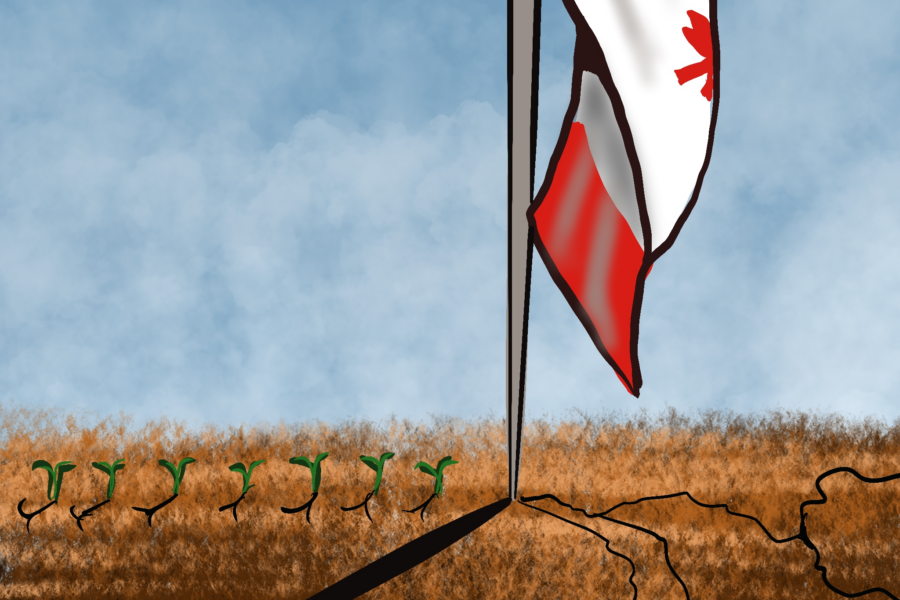
At the Siege of Kanehsatake commemoration event in Tiohtià:ke last year, this saying was shared: “You can break one arrow very easily, but if you take a bunch of arrows, you cannot break them.”
Solidarity between Kanesatake, Kahnawake, and other Onkwehón:we communities and allies helped community members stand their ground during the Siege of Kanehsatake, challenging Canada’s peacemaking reputation around the world, and serving as a historic example of what resistance can look like.
Solidarity continues to be a critical asset in all fights against injustice because when people and groups with power use it to bully and steal, there is also power in numbers, especially in service of a righteous cause.
That’s why colonialism and imperialism are so focused on division and pitting groups against one another. To this day, there are sadly many examples of intergenerational trauma fueling lateral violence, undermining the power of the collective.
It’s no accident, of course, that colonizers on Turtle Island have always sought to erode the numbers of those to whom the land belongs, whether through violence, suppression of language and culture, or other forms of assimilation, such as stripping Onkwehón:we of status rather than acknowledging the right of First Nations to navigate their own membership. Blood quantum and second-generation cut-off come to mind.
At one time, the Indian Act even dictated that seeking a post-secondary education would strip an Indigenous person of their status.
Sunday marks the 150-year anniversary of the Indian Act, which is still the law of the land, even if it has been revised here and there over the years. The bottom line, though, is that this legislation is still a symbol and method of control over First Nations - people and territory alike.

Since ’90, the language around Canada’s relationship with Indigenous people and nations has changed a great deal, but the basic colonial idea that all the lands and waters from coast to coast are Canada’s to use and abuse as the government sees fit is basically unchanged.
Likewise, Canada has rarely honoured its obligations, morally or legally. The government gets involved when it suits its objectives, but then it plays the hands-off game when First Nations actually need something, which is just neglect and a failure to play a supporting role in resolving problems colonialism is still inflicting.
Sadly, Kanesatake is rife with such examples. How long did it take Quebec to bother getting involved with dumping, only to finally target mostly Kanehsata’kehró:non and not those benefitting from cheap disposal? How many arsons have gone unsolved?
Most recently, ISC continues to fail to find permanent funding for a public security force that might stay loyal to the people of Kanesatake, rather than private forces out patrolling for the interests of the few - the ones who profit off the traffic, noise, tree felling, and land grabbing everyone else has to deal with. Why?
Meanwhile, the demand of Mohawk Council of Kahnawake (MCK) grand chief Cody Diabo that industrial activities in Kahnawake’s land grievance area, the Seigneury of Sault St. Louis, be halted, is basically ignored by the outside, which probably views such a claim with a combination of derision and bemusement.
Yet it’s Kahnawake that must continually deal with the consequences when private industry, licensed by the government, poisons not only the land that rightfully belongs to the Mohawks of Kahnawake, but even the environment within the current boundaries.
Have any cities in the area had to relocate a high school, like Kahnawake had to do in the 90s, because of industrial contamination? Only for environmental concerns to arise in the new location down the road?






Meanwhile, when Carney and the Canadian government talk about sprinting to build projects in the “national interest” under the Building Canada Act, there’s only one “nation” they’re talking about, and it’s not the Kanien’kehá:ka Nation.
That’s why the MCK is right to pursue partnerships with other First Nations, with one signed just this week with the Abenaki Councils of Odanak and Wôlinak being billed as historic. These communities have a great deal of expertise in both economic sovereignty projects and the overall fight against Quebec and Canada when it comes to territorial rights.
Collaboration will offer opportunities not only for projects that can reduce dependance on government and increase the community’s leverage but also creates new channels for exchanging information and standing up to governments that never cease trying to push First Nations around.
Likewise, while the Assembly of First Nations (AFN) is distrusted by some, smaller affiliations like the Iroquois Caucus and the Jay Treaty Border Alliance offer the opportunity for communities to have their voices heard and expressed in a different, maybe more meaningful way.
Look at what organizations like the First Nations Education Council (FNEC) have accomplished, with a landmark agreement signed in 2022 that provided $1.1 billion in education funding.
First Nations have a lot of leverage, but Canada and Quebec are still partial to the divide-and-conquer/steamroll strategy.
All signs point to these tactics tightening as Canada has made building major projects quickly one of its top priorities in the face of US agitations. That means consultations, already woefully inadequate, being even more rushed or skipped altogether.
Sign up for email updates from The Eastern Door
Sure, Carney’s projects will find nominal support here and there, depending on the incentives, but that’s not good enough, and the government knows it, given the years-long protests that have emerged when projects have moved ahead with minimal support.
There’s nothing simple about standing up to a government that thinks it has the right to operate as it sees fit, no matter how it affects Indigenous territories and populations.
But when First Nations stand together, negotiate together, share information, and apply their leverage together, the “national interest” can mean something very different.
Marcus Bankuti, managing editor
Steve Bonspiel, editor/publisher