Men must stand up against violence
Megan Kanerahtenha:wi Whyte The Eastern Door
Last week marked the annual Moose Hide Campaign, a fast-growing, Indigenous-led movement coming out of BC with a simple goal, to unite folks around putting an end to gender-based violence once and for all.
The movement has become a staple for its simple message that violence against women and children is unacceptable, preventable, and that men and boys must take a leading role in extinguishing gender-based violence, including sexual violence.
That might sound obvious, but too often the burden has been on women to advocate for an end to something that is almost entirely perpetrated by men.
One reason, no doubt, is that many men fail to recognize the prevalence of gender-based violence, or in many cases even what constitutes it.
Ignorance is no excuse though. All a man needs to do is keep his eyes and ears open and listen to the lived experiences of women, girls, and gender-diverse people to know that we’re not talking about isolated incidents. It’s an endemic problem, with rotten roots, that requires a radical approach.
One thing’s for sure, men shouldn’t be looking for reasons they’re not part of the problem, but instead searching for ways they can be better.
It’s not enough to tell yourself that you don’t raise your hand at women and then use that hand to pat yourself on the back. Violence is insidious and pernicious, and in moments where you’re slamming cupboards or angrily speeding in your car, you’re part of the problem.

So, too, when you fail to speak out, broach hard conversations with friends and family, or intervene in appropriate ways - too often, it should be noted, perpetrators react to embarrassment by taking it out on their victims.
Then there are the always watchful eyes of the next generation, which is why it’s so important to loop boys into this conversation early and often, to model behaviour that is beyond reproach, to explain concepts like consent and respect so that by the time they’re grown up, these are second nature. In case it’s not clear, “boys will be boys” is not the way to do that.
Incidentally, we’re of the mind that glorifying violence doesn’t help matters. We should be teaching the next generation that “blowing off steam” isn’t a good reason to lash out. Learning to control and process our emotions in a healthy way - very different from bottling them up or hiding them - is the path the strong man takes.
The Moose Hide Campaign is all about fostering conversations and speaking up, which is crucial to building a safer world for women, girls, and LGBTQ2S+ people, but of course, it’s not the first major campaign to address violence against women and girls.
The White Ribbon Campaign, 35 years old, emerged out of the shocking murder of 14 women at Ecole Polytechnique. It too was founded to recognize men’s responsibility to end gender-based violence.
But the Moose Hide Campaign, with its Indigenous perspective, caught on because it is so needed.
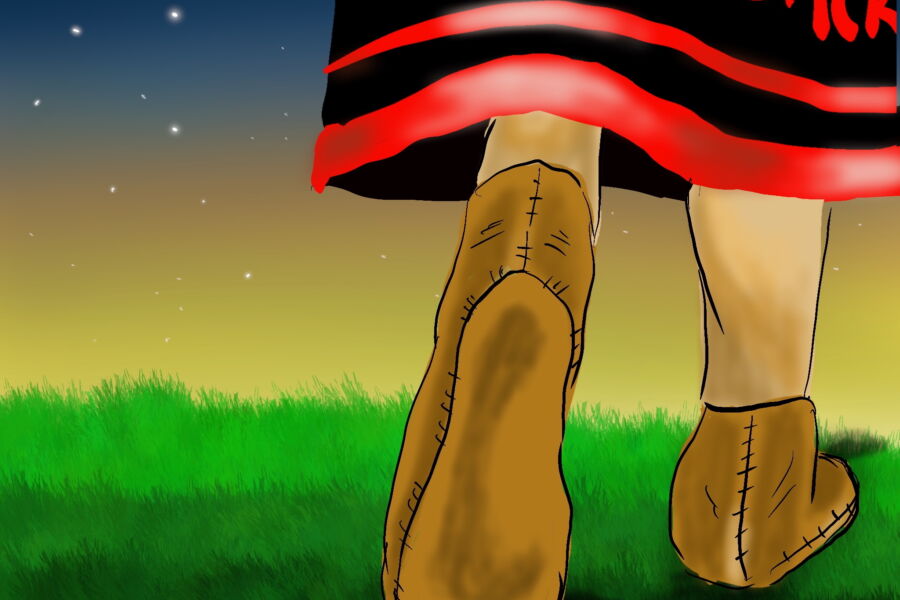
It began in 2011 when Paul Lacerte and his daughter Raven were moose hunting on their traditional Carrier territory, which is along what is known as the “Highway of Tears,” a segment of BC where so many women Indigenous women and girls have gone missing or been murdered.






A patch of moose hide took the place of a ribbon, and the organization has said it has handed out millions of pins representing the Moose Hide Campaign. The campaign’s leaders have pointed out that this amounts to millions of conversations had about an issue that is so often wrapped in silence.
Indigenous women and girls, as we were reminded on Red Dress Day earlier this month, suffer a disproportionate level of gendered violence, so of course an Indigenous-led solution is needed.
Not only that, but the movement’s emphasis on ceremony reflects the power of reconnecting with traditional culture. After all, traditional Kanien’kehá:ka culture is matrilineal, built on respect for women as leaders and decision-makers.
Colonial culture, built on theft and power, has wrought so much intergenerational trauma, which contributes to violence.
Campaigns built on healing offer a powerful avenue to ending violence against women.
Here in Kahnawake, so many people have applied their hearts and minds to promoting change and offering resources and support.
Whether talking about Kahnawa’kehró:non creating a grassroots network of support for women who have experienced sexual abuse, or something like the Kahnawake Family Violence Action Group, which includes several community organizations, the community is full of talented and caring people working toward a future free from the scourge of domestic abuse.
Sign up for email updates from The Eastern Door
Meanwhile, a growing willingness to confront gender-based violence across society is key, such as a new bill in Quebec announced last week, that aims to combat intimate partner violence by empowering individuals to look into their partner’s or ex-partner’s histories with domestic violence.
Now the government needs to roll up its sleeves and hammer out the details of the bill with the input of Indigenous advocates, who have worked so tirelessly in hopes of seeing an end to Indigenous women, girls, and LGBTQ2S+ being targeted.
But this problem can’t be solved in a vacuum. That means it’s time for all of us to step up and be part of the solution. Sure, that can seem intimidating. It’s hard to know where to begin.
No woman should have to be seen as a daughter or mother to be humanized, as so many slogans about being kind to women seem to imply, but there is something instructive about a father and daughter, hunting together on their traditional territory, sharing ideas and coming up with a campaign that has sparked millions of conversations in the years since.
That’s the power of the transmission of values.
Marcus Bankuti, Managing Editor
Steve Bonspiel, Editor/Publisher