The media should be at public meetings
Megan Kanerahtenha:wi Whyte The Eastern Door
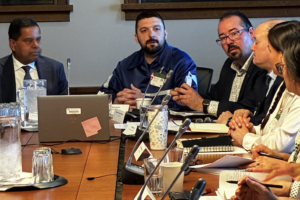
It has been nearly two years since the Mohawk Council of Kahnawake (MCK), at the urging of community members, agreed to hash out a media protocol for public meetings.
Yet when things allegedly got out of hand at the Golden Age last week during a Kahnawake Legislative Commission community mandate meeting for proposed amendments to the Election Law, the local media wasn’t there to tell you what happened from our own perspective.
Now the Peacekeepers, the media, and most importantly, the community at large, are having to piece together what took place.
That has nothing to do with the commitment and diligence of our journalists, who work hard to deliver the quality of journalism our readers deserve and expect.
Rather, it’s because Kahnawake’s oldest homegrown newspaper is still not allowed to attend community meetings for the purposes of reporting, pending a media protocol that appears to be on the backburner once again.
Why does that matter? Well, plenty of reasons, not least that the community is not benefitting from the media’s value in helping to explore the full substance of the public-interest issues under discussion.
As nice as it is to send the paper to print on Thursday nights and grab the Nintendo controller, we would have rather been doing our jobs. Covering public meetings is pretty much Journalism 101, and for good reason. That’s where community leaders present plans and engage with their constituents. It’s sometimes where decisions are made. It’s a great place to figure out where to dig deeper.
We work hard to overcome this obstacle, but the fact remains that it only does a disservice to the community when we’re not in the room.

After all, for thousands of Kahnawa’kehró:non, being there just isn’t feasible when it competes with family dinner, hockey practice, taking care of elderly parents, working overtime, or a million other things.
And these Kahnawa’kehró:non deserve to know what’s going on with the issues of the day and to be able to judge the behaviour of their leaders without relying on what they’re hearing on Facebook or two aisles over at the Mohawk Market.
Look at what’s being alleged in this case. On the one hand, we have witnesses who say a Council chief laid hands on community members. On the other, we have a chief who says he didn’t do anything wrong. We have a police force that is taking statements and investigating.
People are probably choosing what to believe based on what they think about the people involved, and that’s understandable - what else do they have to go on?
First thing’s first, short of standing in the way of a violent situation, nobody should be laying their hands on anyone, and that goes double for people in positions of authority.
Think about it. One person’s intervention is another person’s aggression. In the heat of the moment, people don’t know their own strength. Everyone brings their own history to the table when an uninvited physical interaction takes place, and then things go downhill fast.
Leaders must lead with their words, and when this isn’t possible, call in people who are trained in physical intervention, and, crucially, trained to determine when physical intervention is necessary to de-escalate a situation, because a lot of times, it’s not.
Just imagine if something like that happened at a Montreal borough meeting. Trust us, it would make the nightly news and be the chatter of the morning radio, and while people might debate what’s reasonable, the facts would not be in dispute.




That’s not really what this editorial is about, but at the same time, people’s reputations are at stake, and for what can only currently be described as an “incident” to be so murky, when it could have been clear, is really too bad for everybody involved.
So, we piece together what we can, including that an active investigation exists, and statements were made by both the chief allegedly involved (on Facebook) and the Council itself, and we let you decide.
Our readers and, well, pretty much everyone in Kahnawake, will remember when The Eastern Door was accused of a so-called “breach” that led to the Council cutting off communications with us very abruptly and publicly.
We don’t agree with that version of events, and let’s just say we’re skeptical of the lexical coherence of the words “secret public meeting,” which seems to us a contradiction in terms.
But we’ll spare you the details of that unfortunate chapter, having written thousands of words about it at the time.
The bottom line is something good came out of it, we thought, when it was decided clarity was needed. We were enthusiastic to be a part of developing a process that would allow our journalists to attend these important meetings and report on them fulsomely and accurately, while abiding by acceptable terms that do not undermine this mission, for the benefit of the community.
We are still eager. We acknowledge the sensitivity of certain items (although if it’s really confidential, you probably shouldn’t say it at a public meeting). We respect the need to give space to community members to express themselves in a way that feels safe for them.
Besides, that secret public meeting? Nothing sensitive was revealed by us, and, in the end, the MCK lawsuit against Chateauguay was dropped. The outcry from the Council was all for naught and the unilateral Facebook post that started it all ended up as an important lesson of what not to do as a sitting grand chief.
Sign up for email updates from The Eastern Door
We have an important role to play in the simple fact that the presence of journalists makes public meetings more safe, not less.
Readers of The Eastern Door know we have never been shy to dig into stories that challenge power, if that’s where the facts lead us. And we always try to get all sides, because that’s what responsible journalists do.
That doesn’t mean all sides necessarily give us their point of view. Sometimes it’s for legal reasons, sometimes it’s professional reasons, sometimes it’s just because they don’t like that we’re doing our jobs. We work hard to get those perspectives.
But nothing beats being in the room.
Marcus Bankuti, Managing Editor
Steve Bonspiel, Editor/Publisher