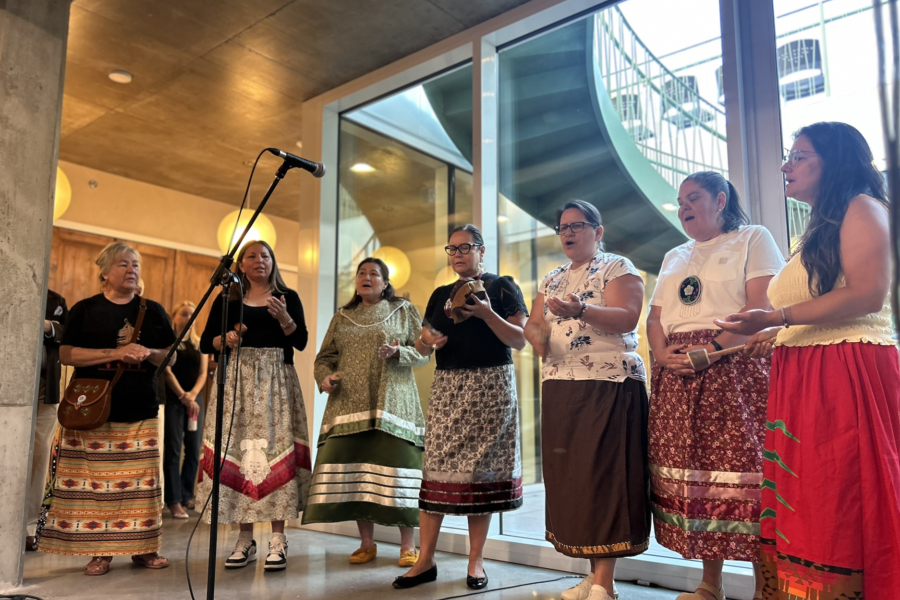
Caretaker council at work

Caretaker Council chief Brant Etienne at the Mohawk Council of Kanesatake office. Hadassah Alencar The Eastern Door
The Mohawk Council of Kanesatake (MCK) “caretaker council” continues work under a limited mandate outlined by Federal Court last year.
While their role is to keep the community going from an administrative perspective until an election can finally be held, it is not always simple to determine what falls into this mandate.
“All we’re doing right now is we’re just holding back the flood,” said MCK caretaker council member Serge Otsi Simon. “We’re just keeping our basic services going.”
For Brant Etienne, another incumbent on the caretaker council, the work mandated by the judge’s order includes the majority of the work its members have always done.
The caretaker mandate “is not that different from our normal mandate,” said Etienne. “I’d say we’re still at about 90 percent, if not more, of the workload that we had beforehand.”
An October 2025 Federal Court decision granted injunctive relief appointing a caretaker council made up of five outgoing Council chiefs, including Simon, Etienne, Amy Beauvais, Denise David, and John Canatonquin.
The caretaker council is mandated to engage in “simple administration matters such as day-to-day administration, the provision of essential services to community members, ordinary payable accounts, management of administrative staff, the continuation of in-progress projects, and other measures necessary to ensure the continued functioning of Council and the protection of the community’s legal interests until the decision of the Court on the underlying application,” wrote judge Phuong T.V. Ngo in the court’s ruling.
The interlocutory injunction was requested by the MCK last year after the election was suspended by chief electoral officer Graeme Drew the eve before the election scheduled for August 2, 2025.
The cancellation threw Kanesatake governance into a new level of uncertainty.

Amanda Simon, a prominent candidate during the 2025 election, said caretaker council members’ roles remain limited in scope, according to the judge’s ruling.
“The election failed. The caretakers are a consequence of that failure, not a solution,” said Amanda Simon. “There’s no mandate for expansion, no lawmaking, and there’s no restructuring under their current mandate from the judge.”
She disagreed with Etienne’s presence at the Assembly of First Nation (AFN) special chiefs assembly in 2025 as a representative of Kanesatake.
“Perhaps he didn’t understand what a caretaker role was,” said Amanda Simon “I always like to give the benefit of the doubt. Perhaps he wasn’t aware of what that would mean, and perhaps he wasn’t aware of the optics.
“It can be viewed in two ways – that he truly believed that he was still representing Kanesatake, and perhaps he needed a little bit more criteria around what an outgoing caretaker meant, or he’s hanging on for dear life, to a position that is really no longer his.”
Etienne disagrees that his presence at the AFN event was overstepping the mandate imposed by the Federal Court judge. The conference involved discussions about Bill S-2, an act to amend the Indian Act, which falls under protecting the community’s legal interests, he said.
“Kanesatake has the right to be represented in these national forums when there are issues,” said Etienne. “The Bill S-2 issue was being discussed. These are issues of importance politically, not just for individuals now, but for the future.”





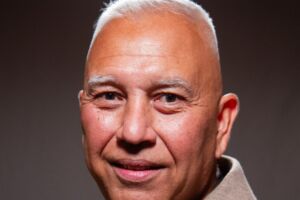
Etienne also disagrees that the mandate given to the caretaker council is limited in scope.
“I will also say the ‘administrative task’ is a spin. I would say some political opponents are trying to use it in order to discredit or limit the work that has to be done,” said Etienne. “In reality, the caretaker government does have the explicit responsibility to take any actions necessary to protect the rights and well-being of the Mohawks ... even if it’s political in nature, if there’s something that were to occur that would impact the rights of the people, we have to act on it, even if it’s political.”
In the court ruling, Judge Phuong T.V. Ngo noted the MCK sought an order “confirming that this Court retains jurisdiction over any disputes related to the capacity of the above-named Council Chiefs to make or carry out such matters or whether a particular act constitutes ‘simple administration.’”
If parties involved in the case disagree on what constitutes “simple administration” they may seek “a case management conference with the Case Management Judge,” wrote Judge Phuong T.V. Ngo.
Caretaker council members fear issuing public communiques about the struggles the team may facing lest the communiques get used against the council, according to Serge.
“With this council … a basic struggle is communications, trying to communicate the issues that you’re facing, communicated in a way people understand,” he said. “You always have the legal part of it, ‘How is your opposition going to use this, this communique, against you?’”
For Simon, collaboration among councillors during this time has been difficult.
“It’s like I’ve hit a brick wall,” said Simon. “It’s like there’s no reasoning at this point with anybody.”
Sign up for email updates from The Eastern Door
Etienne is more optimistic.
“I won’t lie and say that this has been a smooth mandate,” said Etienne. “It gets heated and everything like that, but the table itself hasn’t dissolved,” referring to the five caretaker council members.
Simon and Etienne hope another election will take place this year. While Simon is considering stepping out of the race, Etienne and Amanda Simon intend to run.
The caretaker council will remain in place until the Federal Court rules on the application for judicial review launched by the MCK.