Temporary injunction granted in dumping

More than a year after a wave of dump trucks carrying contaminated soil began streaming into Kanesatake, a Superior Court judge issued an emergency injunction order Monday to halt illegal dumping until the request can be considered again next Friday.
The hearing to consider the temporary injunction had been postponed from its original date of September 25 to give the defendants more time to obtain legal counsel. Dumping continued in Kanesatake following that date, a fact lawyers representing the Attorney General of Quebec highlighted in court on Monday.
Defendants are ordered to cease deposits of contaminated soils in their land. The injunction also bars holders of specific lots from depositing soil, backfilling, rockfilling, clearing trees, or constructing buildings or boat ramps on the coast of the Lake of Two Mountains.
Only lots on the shore of the Lake of Two Mountains were targeted by the Quebec environment ministry’s Operation GRAVIER, which saw 20 investigators and enforcement officers descend on Kanesatake to finally test soils long suspected of contamination.
Superior Court justice Benoit Emery said it was the court’s opinion that the conditions for a provisional injunction were fulfilled.
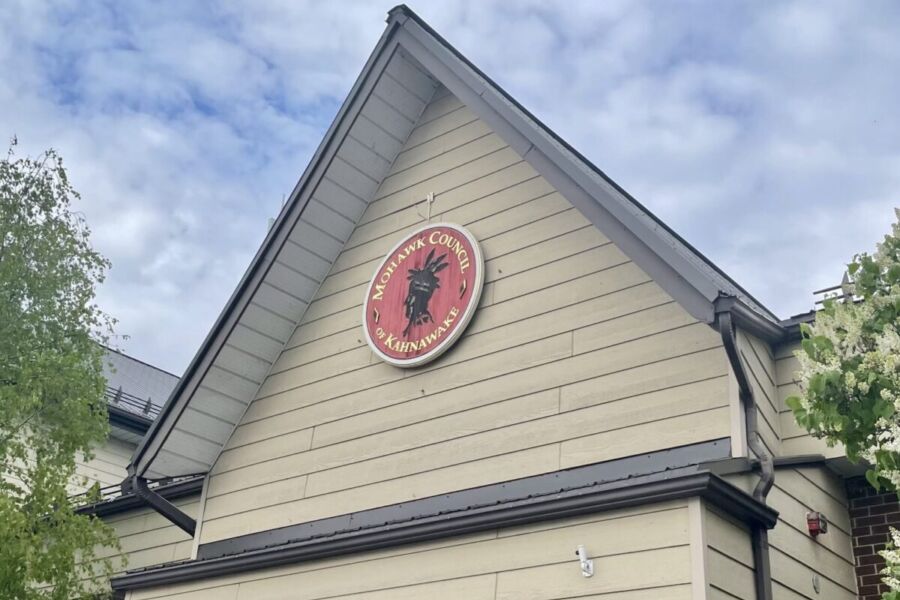
The injunction application was pursued by the Attorney General of Quebec, with the Mohawk Council of Kanesatake (MCK) as an impleaded party alongside the Attorney General of Canada.
While the hearing was put on ice for a week-and-a-half to give more time for community members to obtain legal counsel, only two of 19 defendants had lawyers at the hearing. Jessica Lessard Cross was represented by Fadi Amine, while François Gottlieb represented Joshua Smith-Gabriel.
While these two defendants are cited in the injunction application as having done unsanctioned work in the littoral of the Lake of Two Mountains, their lots are not among those where contaminated soil was found.
As a result, their lawyers argued that it did not make sense for the 19 defendants to be grouped together.
The defence lawyers also argued that the Quebec environment ministry’s conduct did not support the government’s position that the situation is urgent and in need of immediate relief.

“The bottom line is, from the fall of 2023, they basically did nothing,” said Gottlieb.
Indeed, the government response lagged as Kanehsata’kehró:non and members of surrounding communities sounded the alarm on a deluge of illegal dumping.
The defence lawyers also argued at length that the Attorney General did not have jurisdiction to bring the case. They used the Kanesatake Interim Land Base Governance Act to argue this can only be done by the MCK.
While the lawyers claimed the short timeframe left them in the dark on some legal details - Amine made frequent mention of being hired only three days earlier - they argued the onus was on the province’s Attorney General to show it has the authority to bring the case.
The MCK’s counsel, Dionne Schulze lawyer Wade MacAulay, spoke only briefly, informing the court that Council was not opposing the injunction at the provisional stage. He also said that Council is not aware of permits being issued for any of the work cited in the filing.
MCK grand chief Victor Bonspille addressed the court following MacAulay, insisting Dionne Schulze was terminated at a public meeting. He also said the Council majority the firm represents were removed at public meetings, a claim that does not seem to be supported by the Kanesatake Custom Electoral Code and is not recognized by any government.
Asked directly by the judge, Bonspille confirmed that he contested the Attorney General of Quebec’s demands to stop illegal work on the shore of the Lake of Two Mountains, citing jurisdiction.
This exchange is explored further in one of this week’s front-page articles.
The MCK posted a statement on Facebook on Tuesday to inform the community of Quebec’s success in obtaining a provisional injunction to immediately halt illegal dumping activities in Kanesatake.
“If the Council doesn’t have the resources, the means, to address this itself, there cannot be a vacuum when it comes to environmental regulation,” said MCK chief Serge Otsi Simon, who has continually expressed concerns this term about a lack of enforcement options when it comes to public security, including for environmental abuses.
“It’s still Kanesatake’s jurisdiction,” Simon said. “It’s not a matter of who has jurisdiction. It’s a matter of environmental violations. Somebody has to be able to enforce that. We can’t leave it the way it is.”
He said everyone is innocent until proven guilty, but that the process is necessary to sort out the damage that has been done and get to the bottom of what has taken place.
“I’m sure there’s some of those members that are going to walk away no problem. It was clean, it was adequate soil, and that’ll be the end of it. But what about those who brought in contaminants? You kind of have to separate the wolves from the sheep.”
Sonya Gagnier, who said she was asked to speak on behalf of elderly defendants who were not able to obtain legal representation, addressed the court immediately before the judgement.
“These people are in agreement with the jurisdiction and constitutional issues that were raised today and which put at play those who were named by accident and were inevitably impacted by this court case,” she said.
Gagnier told the judge these defendants have obstacles to representation and justice, with multifaceted barriers that include an ineligibility for legal aid if the case moves forward.
G&R Recycling co-owner Robert Gabriel, who, according to court documents, acknowledged depositing about 20 semi-trailer loads of rocks into the fish habitat, told The Eastern Door that he didn’t send a lawyer to represent himself at the hearing because the court is merely considering an order to halt work on the Lake of Two Mountains, which he is no longer doing.
The lot in question is occupied by Garry Carbonnell, who does not hold title but rents the land to Gabriel and allegedly permitted the backfilling, according to the court filing.
Robert Gabriel said he did nothing wrong and that unlike some others, he paid for his material at a quarry. The lot he filled in is where his cannabis business High Times is now located.
He suggested the government is lying about the lot having contaminated soil.
Sign up for email updates from The Eastern Door
“The political pressure that was on the government was tremendous,” he said.
He asked hypothetically what would happen if the government said his site was not contaminated. “Everybody is going to turn around and start buying shit and continue expanding onto the riverside,” he said.
According to Quebec’s environment ministry, the pertinent criminal fines can go as high as $1 million for individuals and $6 million for businesses.
The emergency injunction is valid until October 17. A hearing will take place on October 18 where the court will consider Quebec’s request for an injunction that would extend until the court rules on a permanent injunction, which would require a restoration of the coastline and the removal of contaminated soil.
Marcus Bankuti, Local Journalism Initiative Reporter
Clarification: A previous version of this article said a lot at issue was owned by Garry Carbonnell. In fact, while he occupies the land, he does not hold title to it; rather, the lot is part of the Kanesatake Interim Land Base.