Funding announced but questions remain
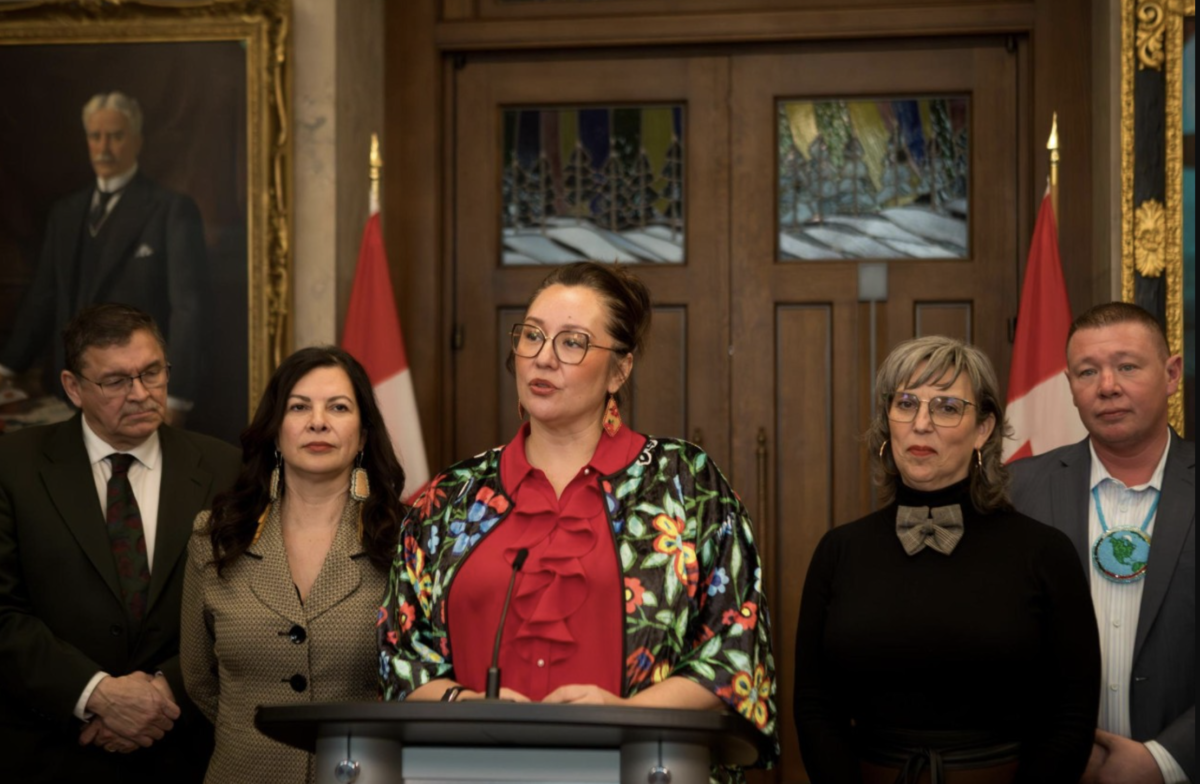
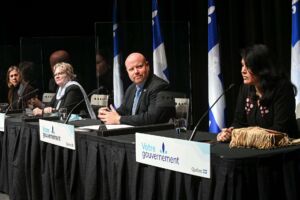
From left to right: Secretary of state Buckley Belanger, minister Rebecca Chartrand, minister Mandy-Gull Masty, parliamentary secretary Ginette Lavack, and parliamentary secretary Jaime Battiste at last week’s press conference announcing $1.55 billion of funding for Jordan’s Principle. Courtesy Indigenous Services Canada
Kahnawake’s health authority believes a $1.55 billion commitment from the federal government towards Jordan’s Principle is good news – but said there’s still more left to be done before it can confidently say that no child in the community will be left behind.
“It’s good to know that we have funding available for our community for the wide variety of services and needs that we have,” said Kirsten Sheridan, health programs liaison at Onkwata’karitáhtshera, which coordinates Jordan’s Principle requests in the community.
“The money is great. I was happy to hear about it, but operational challenges have still tightened a bit, and that makes it more difficult to actually get access to the funds, even though they’re there.”
The funding announcement came at the end of last week and is set to secure the program until March 2027. In a statement to The Eastern Door, minister of Indigenous Services Canada (ISC) Mandy Gull-Masty said that the investment responds to sustained demand for the program over the past decade.
“The renewal provides immediate stability for families and enables communities to deliver services with confidence as efforts to reform Jordan’s Principle in partnership with First Nations leadership and families continue,” Gull-Masty said.
Jordan’s Principle is named after Jordan River Anderson, who was from the Norway House Cree Nation. He passed away in hospital at the age of five having never lived in his home community, while the provincial and federal governments disputed who should pay for his at-home care.
The program’s purpose is to ensure that no other Indigenous child experiences discrimination, with the government of first contact paying for the service upfront and details of the bill sorted between provincial and federal governments later.
Gull-Masty said that she intends to “keep listening” to First Nations leadership and families to understand the challenges they face in accessing services.

“When initiatives are shaped by First Nations, they are more grounded, more effective, and more successful,” Gull-Masty said. “My commitment is to continue this work side-by-side with First Nations, so that every First Nations child grows up safe and supported.”
For the team at Onkwata’karitáhtshera, the funding announcement doesn’t quell anxieties about a key service need of community members.
“There’s still no definitive answer on private school tuition,” said Sheridan.
For many in the community, private schools provide a lifeline for students with additional support needs associated with learning difficulties like autism, attention deficit hyperactivity disorder (ADHD), and dyslexia.
During the 2024-25 fiscal year, Jordan’s Principle covered around $700,000 in private school tuition for students from Kahnawake, allowing community members to attend schools like Centennial Academy, which has the capacity to support specialized learning needs that might not be available at Kahnawake Education Schools (KEC).
However, last year, ISC released an operational bulletin announcing new limitations to what Jordan’s Principle would fund. That included private school tuition, leaving local families with children who attend specialized schooling in the lurch.
In the absence of ISC funding, the Mohawk Council of Kahnawake (MCK) announced that it would cover tuition for 25 students identified as most at risk, contributing nearly $326,000 for the 2025-26 school year. All of those students were diagnosed with special learning, developmental, or emotional needs.
The MCK has long maintained that it expects ISC to reimburse the cost, but the federal government has yet to foot that bill. Sheridan said that she’s also yet to receive any information from ISC about what happens come September for those families – MCK’s funding was a one-time band-aid to ensure continuity of education for affected community members, with the expectation that ISC will fund tuition in future.

Onkwata’karitáhtshera will be having a meeting with Jordan’s Principle regional coordinators at the end of March and hope to get clarity about future funding.
“Some students go to private school for scholarship or athletics, but we have a population that go for special learning challenges where their needs can only be met at these schools, and that’s a health, social, and educational need of these children,” Sheridan said. “They can’t put all private school tuition in one basket, because each case is different, each student is different, and I do hope to advocate for those students, I really hope I can represent the community and give our side of the story about what’s going on in Kahnawake.”
Brittany Mathews, director of reconciliation and strategic policy at the First Nations Child and Family Caring Society, also expressed concern about what accountability measures exist to ensure that the funding actually reaches families.
“The operational bulletin has made it harder for kids to get the help that they need and access the service support they need, so it’s not really clear how this funding is actually going to meet the needs of kids, given that the operational bulletin has essentially set the parameters of Jordan’s Principle and how the money will be distributed,” she said.
The Caring Society has continued to bring human rights complaints against Canada at the Canadian Human Rights Tribunal (CHRT), where the latter has been ordered to immediately address the ongoing backlog of around 130,000 unanswered requests.
While Sheridan said that Kahnawake has no longer been facing delays to their requests, Mathews said that families from other communities have continued to reach out to the Caring Society about the impact that the backlog is having.
“We’re seeing families themselves and First Nations continually raising with both the minister and with ISC that these barriers are hurting their children,” she said. “Children are being harmed by Canada’s poor implementation of Jordan’s Principle, and so far Canada has not addressed its conduct.”
A spokesperson for ISC said that some progress has been made with the number of requests pending intake – i.e. requests that have not been entered into the government’s case management system. That number stood at 7,316 in June of last year and is at 500 today. Additionally, there was a backlog of 5,000 urgent requests last June, a number that is now down to 250.
Sign up for email updates from The Eastern Door
ISC did not respond to The Eastern Door’s request for clarification on the number of remaining requests in the backlog, both urgent and non-urgent, by deadline – in January, the acting assistant deputy minister for Jordan’s Principle confirmed during a cross-examination at the CHRT that the backlog is still at 130,000 requests nationally, representing a decrease of only 5,000 from the reported backlog provided by ISC in March 2025.
“ISC has not said whether or not this funding will be put towards the backlog, or how they’re divvying up the funding, those are details that Canada has not provided,” Mathews said.
ISC confirmed that Jordan’s Principle has baseline funding from different budget streams until 2027-28, with decisions about funding in future years to be communicated ahead of expirations.