Power flowing through Hertel line
Courtesy Mohawk Council of Kahnawake
The Mohawk Council of Kahnawake (MCK) intends to maximize the community’s stake in the Hertel-New York interconnection line, which began transmitting electricity from Quebec this month to power a million New York City homes.
While the deal is still being finalized, it would see Kahnawake own 49 percent of the infrastructure north of the Canada-US border.
“Many of our grandfathers, great-grandfathers, our uncles, our brothers to this day are working in New York City or worked in New York City,” said MCK grand chief Cody Diabo. “A lot of the iconic skyscrapers were built by Kahnawake ironworkers. We do have a connection even since time immemorial with that area. We’re doing our part now to bring (sustainable energy) to New York City as well.”
When plans for the partnership with Hydro Quebec were announced, Kahnawake subscribed to a minimum 10 percent share, five percent of which was to be granted by Hydro Quebec. However, Kahnawake had the option to invest in up to 49 percent of the line.
According to MCK grand chief Cody Diabo, the 10 percent stake would have required community funds, whereas the higher percentage opens up low-interest financing opportunities.
“Everything’s looking towards the 49 percent avenue. It just makes a lot more sense. We’re approved for different loan guarantees,” he said, adding the MCK has been updating community members at meetings, while acknowledging these discussions could have been started earlier.
The project is envisioned as part of a portfolio of clean energy projects, including wind farm partnerships. “We see this is a very viable industry to insert ourselves in, generating power, especially clean power, like wind, solar, and, to a point, hydro,” he said.

The agreement with Hydro Quebec has a 40-year term. Kahnawake will continue to own its stake after that agreement expires, but the terms will be renegotiated, and Diabo argued a higher ownership stake will give Kahnawake better leverage in the future. The infrastructure itself is expected to remain viable for around twice that long, he added.
When it was announced in 2024, the partnership between Hydro Quebec and the MCK was billed as a prime example of economic reconciliation, with Hydro Quebec even announcing a $10 million contribution to the Kanatahkwèn:ke Cultural Arts Center at the same time.
“For us, it’s opening up this door and showing that Kahnawake is a real partner in different developments that take place that stretch across our traditional territory,” said Diabo.
Hydro Quebec has not always been seen as a friend to First Nations, with projects like the James Bay hydroelectric project, which had lasting detrimental effects to Indigenous territory and was built over Cree objections, still in memory. However, under previous Hydro Quebec chief executive officer Michael Sabia, who left his post in 2025, the company sought to build trust with Indigenous communities, according to Diabo.
“Economic reconciliation is a fundamental principle going forward,” said Sabia when the co-ownership of the line was first announced, promising that the company would move forward in partnership with Indigenous communities when projects are on Indigenous lands or affect ancestral rights.
Diabo plans to meet current CEO Claudine Bouchard in the coming weeks.
“We have a lot of, we’ll say, historical grievances. Sabia was aware of that, so hopefully the new CEO will continue on that path,” Diabo said. “That’s what we can hope for in this day and age. There’s a lot of injustices that have happened to First Nations, and it is time for these partnerships to be formulated to truly heal and move on. It’s not that we won’t forget, but we can work towards forgiving and for trust.”




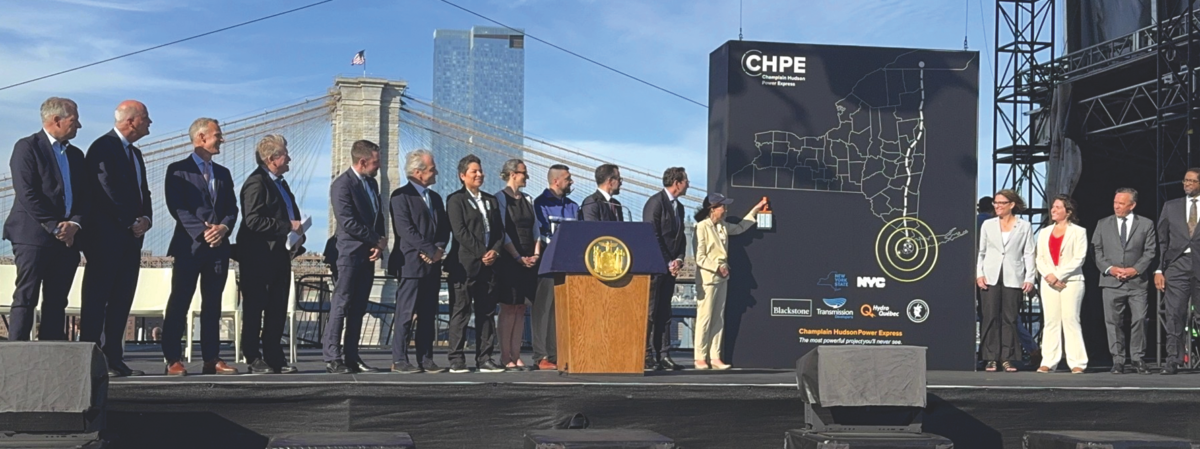
Diabo and former MCK grand chief Kahsennenhawe Sky-Deer, a leading proponent of the partnership, were on hand for the ceremonial flipping of the switch for the Champlain Hudson Power Express transmission line (CHPE), as it’s known in the US side, where New York governor Kathy Hochul thanked Sky-Deer by name and recalled seeing her speak in Whitehall, New York.
“Her words are so touching, so take to heart her conveyance of our responsibility as stewards of this beautiful planet, our responsibility to other generations, future generations, and why clean power like this upholds that sense of responsibility,” said Hochul.
The governor went on to compare the realization of the electricity transmission line to the Knicks’ epic 29-point comeback against the San Antonio Spurs in game four of the NBA Finals - the project took longer than anyone expected, she said, but it’s been seen through. It’s an initiative she has been advocating for since her days as lieutenant governor, she said.
“I was the one who was told to go meet with those people from Quebec who had some crazy idea, and I did. And they had me at hello,” she told the crowd, adding that the project was approved three months into her governorship.
“I am proud to be able to drive this ambition, the boldness that defines this great city, and why we have such magnificent facilities, but if we don’t power them, the lights go out, and we have nothing,” said Hochul. “This is one of my top priorities, to focus on renewable energy, clean, beautiful renewable energy coming down from a place in the world I love, and that is Canada.”
According to Diabo, the MCK is expecting up to $3 million to flow to Kahnawake each year from the Hertel line at a 49 percent ownership stake.
“If you look at the inflationary benefit that we just have provided to the community, that was $2.8 million. Just this alone could cover that, if we wanted to do something annually. These are things now that we’re able to do, or we can use it for other things, other programs or services that aren’t fully funded,” he said.
Sign up for email updates from The Eastern Door
It’s important not to let governments off the hook when it comes to their fiduciary responsibilities to Kahnawake, he said, but argued projects like this one allow the community not to be too reliant on government funding.
“When you look at the overall thing, you’re talking about over $100 million coming to the territory,” Diabo said.
The transmission line was recently discussed at the National Assembly, where Parti Quebecois energy critic Pascal Paradis was critical of the sale of Quebec electricity to the US, saying reserves are low at the moment.
Diabo isn’t concerned, he said, both because agreements are already in place and because Kahnawake is working to diversify its own-source revenues, including in the energy sector, which can help protect the community from changing market conditions.
According to Diabo, Kahnawake’s first proceeds from the project will be backdated to June 1, the date electricity started flowing through the line.
Marcus Bankuti, Local Journalism Initiative Reporter