Council appeals to United Nations on S-2
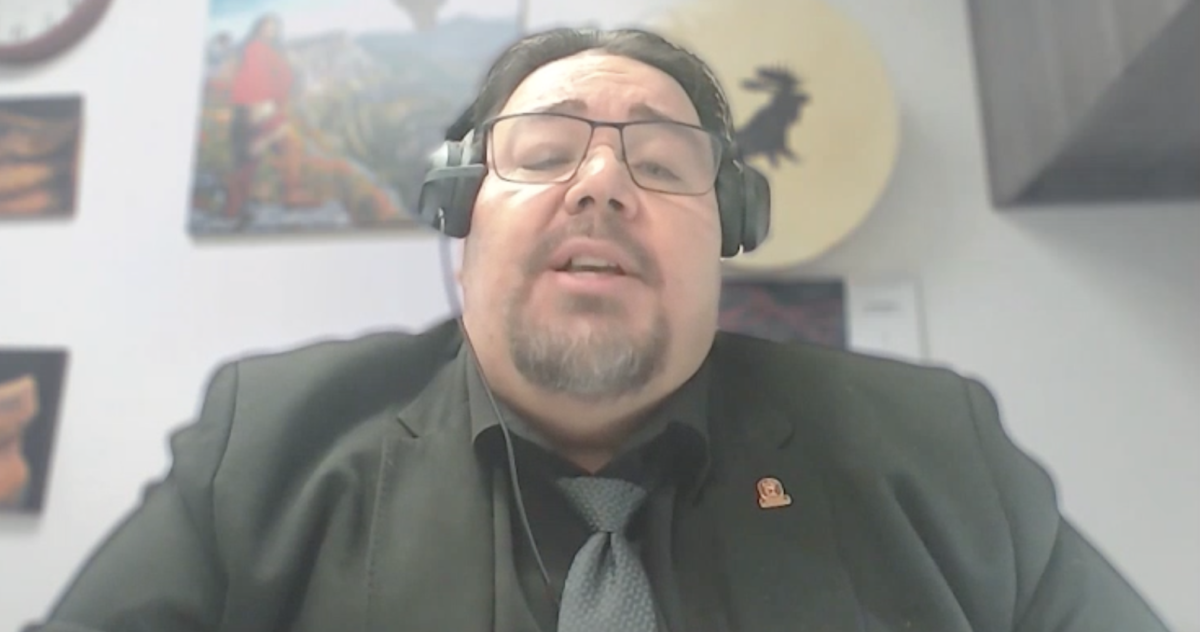
MCK chief Jeremiah Johnson spoke before the Standing Senate Committee on Indigenous Peoples in May to outline Kahnawake’s opposition to Bill S-2. Courtesy Standing Senate Committee on Indigenous Peoples
The Mohawk Council of Kahnawake (MCK) has sent an open letter to the Office of the United Nations High Commissioner for Human Rights, casting Parliament’s push to amend the Indian Act’s registration rules as a violation of Canada’s human rights obligations.
“Nowhere else in the world does another government dictate who the citizens are of another people, so that’s why we felt it important to send it directly to the United Nations at this point because they need to start holding Canada to task,” said MCK grand chief Cody Diabo.
If passed, Bill S-2 could enable thousands of people to regain status that was lost.
Changes proposed by the bill include the elimination of the second-generation cut-off, which is when status is lost after two consecutive generations of only one parent having it. Instead, a one-parent rule would allow status to be passed down by one parent across generations.

Additionally, the bill seeks to ensure those who have a family history of enfranchisement are entitled to the transmission of registration. Enfranchisement refers to when status was lost for one of several reasons, such as when a First Nations woman married a non-Indigenous man, as was the case until 1985, or for obtaining a university degree, as was the case until 1920.
Kahnawake’s Membership Law, the open letter notes, requires that four great-grandparents be Kanien’kehá:ka of Kahnawake prior to membership being approved.
“Canada should get out of it altogether. We have our own law, whether people agree with it or not,” said Diabo. “It was done through the Community Decision Making Process.”
Other modifications proposed by Bill S-2 include supporting women in gaining reaffiliation with their natal First Nation after being automatically transferred to their husband’s. The same would apply to their descendants.



“I stated it to (former Indigenous Services) minister Anandasangaree, I’ve stated it again to (current Indigenous Services) minister Gull-Masty, that Canada should not be in registration. That should be solely at the discretion of First Nations. If Canada wants to give people First Nations status, they can, but don’t register them to any First Nation territory or community. That’s for us to decide who our members are,” said Diabo.
Diabo suggested a possible influx of new members if the bill is passed would not only be an affront to Kahnawake’s sovereignty but could also pose challenges when it comes to service delivery, land allocation, and other practical considerations.
“It’s kind of ridiculous on Canada’s end. They’re not really thinking about it, and I think even some First Nations communities aren’t thinking about the effects,” he said, adding that larger First Nations like Kahnawake would be particularly strained due to funding formulas.
The subject line of the open letter is “Re: Canada’s ongoing role in colonization in the definition of Indigenous Peoples.” The text also refers to the recent Permanent People’s Tribunal ruling that Canada has committed and continues to commit genocide against Indigenous Peoples in Canada.
Sign up for email updates from The Eastern Door
The letter, signed by Diabo, asks that the Office of the United Nations High Commissioner for Human Rights, Volker Türk, formally note Canada’s non-compliance with the United Nations Declaration on the Rights of Indigenous Peoples (UNDRIP); call for a suspension of Bill S-2 pending further consultations; and establish a monitoring framework for the implementation of UNDRIP; the Truth and Reconciliation Commission’s Calls to Action; the Missing and Murdered Indigenous Women and Girls Final Report; and the recommendations in final report of the Independent Special Interlocutor for Missing Children and Unmarked Graves and Burial Sites Associated with Indian Residential Schools.
Bill S-2 has already made its way through the Senate and is now in committee after completing its second reading at the House of Commons in February.
Marcus Bankuti, Local Journalism Initiative Reporter