‘Building Canada’ not the selling point they think it is

Megan Kanerahtenha:wi Whyte The Eastern Door
What does prime minister Mark Carney have to say about the Building Canada Act, which equips his government to steamroll opposition to major infrastructure projects?
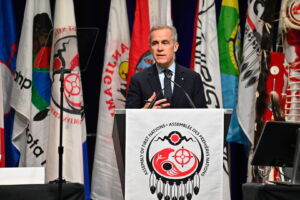
“This is the first federal legislation to put Indigenous economic growth at its core,” he told a room full of First Nations leaders invited to Ottawa. Those same leaders? Well, many had a different point of view, to say the least.
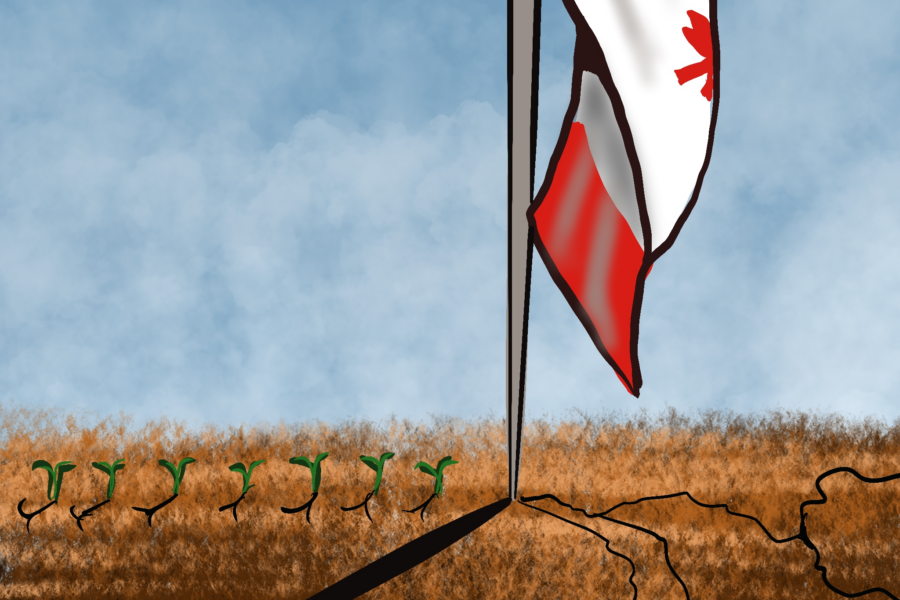
This disconnect can be attributed to so many things, first and foremost of course that the federal government doesn’t really care about the wants, interests, and especially the sovereignty of Indigenous communities; the government generously hands over lip service these days but is tight-fisted where it counts.
Another factor, on that note? The colonial tendency to reduce everything to dollars and cents. That is to say, Carney, who spent his entire career until now dealing with finance, seems to think economic growth is the ultimate virtue.
Well, putting aside that history makes us skeptical that Indigenous communities themselves will be the economic beneficiaries when wealth-generating projects are forced upon them, a project’s economic value is not what makes it good or bad when assessed according to Onkwehón:we values.
There’s the environment, respect for life of all kinds, and seven generations thinking, but it’s also a simple matter of respect for Indigenous sovereignty. The right to say “We don’t care how much you say it’s worth, we don’t want it” or, for that matter, “We know how much it’s worth, and it’s ours.”
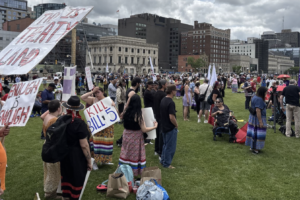
So it’s no wonder opposition to this legislation has galvanized First Nations across the country, whose leaders have been speaking out in droves, and no wonder that Carney and his cohort are looking for ways to steady the storm.

The event was an effort to allay the concerns of the Indigenous leaders and communities who are angry such a pivotal bill that impacts First Nations’ lands passed with so little consultation or input from Indigenous communities, even as it poses a threat to Indigenous rights by prioritizing Canada’s needs over Indigenous objections.
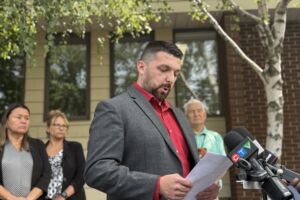
That’s not how things worked out, of course, with some Onkwehón:we leaders even staging a walkout, including Mohawk Council of Kahnawake grand chief Cody Diabo, who emerged with even tougher talk for the government than he had going in.
He told The Eastern Door that he didn’t want Kahnawake to be used for a photo op and that the meeting didn’t give Indigenous leaders a chance to get face time with federal leaders, instead shunting them to large tables amongst themselves, each group getting a single question for the prime minister.
What else is new? It’s classic paternalistic behaviour from the federal government, and one more example of Indigenous communities being seen as checkboxes instead of partners.
Well, now that box is checked, so what happens next?
The law itself sets out the first step, which is to identify projects of national importance via consultation with “provinces, territories, and Indigenous rights-holders.” Let’s just say we don’t like government’s chances of siding against the likes of Doug Ford and François Legault when billions of dollars for the oligarchy are on the line.
The criteria for determining the projects that will be implemented using this blunt law include Canada’s autonomy and resilience, economic benefits of course, clean growth (as if there were any consensus on what that means), and advancing the interests of Indigenous peoples.

What interests are these? This is less clear, but when “fast-tracking” major projects means speeding through consultations or building over deeply held objections, we’ve all seen that show before, and it’s not pretty.
It pains us to think of the harm wrought by the Coastal GasLink pipeline, which essentially put TC Energy under RCMP protection as they desecrated Wet’suwet’en territory and spent years targeting land protectors, throwing them in prison and trying to humiliate them rather than hearing their pleas.
And when “projects of national importance” includes mines that either ought to be left alone or used to enrich the Indigenous communities to which they belong, instead of bankrolled resource extractors, well, we know how that’s gone too.
Diamond companies love to fall over themselves to boast about their clean blood-free stones, but they’re less fond of letting you know that Indigenous leaders have been thrown in prison simply for saying no, as happened to Donny Morris, longtime chief of Kitchenuhmaykoosib Inninuwug (KI) in northern Ontario, along with five other council members in 2008, with the group serving more than two months in jail.
That community of 1,000 people was sued for $10 billion by a private company, Platinex Inc., for standing up to the might of the almighty dollar.
Morris told The Eastern Door a couple years back that he’d still be willing to open the mine but that his community ought to have a fair share of it; there hadn’t been any takers with that little caveat.
What if that mine were recognized as a project of national importance? (That’s to say nothing of Ontario’s similar new Protect Ontario by Unleashing our Economy Act.)
Sign up for email updates from The Eastern Door
There’s plenty to worry about when the “national interest” is defined as Canada’s interest because Canada is built on the idea that might makes right.
Not all the Indigenous leaders in attendance last week were angry about the gathering held by Carney. Cindy Woodhouse Nepinak, national chief of the Assembly of First Nations, said on CTV that many chiefs in attendance were cautiously optimistic following the meeting with the prime minister, adding that the AFN will now be looking to hold the prime minister accountable on his commitments for consultations.
According to Diabo, Woodhouse Nepinak expressed at the meeting to Carney that Indigenous leaders were glad he was their prime minister (Diabo said he set the record straight that Onkwehón:we don’t consider themselves part of Canada).
Well, maybe it means something during an election that Carney was the lesser evil. But now the election’s over.
It’s time for the career economist to prove he understands that some things can’t be balanced on a ledger, and Indigenous rights is one of them. The First Peoples of this land deserve to be treated meaningfully as partners, not checkboxes to be ticked off. Otherwise, nation-to-nation relations is not a way forward, but just another dirty trick.
TED Staff