Standing against Canada Day
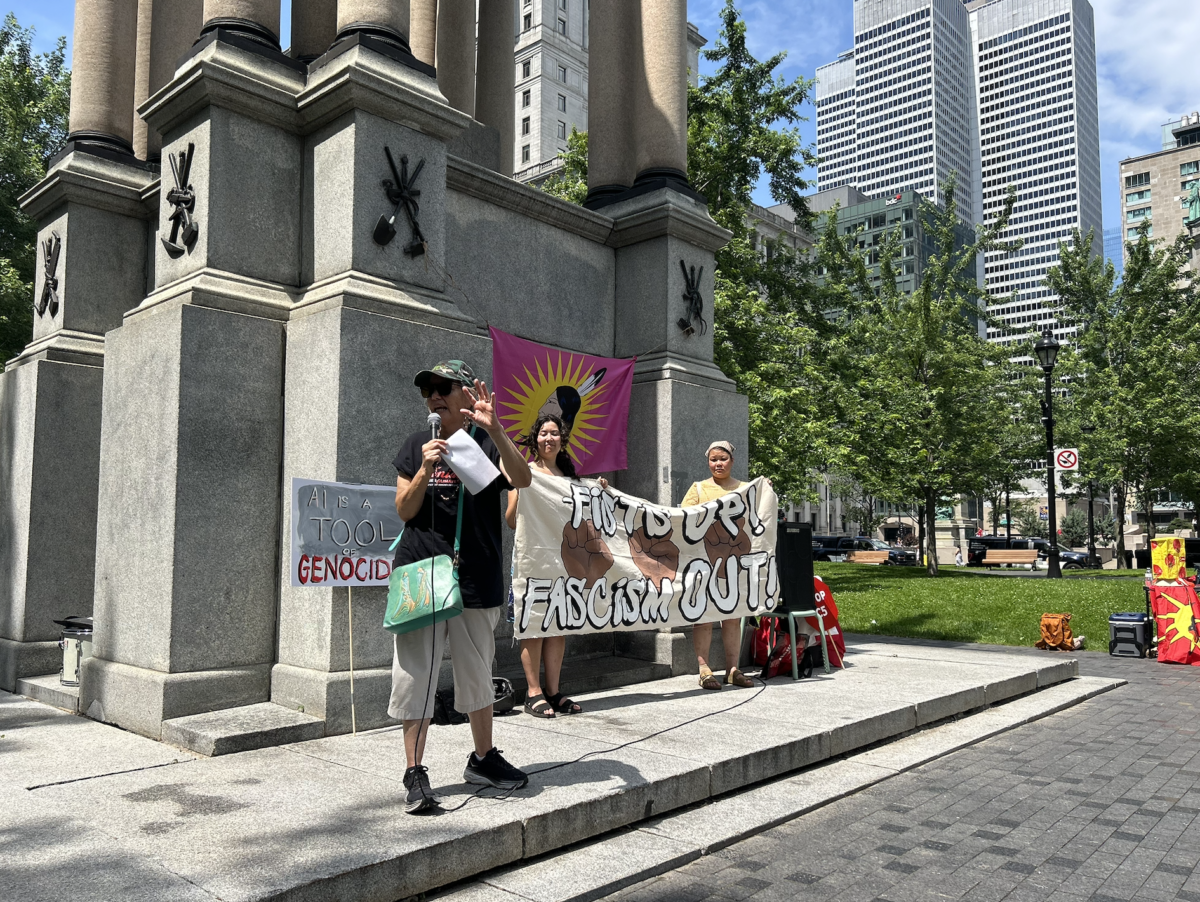
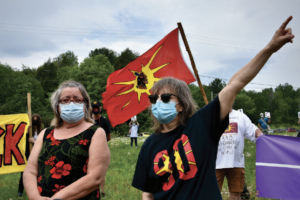
Katsi’tsakwas Ellen Gabriel addresses crowds at the “Fists Up, Fascism Out” demonstration on Canada Day. Eve Cable The Eastern Door
As the rain poured in downtown Montreal on Canada Day this year, Katsi’tsakwas Ellen Gabriel had one message to share loud and clear: standing together as Indigenous people and allies is the way towards progress.
“The First Peoples of Turtle Island need your help, and you need our help,” Gabriel told crowds gathered at Place du Canada for the “Fists up, Fascism Out” demonstration.
The gathering was organized in part to address the federal government’s Building Canada Act, part of Bill C-5, which aims to fast-track infrastructure projects.
Organizers at Wednesday’s protest said that the legislation puts profit over people, and organizers distributed a petition to repeal the Act, which was signed by almost 200 people at the time of publishing.
“I wish Mark Carney would wake up, and stop being blinded by the money that is in his eyes,” Gabriel said.
Speakers from groups focused on Indigenous rights and climate justice spoke to crowds, including Montreal physician Nazila Bettache.
“We’re here today to stand as part of an anti-colonial Canada Day, I want to say that loud and clear,” Bettache said.
“Canada was built on the theft of Indigenous land and territories, and on the genocide of Indigenous Peoples, through colonial projects that continue to this day. I think it’s fundamental for settlers and migrants like myself to stand in solidarity with Indigenous struggles for sovereignty and self-determination, today on July 1, and every day.”

Bettache talked about her experience as a physician, and the impact of climate change on her patients’ health and wellbeing, advocating for Indigenous climate justice as a path forward to address the climate crisis.
“The Carney government, just like our provincial governments, have been using this rhetoric of scarcity, this divide-and-conquer rhetoric, to divide our communities, and shrink our solidarities,” she said. “We’re here to say no to that. We’re actually celebrating our communities and their solidarities, we’re here to reject this narrative of divide and conquer.”
In front of the main Place du Canada monument, organizers draped a sign that read “Fists Up, Fascism Out,” and signs reading slogans like “AI is a tool of genocide” were hung for crowds to read.
Gabriel pointed to issues like the proposed opening of a controversial large-scale data centre near Akwesasne as an example of how Indigenous communities bear the brunt of the environmental impacts of projects related to AI (artificial intelligence).
“We need your help, your expertise, because the government doesn’t listen to Indigenous people, it only listens to its constituents, so help us,” Gabriel said.
Denis Kosseim, a member of Palestinian and Jewish Unity (PAJU) drew a connection between the fight for Palestinian liberation with the fight for Indigenous rights in Canada.
“Settler-colonialism is all about claiming. About claiming, grabbing, seizing, about converting. Settler-colonialism takes away Indigenous homes and takes over Indigenous lands. Settler-colonialism grabs our lands and seizes our resources,” he said.


He pointed to how the Building Canada Act facilitates settler-colonialism, warning crowds of how the rise of data centres and the natural resources used to power AI tools could continually impact the world around us.
“The Building Canada Act is a legal tool facilitating the procurements of natural resources needed to meet the ever-growing demand for AI,” Kosseim said.
For Albert Lalonde, project lead with the Climate Conscience Lab of the David Suzuki Foundation, joining together as advocates and citizens is key to opposing the Act. He said that the way the legislation currently stands risks sweeping infrastructure projects being imposed on First Nations communities without their informed consent.
“It’s the culmination of colonial logic, which amounts to saying ‘You’ve already been conquered, now shut up. You have no rights,’” he said.
“There’s no mechanism to ensure input.”
Gabriel characterized the Act as a continuation of Canada’s ongoing colonial legacy, and another way to exert control over First Nations and their land.
“The Canadian constitution does not protect our rights, because we have to go to court to define them. One of the things that I think is really important for people to understand is that colonialism is something that we are living as Indigenous people on our reserves,” she said. “Our reserves, our lands, which are small, postage stamp-sized lands that we are allowed to live on.”
She said change needs to happen at a fundamental, systemic level.
Sign up for email updates from The Eastern Door
“It’s not enough to sign petitions, and demonstrations are not enough,” she said. “The system is broken. The Indian Act is broken. It’s never been right.”
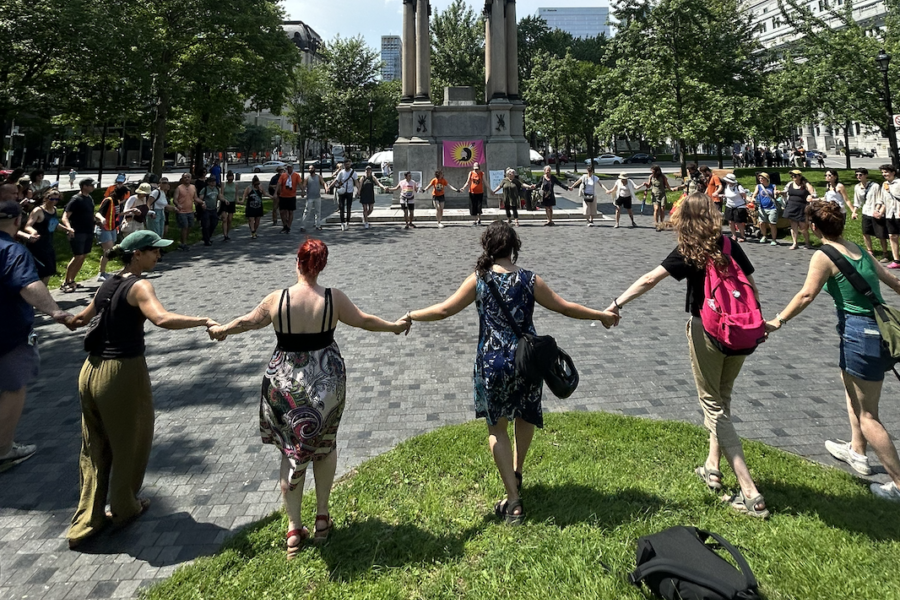
The day finished with a round dance, with organizers and attendees joining hands in a circle and dancing in front of Place du Canada, the clouds finally clearing and the sun beating down on participants.
Gabriel closed out the event with a message of hope.
“This is a beautiful planet. We can breathe. We can grow gardens,” she said.
“Walk side-by-side with us to protect this Earth, because it’s so precious, it’s so valuable, and it’s so beautiful.”