‘Historic’ joint training includes Kanesatake

Courtesy First Nation Paramedics Facebook page
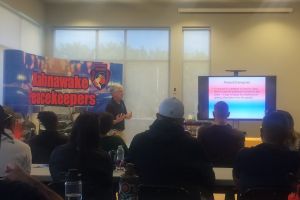
For the first time, Kanesatake Perimeter Security (KPS), First Nations Paramedics (FNP), and the Oka Fire Department participated in a joint emergency response training.
On the evening of March 10, the three teams learned about each team’s different equipment, trained with new equipment, and discussed improvements to their joint approach to improve the speed and quality of their teamwork.
For the KPS, being included in the training was monumental for the organization, according to the security team’s coordinator Kane Montour, even while the security team’s funding remains in limbo.
“We’re being recognized as an emergency service and an essential service,” said Montour.
“It was a historic moment.”
The joint collaboration also comes at a time where Kanesatake needs more intervention.
“We’re seeing levels of crime happening more and more in Kanesatake,” said Montour. “Now more than ever, it’s best for us to be united and work as one unit.”
The event earmarks the growing collaboration between Kanesatake security and other emergency response teams, especially with the neighbouring community of Oka.

“I was really, really proud to see all those men and women just reunited with serving the public in mind,” said Oka mayor Patrick Hardy.
“There were no boundaries between the communities. And I think it’s a strong message.”
A member of the FNP, who is also a volunteer firefighter with the Oka fire team, proposed the idea of the joint training, said FNP president Robert Bonspiel.
“For the community it means preparedness. The people who respond to emergencies are constantly looking or working to improve how we operate together when residents call for help,” said Bonspiel. “They should know that teams arriving on scene already understand how we should work together and are focused on one thing, that is protecting the patient, the community.”
One of the goals of the training was to learn how to use new equipment to cut down on emergency response times.
For example, the paramedics would like to rely on the KPS and Oka Fire Department to prepare or pull out equipment from the ambulance, while paramedics care for patients, said Bonspiel.
At the training, Montour also presented a Kanesatake Community Appreciation Award, an initiative by the KPS to recognize people who have helped Kanesatake, to the FNP and the Oka Fire Department.
“Because without them our jobs would be so much harder,” said Montour.


“Just to say from Kanesatake we appreciate everything that you guys do, and you know, we see you and it doesn’t go unnoticed.”
Hardy, who became mayor last November, has been receptive to collaboration between Oka and Kanesatake.
“I’ve always been open about trying to build a good relationship with the citizens in the organizations of Kanesatake,” said Hardy. “And I couldn’t have written a better script for what happened this week. I was proud and so happy to see what went on.”
The training was informal, but Montour said it could have inaugurated a new approach of regular sharing and collaboration between the three organizations.
But Montour may be hoping for a future that will not come.
Funding for the KPS is set to run out at the end of the month on March 31, after Indigenous Services Canada (ISC) decided to not renew the team’s current funding under the Pathways to Safe Indigenous Communities Program.
“I really feel like we’re breaking down barriers, and the community accepts us,” said Montour. “It’d be a real shame for everything to end right now, because we’re so close to really achieving something very special.”
Robert calls the KPS an integral part of the Kanesatake community - many community members tend to call the KPS first rather than 911.
Sign up for email updates from The Eastern Door
And during an accident, the KPS plays the crucial role of at times being the first response to incidents while they await paramedics, as well as redirecting traffic, which has allowed the paramedic team to focus on giving medical aid, he said.
“Which makes our job so much safer for anybody on scene, that includes patients and paramedics,” said Bonspiel.
In the future, he hopes to see the joint training continue and expand.
“I think that we’re going to be doing this more frequently,” said Bonspiel. “I think that there’s situations that would greatly benefit from advanced preparations and working together with services, KPS, fire department, ourselves, other fire departments, other municipalities, and response calls in our community as well.”
Hadassah Alencar, Local Journalism Initiative Reporter