Autism demystified for first responders
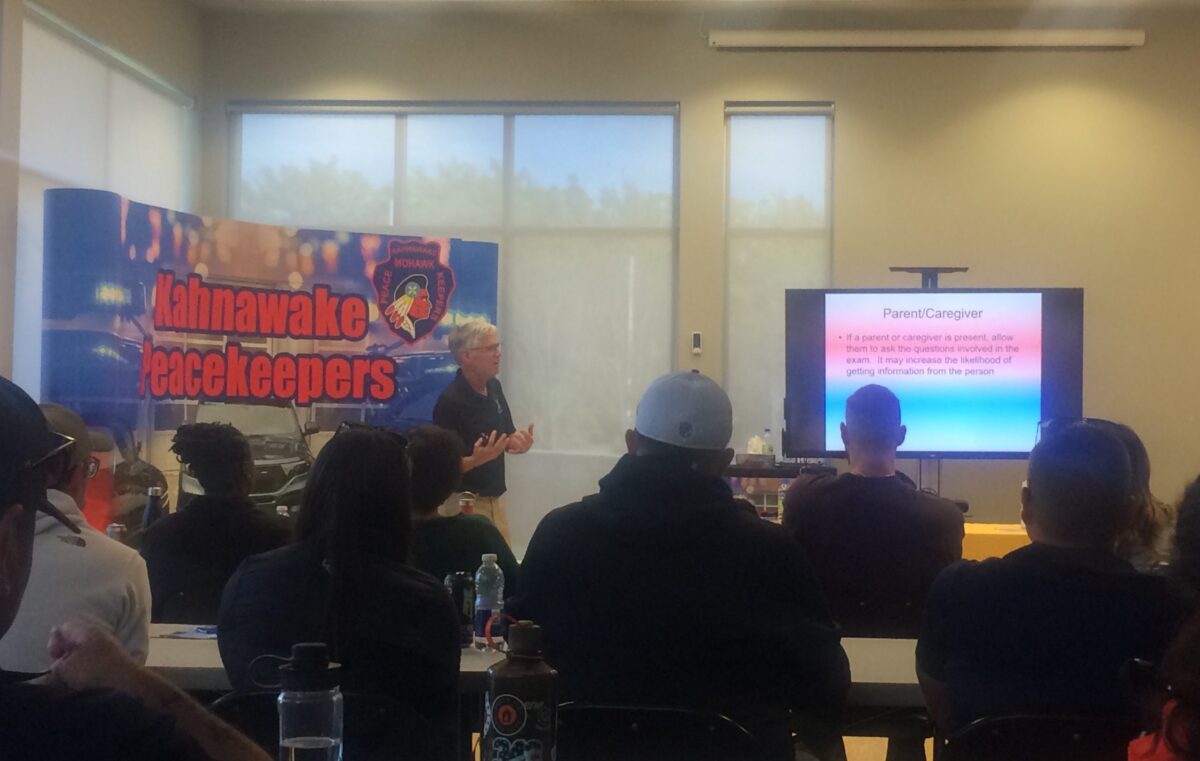
Many peacekeepers, firefighters, and paramedics in Kahnawake will be sporting new badges now to show they’ve undergone autism awareness training. Over 60 first responders in the community took part in the training over this past week, all thanks to the work of Connecting Horizons.
“Everybody wanted to take this course. They were present. They were enthusiastic. They asked a lot of questions. They were very engaged,” said Iris Phillips, the advocacy group’s coordinator.
It was a full house Monday at the Kahnawake Peacekeepers’ station, which saw a crowd of 35 gathered for a day-long discussion on how to best interact with community members on the autism spectrum. Another cohort got to join in on another session the following day.
Social workers with Kahnawake Shakotiia’takehnhas Community Services (KSCS) who work on an on-call emergency basis also got to take part.
“It was overwhelming for me to see not just the ones we anticipated, but extras too,” Phillips said.
The day-long training sessions were led by Bill Cannata, a retired fire captain from Massachusetts, and Jimmy Donohoe, a retired police lieutenant from Florida. Both have children with autism and have been offering the training sessions for the last 18 years.

“We’ve walked in their shoes,” said Donohoe, whose career in policing lasted over 30 years.
Over the course of each day, the two discussed what autism is, how to identify someone with it, and how its level of severity influences people’s behaviours under stress. It also touched on how first responders can best work with parents or caregivers.
Situations can go downhill fast when a first responder fails to recognize they’re dealing with someone who has autism, Donohoe said. They may at times refuse to comply with orders, or not respond when spoken to.
“That’s what we’re trying to train for: how to recognize somebody on the spectrum so they can better handle a situation,” said.
First responders in the room were also asked to talk through how they would react under various scenarios like a car accident.
“It works best with people with autism when you give them their space and time to work through it,” said Cannata, who spent 35 years as a firefighter. “One thing we can’t do is rush. There’s a lot of issues with processing, sensory issues. All of these things come into play in an emergency.”




The pair also touched on how to de-escalate situations to ensure the safety of everyone involved.
“We’re looking out for not only the safety for individuals on the spectrum, but also safety for the first responder,” he said, adding it’s a reality that those with severe autism can become aggressive at times.
Training sessions like these are key to demystifying the condition, Phillips said.
“We want to get away from that stigma of, ‘I don't know how to deal with them,’” she said.
“We don't want them to be intimidated when approaching somebody who's having a crisis or meltdown. We want them to feel comfortable, that they can approach that person, that they can be safe, and that the person can also be treated humanely and with respect.”
She said many of the lessons discussed in these sessions can also be used when dealing with people with severe ADHD, or with elders suffering from dementia or Alzheimer’s.
Sign up for email updates from The Eastern Door
This is the second time this kind of training has been offered to first responders in Kahnawake. Cannata also provided the same training at the Peacekeepers’ station five years ago, she said.
With that she’s eager to see the training offered again in the coming years.
This article was originally published in print on September 13 in issue 33.37 of The Eastern Door.