Changed forever at Ratiwennahní:rats
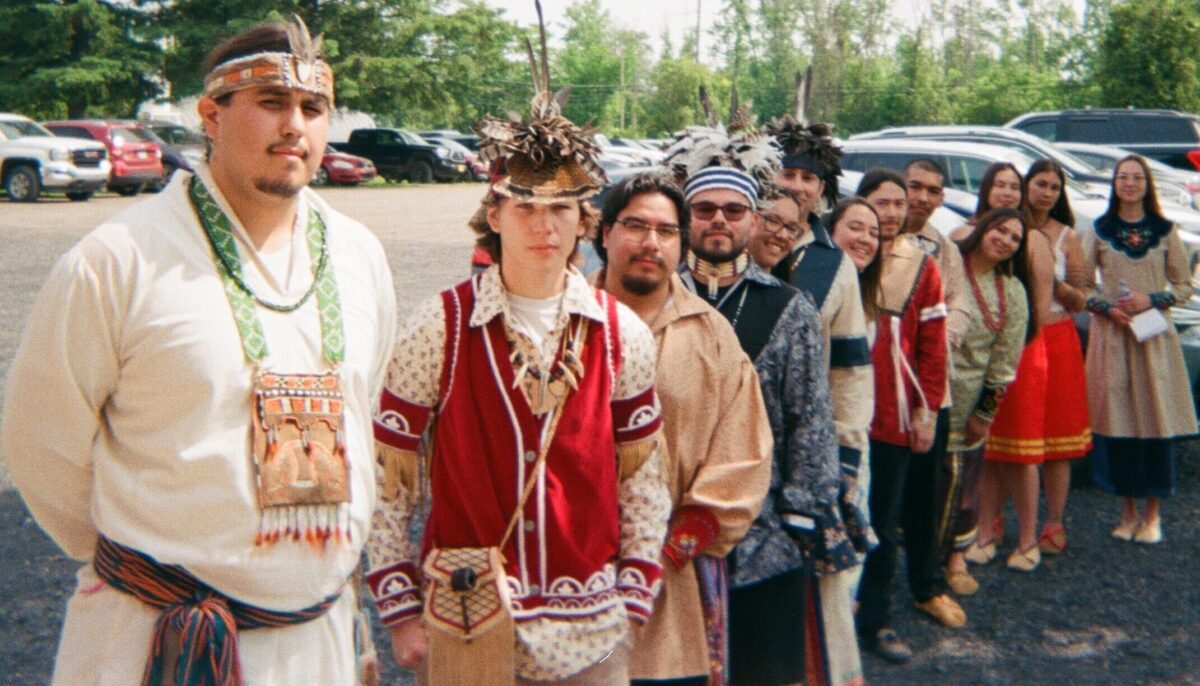
Tióhrhano Zack Diabo (front) with his fellow Ratiwennahní:rats graduates. Courtesy Ionhiaro:roks McComber
Recent Ratiwennahní:rats graduate Tióhrhano Zack Diabo says that his cohort of learners isn’t just special, they’re like “lightning in a bottle.”
“The whole program was us hanging out every day, and we all took something away from it, every single day,” he said. “It was like our nice little piece of paradise.”
Diabo is one of 13 new graduates of the Kanien’kehá:ka Onkwawén:na Raotitióhkwa Language and Cultural Center (KOR)’s two-year Kanien’kéha Ratiwennahní:rats Adult Immersion Program, and while his graduation means that his time in the program is over, he says his language learning journey has only just begun.
“I’m starting to speak for my side of the Longhouse and stuff, I can’t believe it,” he said.
“All of it is crazy.”
Diabo’s graduation from Ratiwennahní:rats marks the fulfillment of a promise made several years ago to the late Melvin Diabo, who had taught Tióhrhano some beginners Kanien’kéha in around 2016, when he was a student at Howard S. Billings High School.
“I had promised him one day I would learn, but I forgot about it for years,” Tióhrhano said.

After graduating in 2020, Tióhrhano planned to go to CEGEP, but the day before classes decided it was the wrong path to go down. Instead, he found himself learning welding at NOVA Career Centre, where there were several other students from Kahnawake. Having grown up outside of the community, Tióhrhano said that he sometimes felt on the edge of understanding his own culture, and being around fellow Kahnawa’kehró:non led to more conversations about language and culture.
Around the same time, a conversation with his cousin, Jordan Stacey, made him more aware of gaps in his knowledge.
“He was asking ‘Do you guys even know the Five Nations in the Confederacy?’” Tióhrhano said. “I actually said ‘Ojibwe’ and he said ‘No, but I’m impressed you even know them,’ and I sort of realized just how much I didn’t know about absolutely anything.”
Encouraged by Stacey, he applied for the program, which he didn’t even know the name of just a few short years ago. When he got in, he knew it was doing the right thing, keeping his promise to Melvin from all those years ago as well as a new promise, this time to himself, to connect more deeply with his language and culture.
He took things seriously, writing in his application that he wasn’t there to make friends, he was just there to study, and for the first couple of months he kept up that attitude, until a “rude awakening” one night, when his classmates called him out during an after-class hangout.
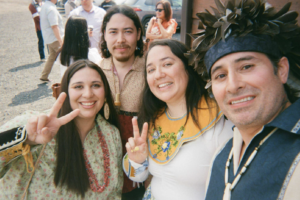
“They kind of went on me like a pack of wolves and the next Monday at school, I just changed. I started being nicer and I started making friends,” he said. “I said I wasn’t going to make any friends, but by the end they’d even become like a second family.”
There were highs and lows throughout the program, including times when Tióhrhano took home tests with lower scores than he was striving for, and moments where he couldn’t find the words in Kanien’kéha to express what he was thinking in English.


Still, he persevered. And when he didn’t believe in himself, his classmates lifted him up.
“Early on, one of my classmates who already knew the teacher looked at me and said ‘That guy is going to become a speaker by the end of this course,’ and I remember thinking ‘Oh, I didn’t realize someone had that much faith in me,’” he said.
With encouragement from his peers, Tióhrhano thrived, and he was ecstatic when, at the end of the course, he received a grade affirming his speaking level.
He said it’s a moment he could’ve never even dreamed of just two short years ago, and credits the Ratiwennahní:rats program with changing his life for the better.
“I feel like a whole new person, I can’t even relate to how I thought back then. I have a whole different mindset in the language. I’m thinking properly, and I’m talking to a lot of elders who wisened me up too,” he said.
Speaking with elders has been a highlight of learning for Tióhrhano, who also works at the Kateri Memorial Hospital Centre.
“I’ve noticed how happy they get when I’m at the hospital because there’s some speakers there and when I spent that extra time with them on weekends it kept me in that language mode,” he said. “When you talk to a new person in Kanien’kéha, it flips a switch, all of a sudden they start following your stories and asking who you are, it’s just so different.”
Sign up for email updates from The Eastern Door
Nowadays, Tióhrhano spends his free time listening intently to recordings he’s collected on USB sticks, trading ones he’s learned inside out for new sounds from fellow learners. He’s planning to keep up connections with his found family from Ratiwennahní:rats and pursue more learning opportunities in the future.
“I’m so obsessive about it now, it’s only up for me with the language, there’s no going back down,” he said.