Politicians need to answer to First Nations
Megan Kanerahtenha:wi Whyte The Eastern Door
Well, it’s official – the writ has dropped, which is to say a federal election is upon us.
The last one was in 2021, and this time around will mark the first time Kahnawa’kehró:non can vote in an electoral district that has now been renamed to reflect the inclusion of Kahnawake: the riding of La Prairie is now known as La Prairie-Atateken, with the latter word meaning “brothers and sisters” in Mohawk. If we voted, of course.
It’s the same moniker that took the place of Amherst Street in Montreal, also in the name of reconciliation.
But what’s in a name? It’s the age-old question, and the age-old answer is that words are only as good as the actions that support them.
If adding a Kanien’kéha word alluding to fraternity is meant to describe a condition of mutual respect between two peoples, then it strikes us that this sentiment is hardly justified. After all, the surrounding municipalities continue to develop wherever and whenever they want, without a second thought to the fact they’re not just building in Kahnawake’s backyard, but smack in the middle of the living room.
In the spirit of the Two Row Wampum, the vast majority of community members will boycott the federal vote; one thing that hasn’t changed is that Canada ought to stay on its own boat and refrain from impinging on the affairs of Haudenosaunee nations.
After all, the name of the electoral district may now reflect the Mohawks to whom the territory rightfully belongs, but the system that upholds this injustice most certainly does not.
When it comes to voter participation, it helps not at all that First Nations members were disenfranchised for so long, not fully able to exercise their right to vote as Indigenous people until the 1960s, the same decade that brought the 1969 White Paper, a renewed effort to assimilate Onkwehón:we, an effort that failed and will always fail.

Nevertheless, when an election season comes around, the stakes can be significant for Kahnawa’kehró:non, not to mention Onkwehón:we from coast to coast, and that’s certainly the case this time.
This election is a special one because Canada feels its sovereignty is threatened by the US and its petulant president.
Sovereignty is the number one issue in this election, which has changed all the political calculations, but it also means Canadian politicians need to look inward and think about what sovereignty and nationhood are, because in this respect Canada is failing hard.
First off, there’s not space enough here to enumerate the failures of the Liberals, who have now been in power for almost a decade. The Wet’suwet’en and other land defenders’ fight against the Coastal GasLink pipeline, while the Royal Canadian Mounted Police run amok fortifying colonial interests? That has been happening under the Liberals’ watch.
Some more examples that pop into mind include sloth in cleaning up G&R Recycling in Kanesatake, an epic backlog in Jordan’s Principle requests, and a failure to support the country’s first Indigenous Attorney General – instead throwing her under the bus.
There are many others.
There were strides under Trudeau the younger, of course, even if many of these developments stem from Canadian Human Rights Tribunal rulings that forced the government’s hand, but the government has talked the talk and sometimes forged meaningful commitments and relationships.
Do you think the Mohawk Council of Kahnawake, which for better or worse is currently tasked with navigating intergovernmental relations, is looking forward to working with Pierre Poilievre and the Conservatives? Fat chance.


There’s bad and there’s worse, and then there’s the Conservatives.
Poilievre was a sitting member of Parliament when he got on the radio and criticized residential school survivors getting compensation, uttering these abhorrent words: “My view is that we need to engender the values of hard work and independence and self-reliance. That’s the solution in the long run - more money will not solve it.”
Disgusting, and awfully hypocritical coming from a beneficiary of one of the most lucrative welfare scams we’ve heard of – spending your adult life as a right-wing mouthpiece running in a safe Conservative riding.
That was back in 2008, but we don’t think he’s learned much. Just the other day, he proposed development of Ontario’s “ring of fire,” a mineral-rich region that is home to more than a dozen Indigenous communities, and to do it fast - surely without the time and patience to ensure any mining arrangements will respect Indigenous autonomy in the region.
To Poilievre, Indigenous rights are an afterthought, if they’re a thought at all.
Even the NDP, which exhibits a more robust view of Indigenous issues, is already garnering some criticism after a plan to open up public land for rent-controlled housing was announced in Montreal, where this policy would mean further development of unceded Kanien’kehá:ka land.
A press release promises the measure “will be implemented with the utmost respect for the inherent and Treaty rights of the Indigenous communities.”
Land acknowledgments are easy, but time and again, land back is elusive. Why?
Sign up for email updates from The Eastern Door
Every party needs to speak up about what it will do to actually support First Nations and stop trying to undermine their sovereignty.
Mark Carney, now the prime minister of Canada, went to Nunavut and met with Indigenous leaders even before picking up the phone to call Trump, which he still hasn’t done. On the other hand, he is catching flak for his work for Brookfield, a goliath that has bullied Indigenous communities.
Talk is cheap, and in this country it’s talk, talk, talk.
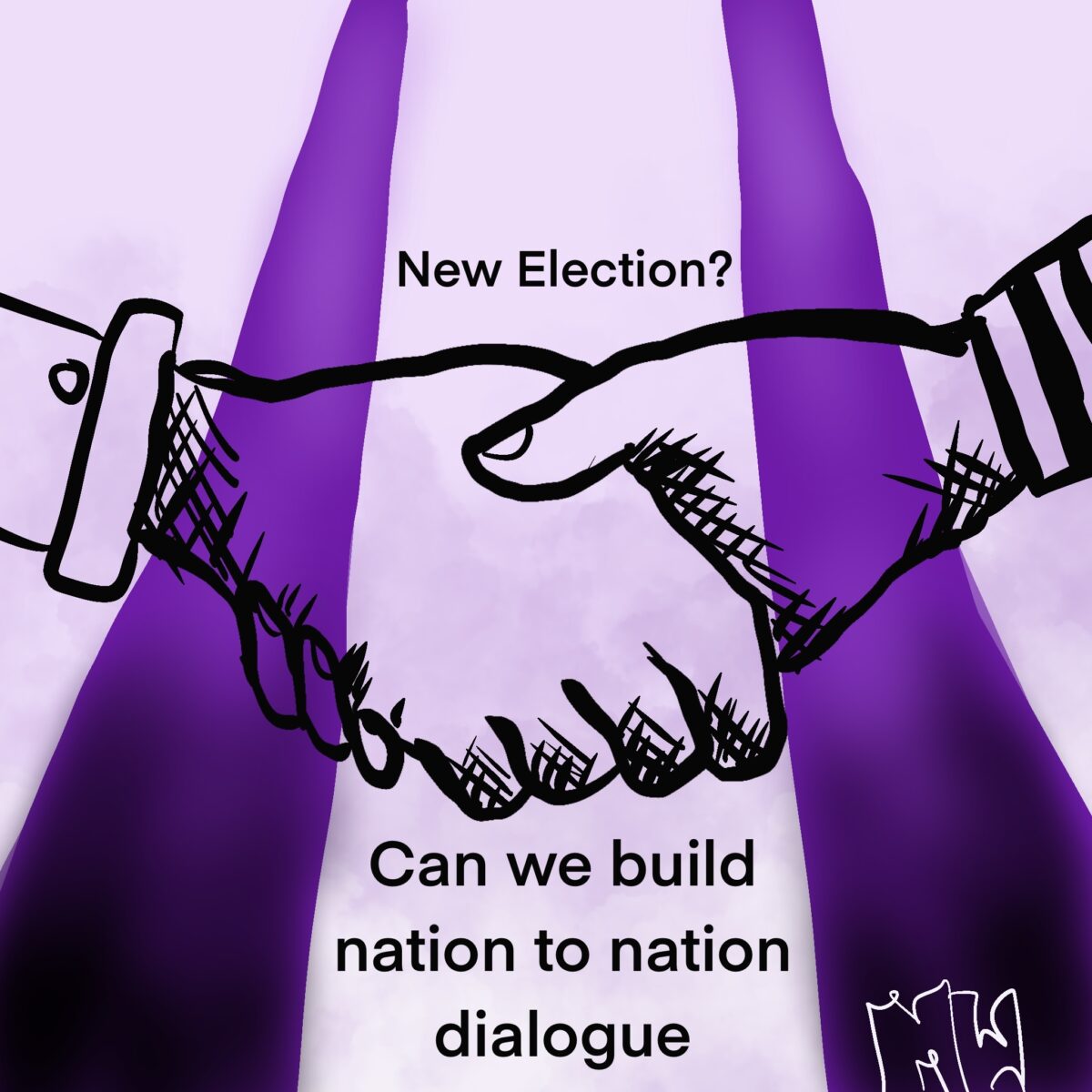
For that and many reasons, by all means, stay home. A refusal to take part is more than justified. Regardless, politicians owe First Nations an explanation of how they plan to wield the power they seek.
On the other hand, we’re reminded of a Kahnawa’kehró:non voter who, in 2021, would only speak to us about their decision to vote on the condition of anonymity. We hope those who do choose to vote won’t fear ostracization, because as wrong as it is, the government’s decisions play a big role in the life of Kahnawa’kehró:non, and it’s understandable why some may want some small say in that.
Just remember the real fight doesn’t happen at the ballot box.
TED Staff