Meloche awarded prestigious honour

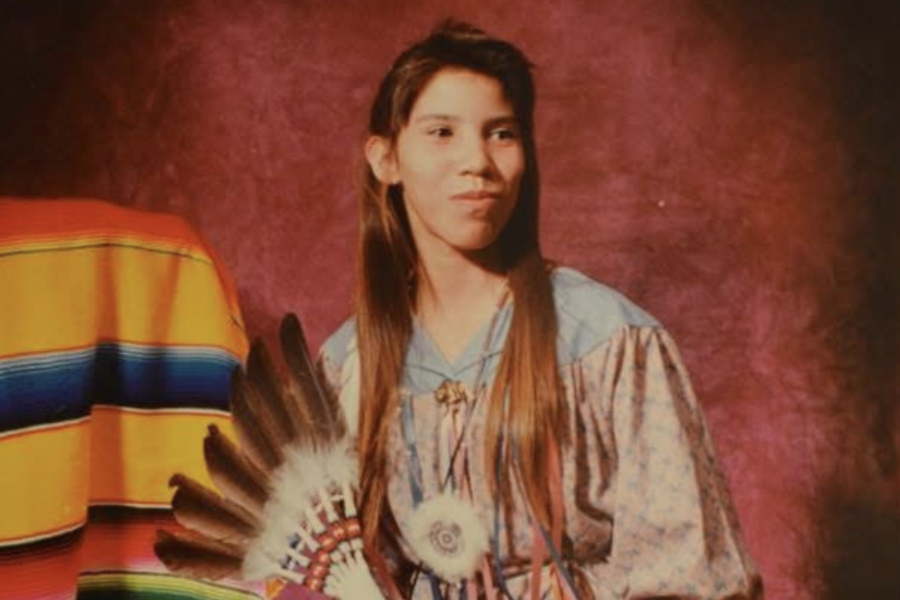
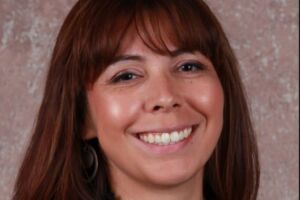
Konwatsitsawi Meloche proudly stands beside the Maskwacis Cultural College banner after receiving her honourary doctorate, a recognition of her decades of work in education, healing, and the revitalization of Indigenous knowledge. Courtesy Konwatsitsawi Meloche
With a radiant smile and dressed in regalia blending academic tradition with Indigenous identity, Konwatsitsawi Meloche accepted her honourary doctorate from Maskwacis Cultural College. For Meloche, the recognition represents not only her decades of work in education and healing but also the survival and brilliance of Indigenous knowledge in spaces that once dismissed it.
“Honestly, I never imagined myself receiving an honourary doctorate,” Meloche said. “Even when they offered it to me, I thought this is not going to happen. I didn’t think it would go right through to the end like it has. So, when I did the work, I just said, you know what, I’ll go straight into this. And here we are.”
She earned her bachelor’s degree at Concordia University, but when she later applied for a PhD there, she received a rejection letter stating that “more qualified people” had applied.
“I was shocked,” Meloche said. “I had been one of their students for many moons. And then the former president of Maskwacis Cultural College told me, ‘If you do what has to be done, perhaps we can honour you with a PhD.’ That changed everything.”
For Meloche, the recognition of her life’s work and decades of research into the impacts of Indian residential schools, intergenerational trauma, and lateral violence in Indigenous communities carries profound meaning.
In 2002, she completed her master’s degree, writing about the effects of residential schools on Indigenous communities. At the time, her defence committee dismissed her work as “rhetoric.”

“Back then, Canada wasn’t ready,” she said. “But I had already been traveling Indian Country for years, listening to people’s stories, hearing about the violence, the drinking, the pain. I knew it wasn’t rhetoric. It was lived truth.”
From the beginning of her career, Meloche worked to indigenize education. Long before “Indigenization” became common language, she was incorporating Indigenous imagery, teachings, and perspectives into her presentations first through overhead projectors and photocopied postcards, and later through PowerPoint. She reframed educational tools to centre Indigenous perspectives.
“I indigenized all my work way back then,” Meloche explained. “Now we talk about Indigeneity and Indigenization as if it’s new. But we were doing this decades ago.”
Meloche has travelled across Turtle Island for more than 30 years, working with communities from South Dakota to Alaska, Florida to Hawaii. Her focus has been helping Indigenous people understand the deep intergenerational impacts of colonial violence. She has also worked closely with institutions like the University of Oklahoma, serving on their board for 10 years.
“When I start my sessions, I tell people, ‘You may not think you know what I’m talking about, but you do. You know the hurts, the rage, the pain,” Meloche said. “I’ll help you name it and see how systems were built to keep us oppressed.’”
She recalls learning the language of trauma while working with Lakota elders in South Dakota over 25 years ago. “Back then, trauma wasn’t even a word we used. But in those sweats, in those healing spaces, we began to name it. That was a defining moment for me in my career.”

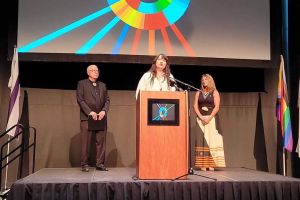
Being recognized by Maskwacis Cultural College holds a special weight for Meloche.
“You know what we call the two eyes? To be able to see through the Indigenous lens as well as the scholarly, academic lens. To have that balance was such a deep meaning for me,” she said. “It defines who I am, my scholarship and my Indigeneity.”
In her address to graduates at Maskwacis Cultural College, she reminded them of the responsibility that comes with education. Quoting Murray Sinclair, she said, “It was education that got us into this mess, and it will be education that gets us out.”
She then added her own wisdom: “This is the only bachelor’s degree that will never leave you.”
Beyond her research and teaching, Meloche has been recognized nationally for her leadership. In 2012, she was named one of Canada’s top 220 leaders by the Governor General’s Leadership Conference. She has since served as the Indigenous Inclusion Advisor for the organization for over a decade, shaping how leadership is understood across the country.
For Meloche, the honourary doctorate is not the end of her journey, but part of a continuum of Indigenous resilience and brilliance. Meloche sees her honourary doctorate not only as recognition of her own work but also as a victory for Indigenous knowledge itself.
Sign up for email updates from The Eastern Door
“This honour isn’t just about me,” she said. “It’s about our people, our stories, our survival. It’s about showing that traditional knowledge is knowledge. That we were always brilliant, powerful, phenomenal people and no institution can erase that.”