Major milestone for Kanatahkwèn:ke

Marcus Bankuti The Eastern Door
Two weeks ago, the doors to Kahnawake’s major new cultural arts centre, Kanatahkwèn:ke, swung open. It was two students from Kahnawake Survival School who had come in hopes of getting a tour.
The building, slated to serve as the home of the community’s cultural revitalization efforts for generations to come, has been shown off to dignitaries and TV cameras, but this request from two community youth stood out to one of the project’s leading proponents.
“I was never so happy,” said Kawennanóron Lisa Phillips, executive director of the Kanien’kehá:ka Onkwawén:na Raotitióhkwa Language and Cultural Center (KOR). “To me, that’s what this building stands for.”
Today, even as workers add finishing touches, Kanatahkwèn:ke is already buzzing with eager learners of Kanien’kéha, but it was at one time just an ambitious $20 million idea - and eventually, as plans grew and inflation washed over the construction industry in the wake of the pandemic, a $55.7 million one.
But the Kahnawa’kehró:non leading the charge were undaunted each time costs rose, and now their perseverance has paid off - this week, it was announced that the $16 million Capital Campaign has passed the finish line, and the total $55.7 million price tag is just about $335,000 dollars shy of being fully funded, most of which is already in the final stages of being secured.
The latest tranche came in the form of $2.5 million from Canadian Heritage’s Cultural Spaces Fund, an application that had been put on ice due to funding constraints in 2022, but which was granted this time around.
“This was the final icing on the cake for us,” said Trina C. Diabo, Office of the Council of Chiefs strategist, who described her disbelief and excitement when she opened the email revealing the infusion. “I read it. I had to go get a coworker to say ‘Can you read this? Is it glitching?’”
For Phillips, years of arduous fundraising is bookended by two important moments, beginning with a $16 million commitment by the federal government in 2022, which really kicked things off - at that time the anticipated cost was just $32 million.
But the donations that poured in near the end were no less meaningful for being in smaller amounts.

At the K1037 radiothon last year, $2,000 pledges helped the fundraiser yield better than triple its goal, but it was the tiniest contributions from the piggy banks of the community’s youngest that really made Phillips’ heart sing.
“I don’t even think I can really describe the pride that I felt that weekend,” said Phillips.
“When I heard children calling in and giving their $20 donations that they were taking out of their savings and that, and challenging others to meet their challenge - it just filled my heart every time I heard ‘$20.’”
The radiothon, a marquee fundraising opportunity in the Capital Campaign’s final phase, raised $660,000, a testament to the community’s support for a building that will host the KOR, Turtle Island Theatre, a Kahnawake Tourism office, and a state-of-the-art museum.
Kahsennenhawe Sky-Deer, who advocated for the project at the Mohawk Council of Kahnawake (MCK) since her days as a portfolio chief, continued to lead the Capital Campaign after her term as grand chief came to a close in 2024. She always believed the money would come, even as substantial challenges arose as costs increased.
“I volunteered my time, energy, and effort to stay on as the chairperson of the Capital Campaign because I believed in this project,” said Sky-Deer. “I believe in our language and culture. We need to keep it here and alive for future generations. It’s been a journey, and I think it continues beyond this.”
Funding came in from all corners, she pointed out, private and public, Onkwehón:we and non-Onkwehón:we alike. Now, on the other side of countless meetings and PowerPoint presentations, Sky-Deer said walking through the building is a dream come true.
“Once you see it, you can dream other things that we’re capable of in Kahnawake. It’s just so inspiring, and I’m so honoured to have been a part of it,” she said, noting there are other needs, like the Kahnawake Youth Center’s plans for a new building.
“It’s a very exciting time in our history,” Sky-Deer said.

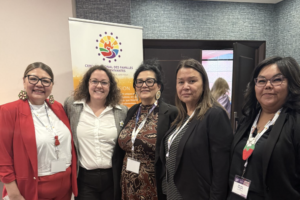
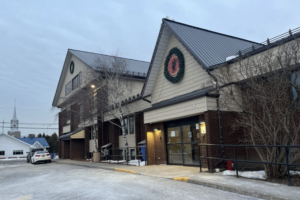
The project is a major boost for Kahnawake’s arts community, Sky-Deer noted, a sentiment echoed by others at a press conference held at the building on Monday.
“What we’re going to have is so beautiful and so monumental,” said Jessica Hernandez, representing Turtle Island Theatre. The organization was previously without a home base. Now the community’s budding thespians will benefit from developing and showcasing their craft in a grand theatre.
“The excitement from Turtle Island Theatre members as well as the community is so amazing,” said Hernandez.
“Knowing that this building is ours, it’s our home, it’s just so meaningful.”
Louie John Diabo, the project manager, was also on hand this week. He played a role in everything from overseeing construction to crunching numbers for grant applications.
“We tried to do everything the right way on this, and it’s going to continue to benefit us,” he said.
The building’s first hydro bills show how effective the building techniques were, he said, which not only make the structure environmentally sound - it boasts a semi-submerged first floor, triple-pane windows, and other features - but cost-effective to operate as well. In its first month of operation, the electricity came to less than $10,000.
“Compared to buildings that are half the size of it, our hydro bill is less than that,” said Louie John.
While the structure is pretty well paid off, fundraising is expected to continue for operational funds. the significance of the achievement for the community.
Sign up for email updates from The Eastern Door
“This project is going to have a tremendous impact for our future generations,” he said.
“I know that when I was growing up, I didn’t learn the language, but I learned from my children. They’re two years old and five years old,” he said.
He shared that he recently did the Ohén:ton Karihwatéhkwen to open a Council meeting, the first time he did the complete version.
“I practiced it with my children for quite a while,” he said. “Them and hundreds of other children and people in this community will benefit from this project, learning their language and culture immediately, and it’s something that we all should be very proud of. I see it as a beacon and a symbol of our resilience as a people.”
He credited those who have worked for years on making the project become a reality.
“It wasn’t always cookies and cream,” said Trina. “But we did it, and it’s amazing.”
Marcus Bankuti, Local Journalism Initiative Reporter