Council presents a path to ‘ecological gift’
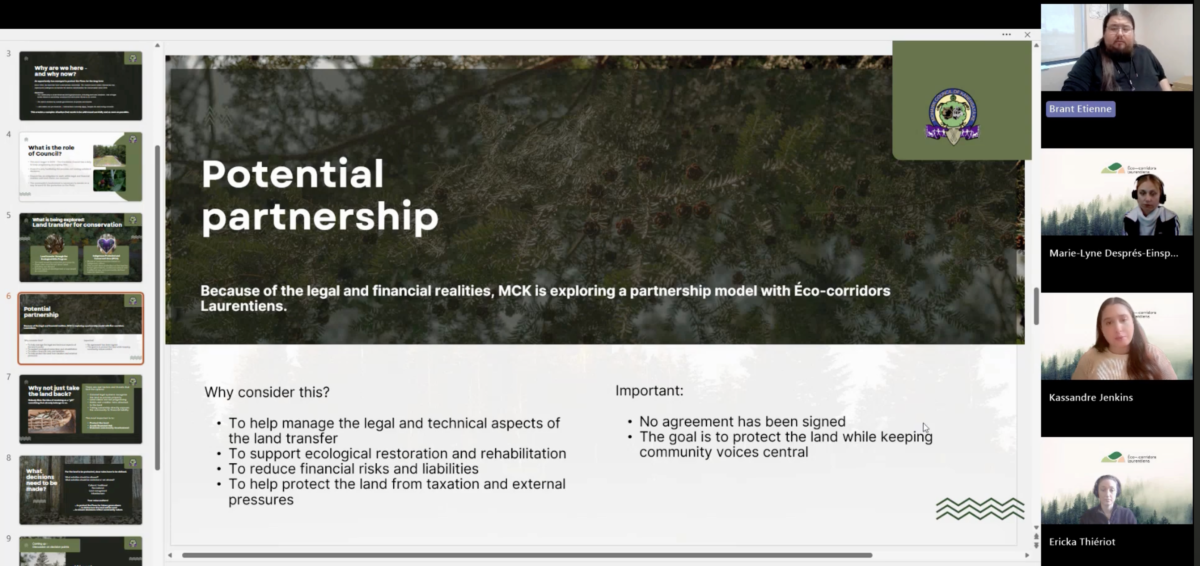
The Mohawk Council of Kanesatake’s engagement session on the future of the Pines on April 30. Hadassah Alencar The Pines Reporter
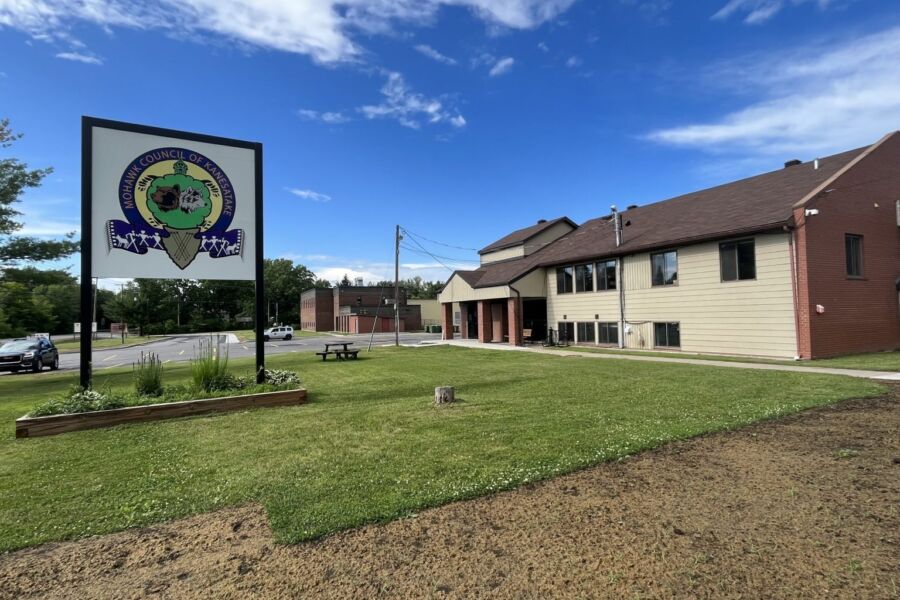
The Mohawk Council of Kanesatake (MCK) has brought a proposal to the community on a plan to work with a third-party organization to manage Pines land involved in an “ecological gift” land transfer to Kanesatake, to help protect the land from seizure and unregulated development.
At two community meetings over the past few weeks, the MCK presented a potential partnership with Eco-Corridors Laurentiens, an ecological protection non-profit organization. The aim of the meetings is to request the community’s input on the proposed partnership and Kanesatake’s response to the “ecological gift,” while some community members feel the gifted Pines land should be rejected.
Eco-Corridors Laurentiens would “help manage the legal and technical aspects of the land transfer,” “help protect the land from taxation and external pressures,” and “support ecological restoration and rehabilitation,” according to some points listed on an MCK April 30 presentation slide.
The first main issue the council hopes to prevent is the land being vulnerable to seizure from creditors. The land would not automatically be included as part of the Kanesatake land base if transferred under the “ecological gifts program,” making it potentially susceptible to seizure, said Etienne.
“This is not hypothetical; it’s happened in the past,” said Etienne.
Last year, the Supreme Court ruled against the MCK regarding a $2 million debt owed by council to Quebec lawyer Louis-Victor Sylvestre, who has made several attempts to seize MCK property to collect the debt. He has until November 2026 to attempt to collect the debt, which would also renew the claim for the debt for another 10 years.
Also, the Municipality of Oka would have jurisdiction to seize the land if Kanesatake does not pay municipal taxes.
“By having another party involved, Kanesatake isn’t put in the situation of having to make a choice about running the risk of not paying municipal taxes,” said Nicholas Dodd, the lawyer who represents the MCK, during the April 30 meeting.

The second main issue the non-profit could help prevent is unregulated development, said Etienne. The partnership could help facilitate police intervention if necessary.
“If somebody comes and tries to build on it or occupy it and everything, you can call the police and have them removed. Whereas if it’s community land, the police generally don’t do that because it’s in a grey area,” said Etienne.
Very few community members have participated in the MCK engagement sessions on the Pines land transfer, said Etienne. Three community members attended the last meeting.
“Unfortunately, we’re not having the participation in person that we expected. We had people register that didn’t show up,” said Etienne.
“But our analytics are showing that the videos, once it’s posted, are actually getting quite a bit of replay and views. So even without the in-person participation, I think people are still watching what we’re saying.”
Some in the community are not participating in the meetings because they disagree with accepting ancestral land as a “gift,” said community member Clifton Nicholas. Accepting land back as a gift undermines broader land claims, he said.
“It’s like a bribe - ‘here, take that and shut up about everything else I’m doing,’” said Nicholas.
“And I’m sorry, the guy has no right to that land. I don’t care who he bought it from,” said Nicholas, referring to Gollin. “There are laws in Canada against buying stolen property, but it falls silent when we talk about Indigenous property.

“If I had a stolen car, I couldn’t go sell it. I couldn’t go gift it either, it’s still a stolen car … MCK is dealing with stolen goods.”
Community members will be able to share their opinions in some manner in the future on whether Kanesatake will accept the Pines land transfer, for example by a vote or a referendum, said Etienne.
Etienne’s response to critiques on accepting the Pines land transfer is for community members to present their solutions.
“Come up with a better plan,” said Etienne. “This is something we’ve been trying to figure out in order to stop the unregulated development or the taxation, the seizure, and everything like that. One of the few options that have come forward in, I think, my lifetime, at least, for us to get a chunk of our land base back outside of the land claims process. And it achieves that explicitly, with the intent of returning the land to us.”
During an April 30 community meeting, Dodd, the lawyer who represents the MCK, said Council has explored the possibility of formally registering the Pines land transferred in question as part of Kanesatake’s land base, but were informed by federal government representatives the process would take years.
“The internal processes the government imposes before it accepts land are significant and take quite a while to work through,” said Dodd.
“They even told us at one point that the government notaries have to look at it, and the government notaries have about a year-and-a-half backlog of things to look at.”
In 2019, former grand chief Serge Otsi Simon signed a memorandum of understanding with real estate developer Grégoire Gollin to transfer land to Kanesatake under a federal “ecological gifts program.” The program allows for a land ownership transfer, but with strings attached, which many criticize could limit Kanesatake’s governance over the land.
Sign up for email updates from The Eastern Door
Lawsuits involving the MCK, Gollin, and the Municipality of Oka have delayed the land transfer for years.
But caretaker council member Brant Etienne said the court cases are not stopping the Council from taking the next steps on accepting the Pines land transfer.
Another community engagement meeting on the Pines “ecological gift” land transfer is scheduled for next Tuesday, May 19, which is set to include results from the community survey on the matter.
Hadassah Alencar, Local Journalism Initiative Reporter