Lands report ready
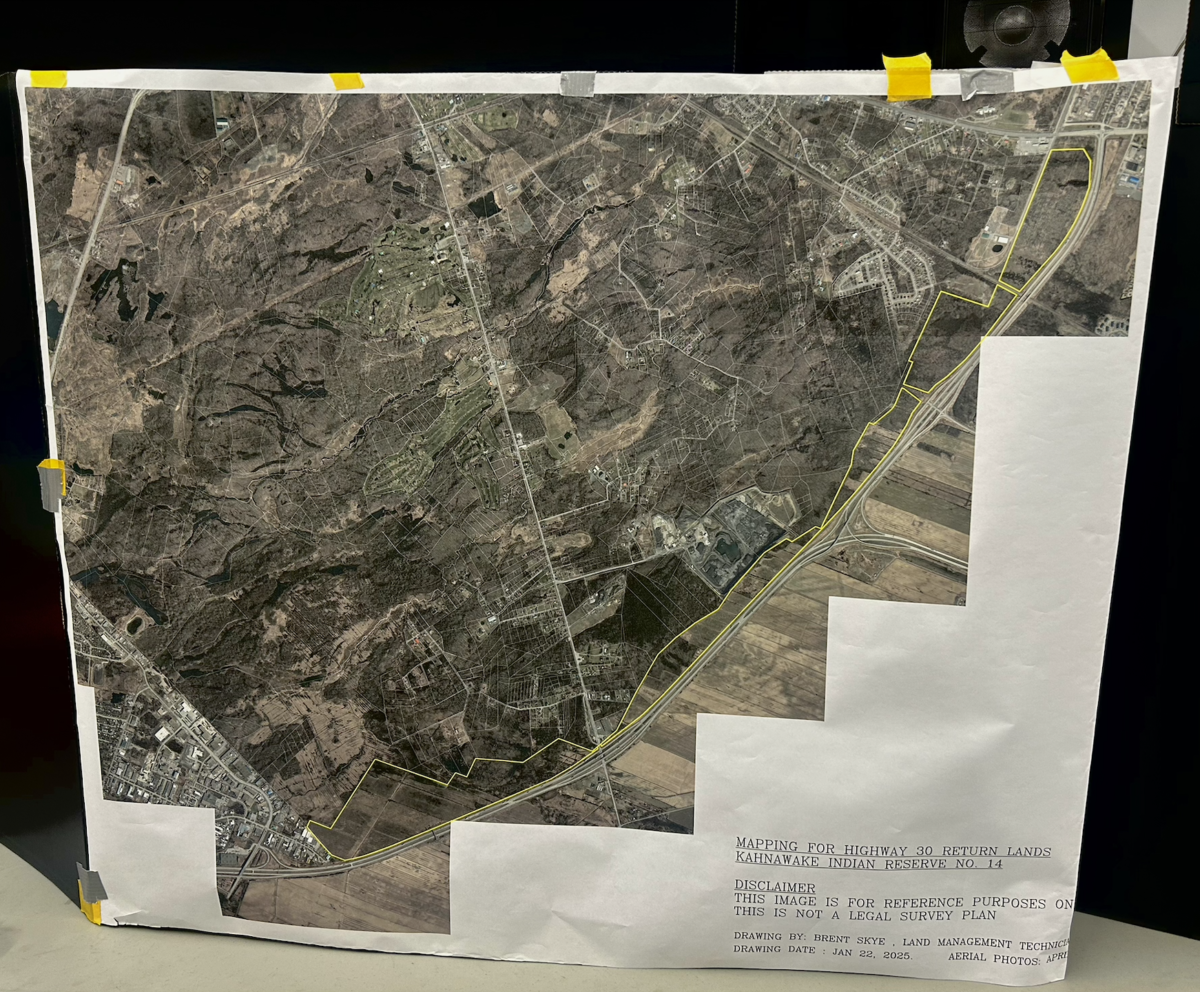
A mapping activity from the Lands Summit back in February, where community members were asked “What would you do with over 500 acres of land?” Eve Cable The Eastern Door
A report compiling community ideas for what to do with more than 500 acres of returned lands along Highway 30 and Old Chateauguay Road has officially been released, with ideas including housing projects, conservation, and environmental protection.
“I would say people in general seemed really passionate about it,” said Neil McComber, who along with Louise Mayo, led the independent consultation process in February and March of this year.
He said more than 500 participants came out for consultations, which the Mohawk Council of Kahnawake (MCK) published this week.
“It was much more than we anticipated,” he said. “It was very nice to see so many people get involved.”
Consultations took the form of mapping activities, focus groups, engagement kiosks, and individual sessions, gathering thoughts from Kahnawa’kehró:non involved in various facets of the community. The final report is prepared by the Lands Designation Working Group (LDWG).

In mapping activities, for instance, community members could draw directly on maps of the returned lands, segmenting what areas they’d like to see used for what purpose. That activity officially launched at the Lands Summit in February, and was also brought to local hubs like the Tewatohnhi’saktha lobby and Tóta Ma’s, as well as homes and offices.
The consultation process focused on ensuring a wide range of community input was gathered, encompassing a broad range of ages – 25 per cent of participants were under 30, 47 per cent were between 30 and 59, and 28 per cent were over 60.
Mayo said it was particularly interesting to hear input from community youth from consultations carried out with grade 10 and 11 Kahnawake Survival School (KSS) students.
“When I saw their remarks, I was really impressed, they were very forward-thinking in the sense of attending school and knowing what they would want locally because they’re close to Highway 30,” she said.
McComber added that the youth were particularly engaged in the mapping element of the project, adding that there were very wide-ranging ideas from all youth and no one clear theme.
“Many more younger people filled out the map, a lot of adults gave their opinion and weren’t specific on where they wanted their ideas to go or on pieces of property, but the youth were more specific and were drawing things out more often,” he said.
Various designations were identified for the different parcels of land within the returned lands: agriculture, for in ground farming activities; commercial, for offices, food services, and community-owned businesses; conservation, which would maintain the land in an undeveloped state to preserve ecosystems and trail systems; institutional, for community facilities like schools, health centres, or administration; residential, for housing; mixed-use, for developments like mid-rise condominiums or apartments above or adjacent to commercial spaces; and recreation, for public or community-based leisure, physical activity, and wellness.
Using a feasibility study, community responses were translated into concrete acreage plans for what to do with each parcel of land. Conservation was the top priority with 160 acres of land suggested for that purpose.
Housing was also an important priority for participants – the community proposed around 137 acres be reserved for housing, with the LDWG suggesting 126 acres based on feasibility and input from environmental assessments and Lands Unit technicians.
“Even people who already have a house, they were saying ‘I know our community needs housing,’” McComber said. “They may not even necessarily want housing on the highways, they’re not the greatest locations, but ‘we need housing’ was a really common thing.”
Sign up for email updates from The Eastern Door
The LDWG will now present the report to the community through a variety of in-person sessions, which will allow community members to review the results, add further input, and ask necessary questions.
“People’s opinions will change once the results come out and as discussions change, but this is a good snapshot of what the community was thinking in this snapshot of time,” McComber said. “The results are not binding, they’re not plans, it’s just an idea of what people are thinking.”
The full report can be found on the MCK’s website.