Kahnawake says no to firearms program
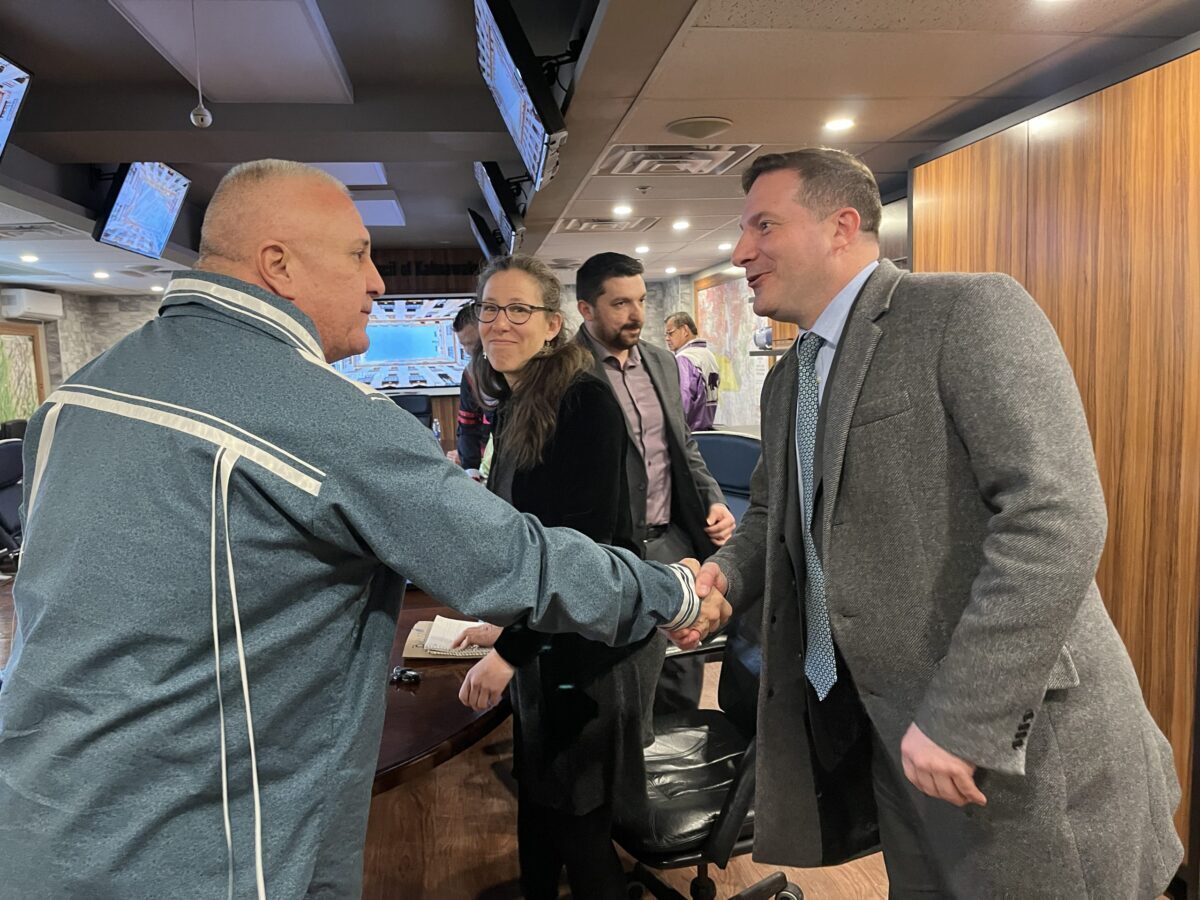
Then-minister of public safety Marco Mendicino met with Mohawk Council of Kahnawake (MCK) chiefs in 2023 to discuss concerns about what is now known as the Assault-Style Firearms Compensation Program. More than three years later, those concerns have not been properly addressed in the eyes of many, including MCK grand chief Cody Diabo. File Photo
The Mohawk Council of Kahnawake (MCK) reiterated last week a position that it has long-since held: that what was once Bill C-21 and is now the Assault-Style Firearms Compensation Program (ASFCP) is flawed, rushed, and is putting resources in the wrong place to combat crime.
The MCK published a press release on March 20, putting that position into practicality, stating that the Kahnawake Peacekeepers would not be administering the ASFCP - the deadline of which to opt in is March 31.
Kyle Zachary, spokesperson for the Peacekeepers, said that they don’t have the resources or personnel to take care of collecting firearms.
“If we have people suddenly turning up with all these guns, that will put a strain on our operations, because you need to document every single thing about that firearm,” said Zachary.
“There are serial numbers, there’s barrel lengths that have to be measured. There’s a whole amount of expertise that goes into identifying firearms, doing everything that needs to be done in one of these buyback operations. We don’t have the staffing to do that. I can’t even theorize how many people we would need.”
Safe and legal storage would also be a concern, Zachary said.
“You can’t just throw it in a box, especially if there’s ammunition involved. If there is a fire, that would be a catastrophe,” said Zachary.
“We don’t have the facilities to store that number of firearms and do it safely. It doesn’t make sense, from an operational standpoint, to go forward with this.”

Bill C-21 was proposed at a time when gun violence was on the rise in Canada - 2019 data from Statistics Canada shows that violent crimes involving firearms increased by 81 percent over a 10-year period in Canada.
Despite that, MCK grand chief Cody Diabo said that the ASFCP is not targeting the right place to curb violence.
“Penalizing law-abiding citizens doesn’t increase your safety at all. They should have utilized all this funding to provide more resources for law enforcement,” said Diabo, citing a recent report stating the Royal Canadian Mounted Police (RCMP) was experiencing a shortage of 3,400 officers.
“Maybe they should have done a better job campaigning to hire more police officers rather than saying ‘let’s take guns away from the people who obey the law.’”
Diabo said he was concerned about where efforts to control firearms would stop.
“What is their goal? Because right now, it just seems like it’s to disarm the population,” said Diabo.
Community member Patrick Tionekahten Zachary shared similar concerns.
“With the American Indian Movement (AIM) and resistance of the 1960s-1970s, Indigenous people in the US and Canada armed themselves. With this, the language about gun ownership is concerning for Kahnawake as it portrays us in the same vein as François Legault, who said we had AK-47s at the blockade in 2020.



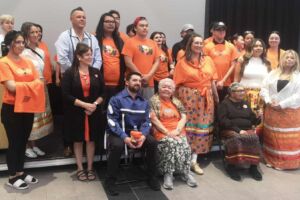
“This language echoes that of 1990. Every community member there at the time remembers the forceful entry of the Surety du Quebec and army at the Longhouse and on the Island,” said Patrick.
“I understand that it is difficult not to be concerned and frustrated because of the history around this. People remember that they banned our songs, dances, culture, and targeted our women and children in an effort to exterminate us.”
He was also concerned about how some firearms that are used for hunting, like the Ruger #1 single-shot rifle, were targeted by the program.
“I think it is incredibly suspicious that they are targeting hunting rifles while lumping them in with some so called ‘assault style weapons’, which are limited to five rounds and were rejected by Ukraine as inadequate for warfare,” said Patrick.
“They want our people to be insecure and weak so that we cannot stand up to their policy of development.”
Diabo said that he has had discussions recently with public safety minister Gary Anandasangaree about the compensation program, where he shared the MCK’s concerns. He was frustrated that public safety Canada appeared to be inflexible in regards to amending the program.
“Provinces are saying they don’t agree with it, police forces are saying they don’t agree with it, but they’re still going right ahead with this,” said Diabo.
“I was hoping that at least, maybe, the new government would walk back some of these things, but according to them, they have no time. If you were able to pass Bill C-5 in less than a month, I’m pretty sure you could walk something back, especially of this magnitude.”
Sign up for email updates from The Eastern Door
Diabo also said that the relatively low compensation for some weapons, which were acquired legally for much more than what the government is giving back, was also unfair.
Diabo said the main concern now would be the potential criminalization of Kahnawa’kehró:non who do not take part in the program. October 30, 2026, is the last day of amnesty for those who do not comply with the program.
“The last thing we want is our people criminalized. We’re still seeing what we can do, but all indications, and every conversation I had, was that Canada is not backing down on this one,” said Diabo.
Public Safety Canada did not comment in time for The Eastern Door’s publishing deadline.