Council attends education meeting

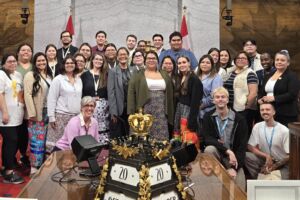
Serge Otsi Simon at the First Nations Education Council annual general meeting from April 21-22. Courtesy First Nations Education Council Facebook page
Last week, caretaker council member Serge Otsi Simon and Kanesatake Education Center (KEC) education director Watsenniostha Nelson attended the First Nations Education Council’s (FNEC) annual general meeting in Quebec City, where they discussed ways to fund and strengthen Indigenous education.
At the meetings on April 21 and 22, the FNEC revealed it is attempting to secure a 10-year funding agreement with the federal government, double the current five-year term.
“I feel like 10 years would give a little bit more time for all of our communities to really settle in and then really get things done without having to go back and start renegotiating again so quickly,” said Nelson.
Current funding ends in 2027, said Nelson.
However, while supportive, Simon is skeptical the FNEC could attain a longer funding agreement.
“It was hard enough to get the feds to commit to five years, and now you’re going to try to get 10. My opinion, well, I don’t think it’ll pass, but good luck with it anyway. I’ll support it 100 percent,” he said.
Simon gave his input on various topics including the FNEC achieving a longer federal funding agreement and improving educational infrastructure.

During a session about funding towards educational infrastructure, Simon suggested the FNEC help standardize the funding application process. At the moment, Indigenous communities apply for infrastructure funding separately, which can make it difficult to know the optimal answers required on funding applications.
“When you’re about to begin the project, the government will call and have all kinds of questions relating to the project, and then you got to go back, and you got to look for the information, put it all up in a document, send it to them, and oftentimes, there is push back on the project,” said Simon.
Many communities do not have schools or need to expand because of a growing population, said Nelson.
A standardized process would include implementing similar policies and procedures on educational infrastructure in different Indigenous communities, said Simon. It would not necessarily include adopting similar or same building plans.
“It would save a lot of time and headaches between us and the governments,” he said.
Some community members raised questions on whether the attendance of Simon overstepped the caretaker mandate imposed by the Federal Court last year, including Amanda Simon, who was a respondent in the case as a candidate in the suspended election.
Amanda Simon, who plans to run when the election takes place, said the caretaker council’s limited mandate means members cannot negotiate new funding agreements or begin new projects.





Last year, Federal Court judge Phuong T.V. Ngo wrote in the ruling that a caretaker council is mandated to engage in “simple administration matters such as day-to-day administration, the provision of essential services to community members, ordinary payable accounts, management of administrative staff, the continuation of in-progress projects, and other measures necessary to ensure the continued functioning of Council and the protection of the community’s legal interests until the decision of the Court on the underlying application.”
Serge disagrees with those who think he overstepped the mandate by attending, participating, and voting at the FNEC meeting.
“I’m doing what I have to do for my community, whether I’m caretaker or not, and if they want to challenge it in court, they’re free to do that,” said Serge. “But I’m doing this out of good faith towards the kids of our community.”
Amanda said she does not plan to challenge the caretaker council’s approach in court.
“However they decide to behave as caretakers is on them. I’m not playing the role of policing their caretaker role. It’s not something I want to do. It’s not something that anybody should be placed in a position to do,” said Amanda.
“I will not be taking this to the Federal Court, because, again, they get to play with public dollars. I get to pay with my own. This costs me money personally.”
Nelson said it was helpful to have Serge Simon present at the FNEC meeting and that she considers his participation as a caretaker council member at the meeting to have been appropriate.
Sign up for email updates from The Eastern Door
“Education is critical for our community, for our students. And as the director, it’s important for me that we continue to move forward,” said Nelson. “Even though maybe this aspect of politicalness is on pause at the moment, my work does not end, it doesn’t stop.”
The ongoing Federal Court case will inform when and how the next election can occur.
Hadassah Alencar, Local Journalism Initiative Reporter