Controversial track spraying takes place

Olivier Cadotte The Eastern Door
The Canadian Pacific Kansas City (CPKC)’s vegetation control measures were enacted on its track in Kahnawake territory - albeit not without public opposition from inside the Mohawk Council of Kahnawake (MCK).
That vegetation control is the spraying of glyphosate-based herbicides on the track ballast, the foundations made of rock on which trackage is placed, an area 16 feet wide. The process takes the railway company 20 or so minutes to do throughout the three KM of track in the community.
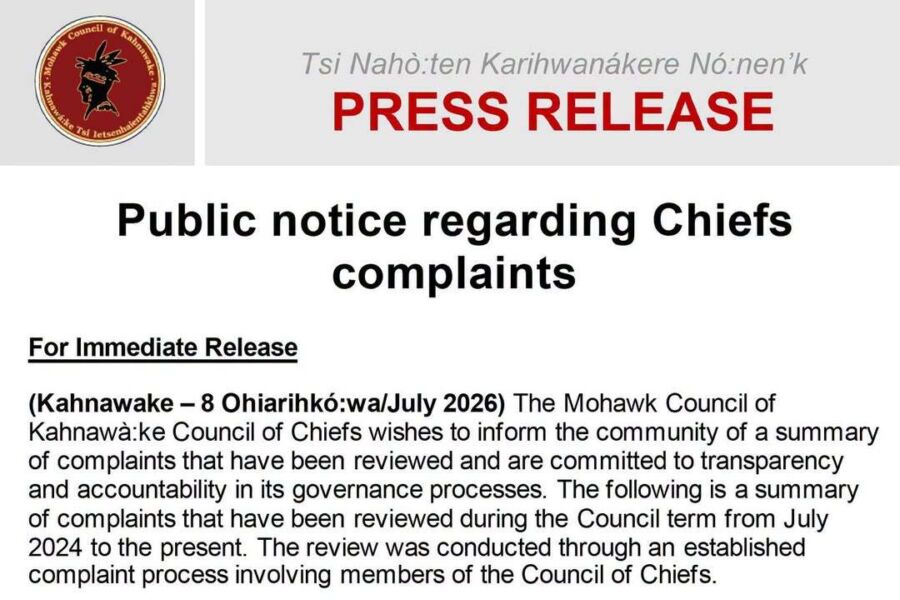
In a press release from the MCK, council chief Ryan Montour, lead on community safety, said that these measures are a matter of making sure the tracks can be properly inspected and maintained.
CPKC is required to do so by Transport Canada’s Rules Respecting Track Safety, and Health Canada Pest Management Regulatory Agency has approved the products used for the spraying.
“The most important issue here is to prevent the possibility of a train derailment and to protect our people,” said Montour in the press release.
Permission to do so was granted by the council table, with two council chiefs, Jeremiah Johnson and Jeffrey Diabo, opposed.

Johnson has been a staunch advocate against the spraying of the tracks, stating in a past interview with The Eastern Door that alternative solutions to vegetation control were needed.
“There are many alternative methods for the removal of vegetation. The simple fact is that it’s cheap. It’s a lot cheaper and efficient, and easier, to go and spray some chemicals on the tracks and be done with it, than to actually go and find one of those alternatives, and that’s what it boils down to,” he told The Eastern Door in April of this year.
Following the permission being granted, Johnson posted on Facebook about his displeasure regarding the outcome of the vote.
“I am very sorry Kahnawake, but neither myself nor the warnings from Kahnawake Environmental Protection Office (KEPO) were able to convince the table,” he said in his now-deleted post.
KEPO is against the usage of herbicides as a general rule, not just on tracks.
The deletion of the post, and follow-up posts on Facebook by grand chief Cody Diabo and Johnson, caused some controversy when it happened on July 17, with some comments seeing it as “bickering” and others questioning whether or not the clarifications made by the grand chief on the question of the vote on spraying should have been instead made via official channels.






“As the grand chief my job is to make sure that the proper information is going out,” he said.
Part of that “proper information” includes the fact that while CPKC was allowed to spray this year, a formal letter was sent demanding that an environmental study be paid for by the railway and overseen by KEPO, without which spraying would not be permitted next year.
He also said that alternatives needed to be found and discussed long before next summer, to give the council table time to examine them - he said this vote alone meant several hours of back and forth between the chiefs present already.
“Let’s gather some evidence. Let’s do our environmental testing, let’s test air quality in the area, let’s do all that work now, and it gives us more ammunition in the future,” said Cody.
“I think we all share some of the concerns and the sentiments, but being presented the whole picture and figuring out what’s the path forward is needed.”
He also said that the matter of the rails themselves needed to be addressed.
Sign up for email updates from The Eastern Door
“The community does not want the tracks here, so how do we begin that conversation?” said the grand chief.
Johnson did move to address the controversy as well, saying that he “posted in haste and did not include all relevant information and Cody is correcting that.”
Both he and Jeffrey Diabo declined to comment to The Eastern Door.