Council opposes Indian Act bill
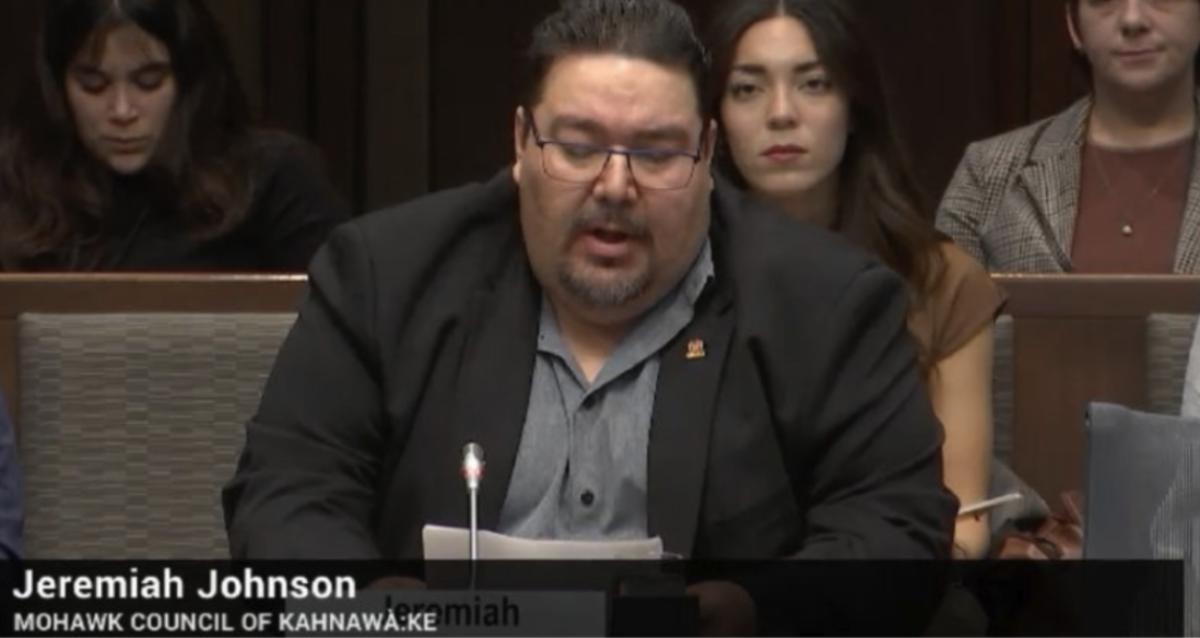
MCK chief Jeremiah Johnson speaking at the Senate of Canada this week. He told senators that Kahnawake “adamantly opposes” Bill S-2, which would amend the Indian Act.
A new bill that would amend the Indian Act could see thousands of individuals become entitled to status that weren’t before, a situation that Mohawk Council of Kahnawake (MCK) chief Jeremiah Johnson said could be problematic.
Johnson was in Ottawa this week to speak before the Standing Senate Committee on Indigenous Peoples about the proposed amendments to the act.
“We’re opposed to the amendments, and we’re opposed to the Indian Act, and we made that clear,” Johnson said.
The bill, known as Bill S-2, includes a number of new provisions to update the Indian Act, including the restoration of full status to First Nations people who previously lost their status through enfranchisement or deregistration.
Specifically, that includes women who were forced to join their husband’s band list after marriage - under Bill S-2, those women would be allowed to re-register with the nation that they were born into.
The amendments to the Act would also allow for First Nations people to be granted status who had their status taken away through enfranchisement, which was often involuntary. Individuals could be enfranchised historically in a number of situations - from 1869 to 1985, a First Nations woman would lose her status if she married a non-Indigenous man, and from 1876 to 1920, individuals were removed from band lists if they got a university degree.

Johnson said that MCK is not opposed to the reinstating of individuals to communities who have been removed for unjust reasons, but rather that it’s opposed to the Indian Act being used as a means of determining membership.
“We’ve already made moves to do that in our local registry. We understand that those things were very bad for our people and they reduced our numbers, and that was their plan to reduce our numbers,” he said. “How we reinstate those people and how we move forward from those things has to have more First Nations input and engagement. We have to be involved with these discussions.”
Johnson spoke alongside a number of key witnesses at the Senate Committee, including grand chief Jerry Daniels of the Southern Chiefs’ Organization (SCO). He argued that Canada must go further than just making amendments to the Act.
“We can no longer accept Canada’s paternalistic views of our identity, and we call for substantial and overdue reform,” he said.
While the amendments represent steps towards eliminating discrimination in the Indian Act, the bill fails to address the issue of second-generation cut-off - where an individual’s status is removed after two generations of one non-status parent.
“Nowhere else in the world do you see citizens of countries, like Canada for example, where if you had a child with a non-Canadian you would eliminate that child from being able to have Canadian citizenship. And the same should be done for First Nations,” he said. “The jurisdiction of First Nations should prevail in that instance.”




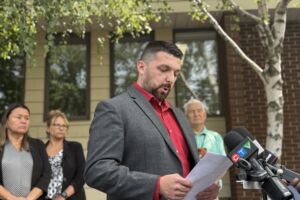

Johnson echoed that sentiment, telling the Standing Committee that the proposed bill continues a “longstanding pattern of federal overreach into matters that are inherently for First Nations to decide.”
He pointed to the potential 3,500 individuals to regain status, highlighting what he described as a lack of meaningful consultation about what the process might look like should those individuals seek residency in Indigenous communities.
“There’s been no dialogue about how this influx could affect our housing, our services, our governance, or our laws,” Johnson said. “Again, we’re expected to absorb the consequences of decisions made without any meaningful engagement or our consent.”
He pointed to the authority of the Kanien’kehá:ka of Kahnawà:ke Registry (KKR), telling senators that the community does not recognize the right of the Indian Act to determine who is from Kahnawake.
“Who is Onkwehón:we is for Onkwehón:we to decide,” he said.
Witnesses from other communities and organizations have been taking part in Standing Committee sessions throughout October, including Marjolaine Etienne, president of Quebec Native Women (QNW).
Sign up for email updates from The Eastern Door
She told senators that QNW supports the advances proposed in the bill, but feels it doesn’t go far enough - namely in regards to the second-generation cut off and concerns about the implementation of the bill. She said that previous federal reforms have failed due to delays and bureaucracy, and it’s crucial that a roadmap be created so that Bill S-2 can be implemented effectively.
“It seems necessary to agree on a clear, appropriate, and adequately funded plan, as well as an independent monitoring mechanism,” she said. “In addition, the government must provide sufficient resources to facilitate the integration of new registrants into communities. Without this, the reform risks creating tensions between new registrants and already recognized members.”
Johnson said he was pleased with how the hearing went overall, and felt respected by the senators who were present, including senator Michele Audette, who is Innu, and Cree senator Mary Jane McCallum.
“We’re all Onkwehón:we and we’re all looking to do the same thing, which is to protect ourself and protect our future generations,” he said. “We might have differing opinions on how to do that and get there, but essentially we all want the ]same thing.”
Committee hearings continued this week, to continue to establish what amendments will be made to the bill before it moves forward.