Caretaker chief’s presence questioned
Courtesy Assembly of First Nations
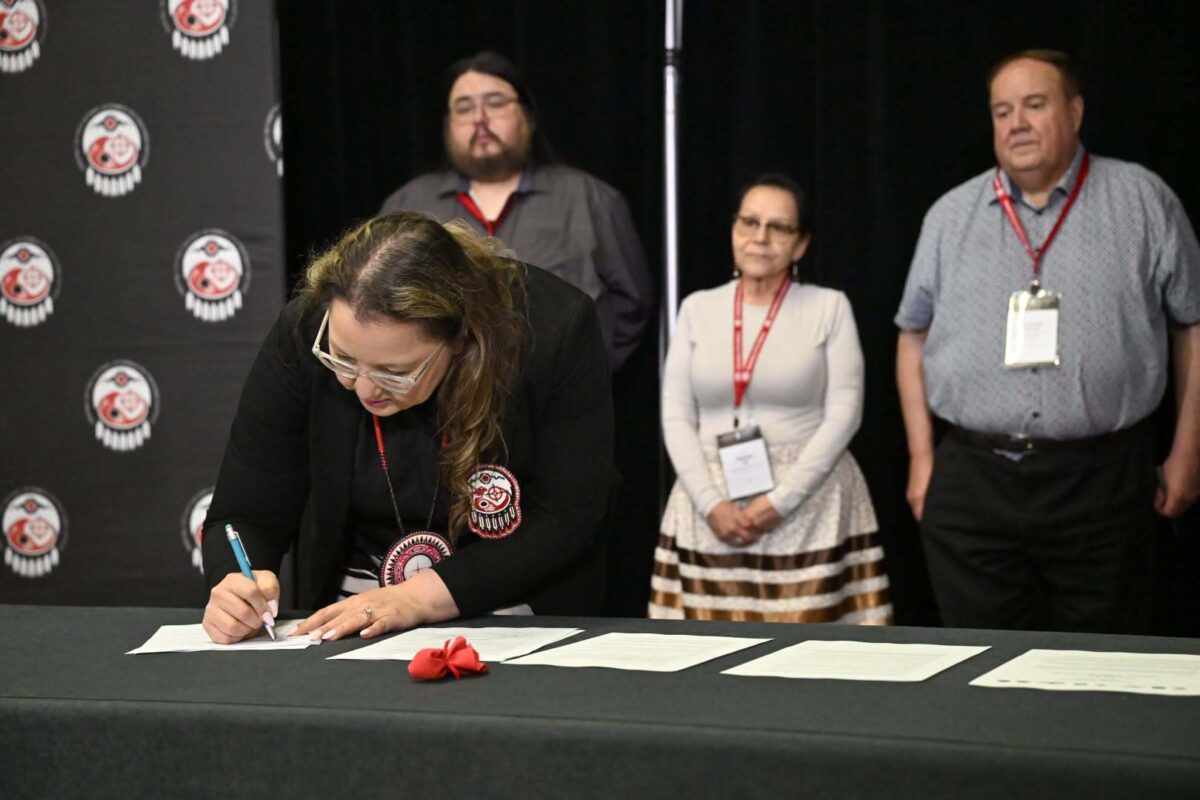
Mohawk Council of Kanesatake (MCK) caretaker council member Brant Etienne attended the annual general assembly of the Assembly of First Nations (AFN) last week, but some Kanehsata’kehró:non have criticized his presence and participation at the meeting.
Etienne said he attended the three-day general meeting to vote on resolutions as a council chief, advance ongoing community projects, and meet with other chiefs. From July 14 to 16, he participated in smaller meetings and in some of the plenaries and focused on the community’s security needs as well as general interests at the assembly.
For example, on the first day, Etienne addressed the assembly to remind other chiefs that Kanesatake’s need for improved security is shared by many other Indigenous communities, and the assembly must keep pushing the government for support on the matter, he said.
“Until boots are in the ground, money is in the bank,” said Etienne. “We always have to keep pressing and trying to find solutions.”
But former MCK grand chief Victor Bonspille, who attended the general assembly as a guest, publicly criticized Brant Etienne for participating in the annual general assembly as a chief.
Bonspille said Etienne’s caretaker council role is limited to simple duties like administrative tasks and carrying out ongoing projects. He said the title chief” can only be used by elected band council members.
“It’s a sad situation to have somebody at a gathering in the capacity of an AFN general assembly posing as a chief, actually getting through their registration as a chief, when it’s clear that he’s not an elected member of a council, or has a mandate from our community to act as such,” said Bonspille, in an interview with The Pines Reporter.

“For him to take part in any discussions or even sit there and vote on resolutions of the assembly, that is fraudulent.”
Bonspille complained to the AFN over Etienne’s participation in the general assembly as chief. The AFN allows one chief or proxy to represent each community at the general assembly. Etienne said there were no repercussions to his participation at the AFN meeting following Bonspille’s complaint.
Etienne maintains he is a chief in an interview with The Pines Reporter.
“The caretaker council is not a title role,” said Etienne. “We are chiefs. We were elected in 2021, and unfortunately, the mandate has expanded because of the cancellation of the election. But we still maintain the title roles and responsibilities of chiefs. We still operate under that mandate, that is indisputable.”
He said criticism about his attendance and participation at the general assembly were “self-serving politically.” At the assembly, he advanced, renewed, or affirmed ongoing work, and protected the interests of the community, said Etienne.
Last year, a Federal Court decision granted injunctive relief, appointing a caretaker council of five outgoing council chiefs, which included Etienne. The injunction was requested by the MCK after chief electoral officer Graeme Drew suspended Kanesatake’s election on the eve of the scheduled vote for August 2, 2025.
Some of the caretaker council’s mandate includes day-to-day administration, the continuation of in-progress projects, and the protection of the community’s legal interests, according to the ruling by judge Phuong T.V. Ngo.


The ruling allows for disputes related to the capacity and work of the caretaker council to be sought by way of a case management conference.
In an interview in May, Bonspille said he planned to assert a complaint against the caretaker council to the court.
This week, Bonspille said, “Our lawyer knows our position and concern, I will leave it at that.”
Notable resolutions passed at the AFN general assembly
Chiefs unanimously voted for resolutions opposing legislation or policies to expedite major infrastructure projects, such as pipelines, citing concerns that fast-tracked projects would infringe on Indigenous rights and cause environmental harm.
The resolution comes after First Nations chiefs have long critiqued the Liberal government’s Bill C-5, the One Canadian Economy Act, which removes interprovincial trade barriers and expedites major infrastructure projects across Canada.
Under this law, Ottawa may classify certain projects as being in the “national interest,” allowing them to skip the first phase of an impact assessment - including an assessment by an Indigenous government - on a major project. However, the act includes a duty to consult, not obtain an agreement, with Indigenous Peoples whose rights may be negatively affected by an infrastructure project before a project is ordered.
Sign up for email updates from The Eastern Door
Etienne was not present for the vote on this resolution.
Also, chiefs unanimously voted to criminalize Indian residential school denialism, calling on the federal government to amend Bill C-9, Combatting Hate Act, or create a new law that criminalizes “the public condoning, denial, justification, or minimization of Indian residential school denialism as a form of hate speech against First Nations,” reads the resolution.
Only a few weeks before Bill C-9 became law last month, the Canadian Senate voted against amending the bill to include a clause criminalizing residential school denialism.
Etienne voted in favour of the resolution.
Hadassah Alencar, Local Journalism Initiative Reporter