Leaders react to Ontario welfare deal
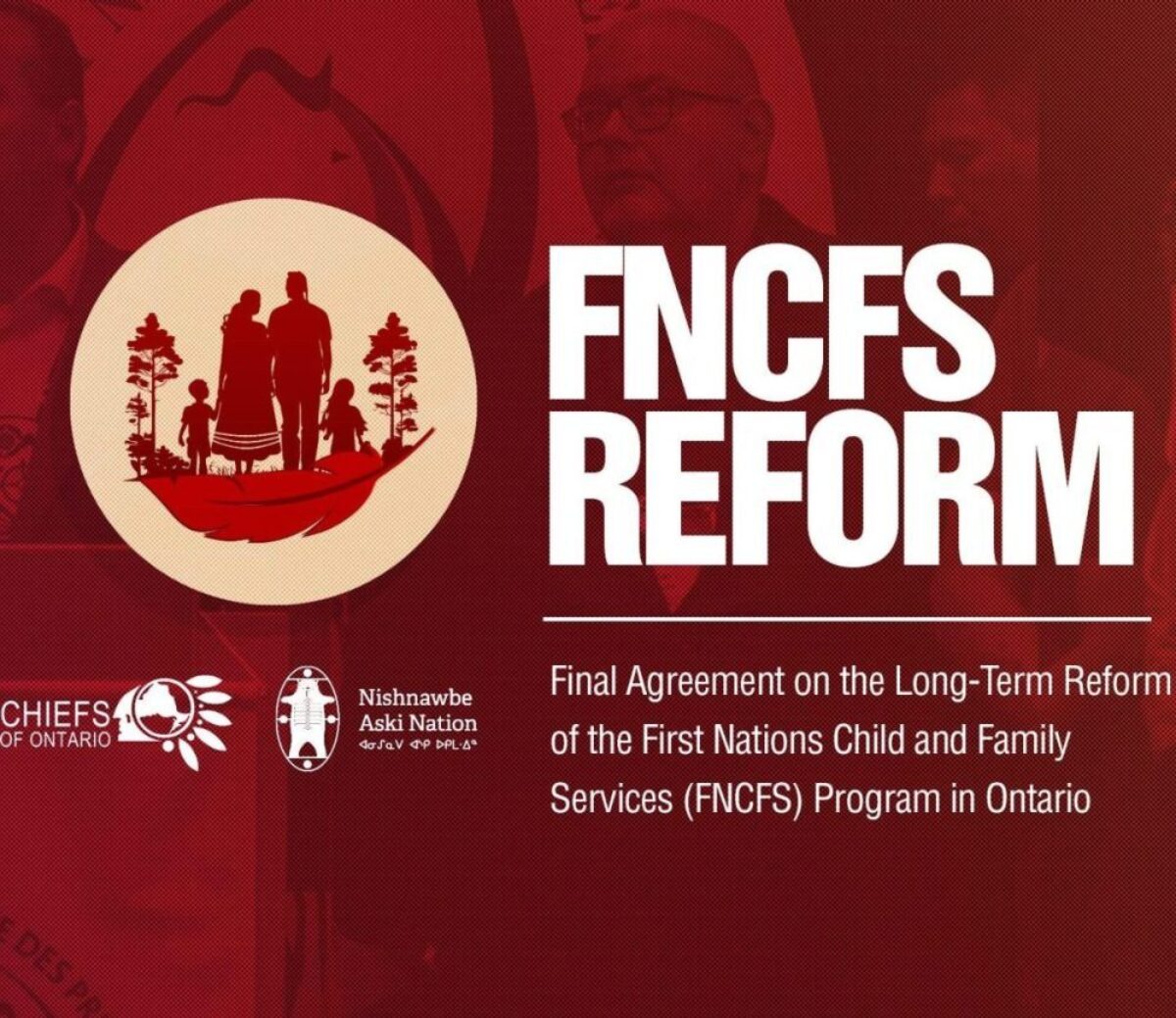
Sources close to the situation have revealed more about a recent region-specific deal struck for long-term reform of the child welfare system, which would ensure funds for Ontario but not yet for other regions across Turtle Island.
“Our region said that we need to end discrimination against our children now,” said Abram Benedict, the regional chief for the Chiefs of Ontario (COO), who negotiated the deal with the federal government alongside the Nishnawbe Aski Nation (NAN), in an interview with The Eastern Door. “We can’t wait another year.”
The deal was announced last week, with $8.5 billion to be provided over nine years to communities in Ontario. That comes after chiefs at the Assembly of First Nations (AFN) had struck down a $47.8 billion reform deal back in October, which had been drafted between NAN, COO, the AFN, and the federal government.
Back then, leading child welfare advocate Cindy Blackstock, who is the executive director of the First Nations Child and Family Caring Society, told AFN chiefs that she believed the deal wasn’t secure enough to protect Indigenous children long-term, arguing that the fine print of the agreement would make the deal subject to annual approval by the government.
She also pointed out that the deal only applied to children who went through the on-reserve welfare system, leaving out large numbers of children, and that the deal could result in child welfare being managed by government agencies instead of by local ones.
Since the AFN vote, Canada has stated that the federal government no longer has a mandate to negotiate further at a national level.

Blackstock said that refusal is, in her opinion, unacceptable. The Caring Society has since filed motions with the Canadian Human Rights Tribunal (CHRT) to force the federal government back to the negotiating table.
“I continue to be really concerned about Canada not negotiating in good faith and frankly breaching honour of the Crown by not coming back to the table regarding all First Nations children in the rest of the country,” Blackstock told The Eastern Door.
The details of the final settlement agreement date back nearly 20 years, when a complaint was submitted to the CHRT by the AFN and the Caring Society, with COO and NAN being interested parties in the complaint.
In 2016, the CHRT ruled that the on-reserve child welfare system had been chronically underfunded, and Canada was ordered to fulfil both a financial settlement agreement for those harmed by the system, as well as to provide long-term reform of the child welfare system to ensure that discrimination doesn’t continue.
The compensation agreement, which was approved in 2023, totals more than $23 billion for those living with the effects of going through the system, but the future of the long-term reform component is still uncertain, with only Ontario having a deal with the government.
The recently-elected regional chief of the Assembly of First Nations Quebec-Labrador (AFNQL), Francis Verreault-Paul, said that the reform deal is high on his list of priorities as he takes office.




“We need a deal really soon for all of our children,” Verreault-Paul said.
He said he wouldn’t rule out the possibility of a region-specific deal, if that were on the table, nor would he abandon the idea of negotiating for an amended version of the current deal previously struck down by the AFN.
“The mandate is going to come from chiefs and grand chiefs, and I’ll always respect that,” he said.
Benedict said that while COO and NAN were meeting with Canada to finalize the agreement, weekly feedback sessions were held with Ontario chiefs to go over concerns and feedback.
A vote was also held with those chiefs to decide whether to move ahead with the agreement – 76 chiefs and proxies voted in favour of the agreement, four were opposed, and three abstained.
“The government was clear that they don’t have any expanded mandates to put any more resources on the table, and so we knew that they wouldn’t enter into negotiations with us if we were asking for more,” said Benedict, who added that Ontario chiefs lobbied Canada for a region-specific deal after the AFN vote. “Essentially, all the elements that were in the national reform deal that pertain to Ontario are what form the agreement we have for us.”
Sign up for email updates from The Eastern Door
The region-specific deal leaves the rest of the provinces in the lurch, but Verreault-Paul said he can’t fault Ontario for moving ahead.
“It’s a very complex file. I think we’ve heard chiefs across Turtle Island, and we need to do things differently, but at the same time as a human being I can’t go against something that could be good for our children,” he said.
“If Ontario decided that this is the way to do things and it’s going to be best for the children, I just hope that it’s not going to go against the other regions.”
The deal itself must be ratified at the CHRT, where other parties including The Caring Society will be permitted to speak on whether the agreement meets the CHRT’s orders to address discrimination.