Cannabis board calls it quits
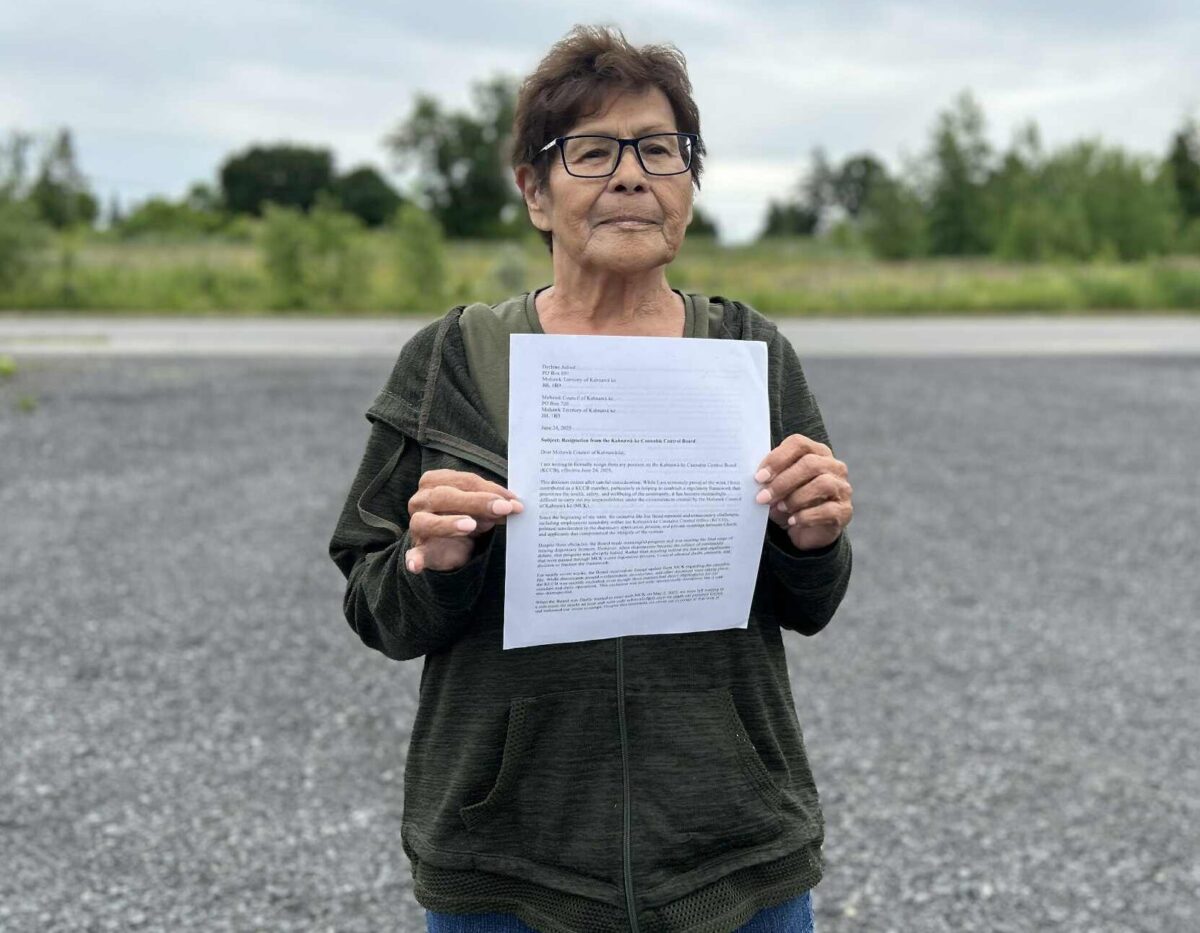
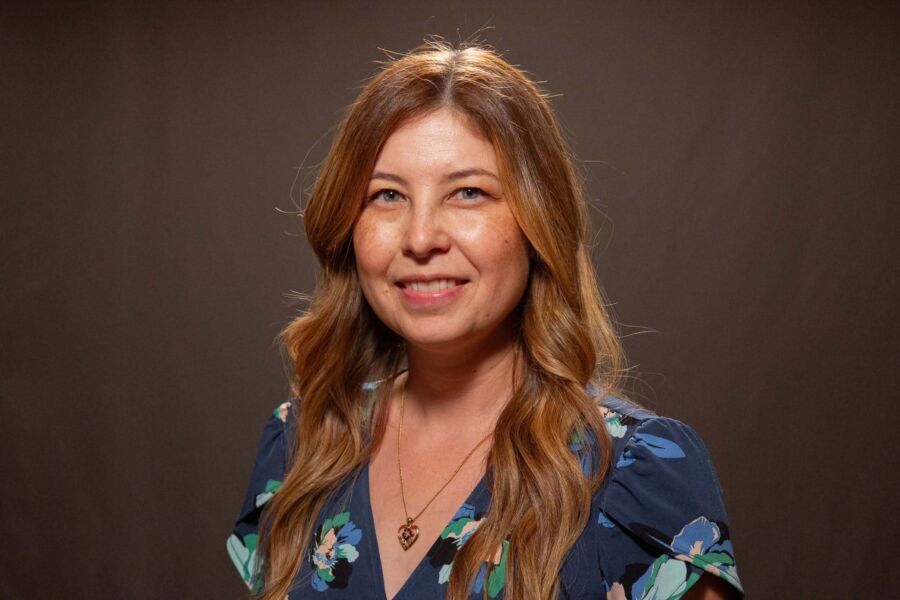
Former Kahnawake Cannabis Control Board Member Darlene Alfred stands with her letter of resignation, which she shared in full with The Eastern Door this week. Eve Cable The Eastern Door
A former Kahnawake Cannabis Control Board (KCCB) member said that part of the reason for her departure is because of a loss of faith in “the integrity of the system,” with a meeting between a dispensary license applicant and three Mohawk Council of Kahnawake (MCK) chiefs last year deepening her concerns about “political interference.”
Darlene Alfred submitted her resignation from the board on Tuesday, less than three weeks after the resignation of Kary Robertson, who had been serving as the KCCB’s alternate board member, a role intended to step in during other board members’ absences.
The KCCB’s chairperson, Tara Jacobs, also announced that she would not be seeking reappointment this week, her term having come to an end on the same day as Alfred’s resignation.
With no board members left, the KCCB’s operations are now officially suspended.
“In reality, this is a done deal now. It should be over,” said Alfred, who believes that it’s unlikely the process of handing out dispensary licenses will continue. “If you don’t have a board, no decisions can be made.”
Alfred shared her letter of resignation with The Eastern Door, which cites repeated challenges within the cannabis file since her appointment to the office in late 2023.
The KCCB is supposed to operate at an “arm’s length” from the MCK, meaning that Council is not permitted to interfere in the board’s main task of administering and regulating the Kahnawake Cannabis Control Law (KCCL).
The board has therefore independently managed the process of tasks like gathering feedback on potential dispensary locations, and handling the first stages of assigning dispensary licenses, typically liaising with MCK chief Tonya Perron, who has been portfolio chief for the cannabis file since its inception.
Right now, a shortlist of applicants eligible for a license exists, and the board has been conducting in-person consultations with individuals who live in the vicinity of proposed sites. Only three licenses would be handed out to community members in a process that would be decided by a lottery between the remaining eligible applicants, with the number of licenses reviewed periodically.
Tensions have heightened in the community over the past few months concerning cannabis, and it’s been a heat felt at the KCCB too. Alfred said that the board received no formal updates from the MCK regarding the cannabis ile for seven weeks while debates about moving forward took place and said that the KCCB’s exclusion from discussions was “not only operationally disruptive, but it was also disrespectful.”
The board was invited to meet with the MCK on May 2, after asking for more communication for weeks.
Alfred said that they were, however, further frustrated by being left waiting for almost an hour after the meeting was set to start. The board members ultimately entered the Council room and announced their intention to resign.

They were followed out of the room by MCK chiefs including MCK grand chief Cody Diabo, who urged them to reconsider, which they did. According to Alfred’s resignation letter, a follow-up meeting on June 10 saw Diabo make “several verbal assurances” that the then-upcoming June 12 moratorium was only “a temporary pause.”
Alfred added that several other MCK chiefs “echoed support for the regulated industry,” which meant that she was surprised to see the Council in subsequent days suggesting the Council would decide after the moratorium whether or not the regulatory framework would proceed.
In Alfred’s eyes, MCK chiefs are saying a different thing to the KCCB and to the community, undermining the board’s authority, which she says undermines the idea of the board operating at “arm’s length” from Council. She said she believes that MCK chief Perron has, however, been deeply serious about the board having autonomy and authority throughout the process, along with MCK’s legal services representative Suzanne Jackson, both of whom she thanked in her resignation.
“I believe they’re both so frustrated with the whole situation too, I think they also have the same kind of frustration and disappointment,” Alfred said.
At ‘arm’s length’
Though MCK chiefs do not have any say in approving or denying applications for dispensary licenses, Alfred said she was concerned to hear of an incident that happened around the time that KCCB first announced the list of initial applicants, which was in October of last year.
Alfred said that board had heard through rumours that MCK chiefs had met with a dispensary license applicant and immediately started inquiring what had transpired.
She said it came to be known that MCK chiefs Iohahi:io Delisle, Jeffrey Diabo, and Jeremiah Johnson had accepted an invitation from a community member to come and tour his facility, which he intended to use to both grow and sell cannabis should he be selected for a dispensary license.
That individual ultimately did not get approved to move forward in the licensing process - though Alfred emphasized that this decision was made for another reason, and not because of the tour. Reasons an individual might get rejected from the process include the location of their proposed dispensary being too close to a school or similar institution, or certain types of criminal record.
When the board discovered what had happened, they brought it up with the Council table, Alfred said.
“I told them I was disappointed in their ways. They had no right to overstep the board and go to a location to see a facility that was created for a dispensary. You overstepped your boundaries,” Alfred said.



A key concern to Alfred was how a situation like this could read to the community. If, for instance, a community member ever had concerns or accusations about what was said between MCK chiefs and an applicant in a situation like this, it’d be impossible to prove that anyone was innocent.
“It’d be your word against his,’” Alfred said.
The board decides who moves forward as a licensee, not MCK chiefs, but Alfred said that it was concerning to know the trio had met with an applicant without the board’s knowledge or consent.
The board discussed the matter with the Council table at the time, and Alfred said that she submitted a formal letter of complaint too, though it was delayed by Delisle’s leaves of absence, which only ended this week. As of now, she said nothing has come of the letter.
Delisle, Jeffrey Diabo, and Johnson confirmed that they attended a meeting with a community member who wanted to give a tour of his proposed dispensary location.
According to Delisle, the meeting came about after the community member in question messaged him on Facebook, inviting him to tour the facility. He had asked Diabo and Johnson if they wanted to join them, as the two were new MCK chiefs at the time, having just started in the organization that summer.
The three met with an individual at the facility and toured the site - Delisle said the building was impressive and that it was and is within his right to attend this type of meeting with community members.
“It’s our role and responsibility to engage with community businesses, it’s under our mandate through the economic development portfolio, and this is what our job is to do,” Delisle said.
Jeffrey Diabo said that he had no idea at the time whether the individual had even applied for a permit.
“We didn’t answer anything, we didn’t guarantee anything, we didn’t provide them a license under the table, we did nothing but go see a facility, an empty facility at that,” he said.
“I’m not involved in cannabis, I’m keeping my name out of it, but I don’t see anybody else using that visit to influence their decision, that’s not happening, so any accusation to that regard is patently false.”
Johnson confirmed that he was on the cannabis portfolio at the time of his visit, a portfolio he still sits on.
Sign up for email updates from The Eastern Door
“None of us would have any influence over whether anybody gets a licence or not, we were just really interested to go and see the facility, because we’re council chiefs, and we have to be open to the community and be available when asked,” Johnson said.
Johnson said the facility was large, with an area for processing that was to meet Health Canada standards, plus an area at the front of the building that was intended to be a dispensary in the future.
“That was all really, I just felt like a community member taking a tour,” Johnson said.
He recalls the board members raising their concerns at the time but that nothing came of the complaints. He said he hadn’t heard anything further about it until this week.
“It didn’t sit right with some of the board members, but it was really a non-issue, kind of a misunderstanding,” he said. “It wasn’t a secret.”
What’s next
Perron said that the board will remain suspended until at least two new members are appointed, and that there will be a call for new members within the coming days.
“I’m disappointed that it led to this, but not in the board. Honestly, I can’t blame the board members if this is what they’re feeling, given everything that’s been going on for the last couple of months,” Perron said. “I’m disappointed that we lost such great board members and community members that were willing to make this commitment to seeing this through and having a regulated industry where health and public safety were ultimate objectives.”
The moratorium enacted by the MCK on June 11 is effective until July 25, but if there are no new board members elected by then, the KCCB will still be suspended, and no progress can be made on the cannabis file.
Jacobs declined to comment, and Robertson could not be reached for comment.