Controversial paddlers visit Kahnawake
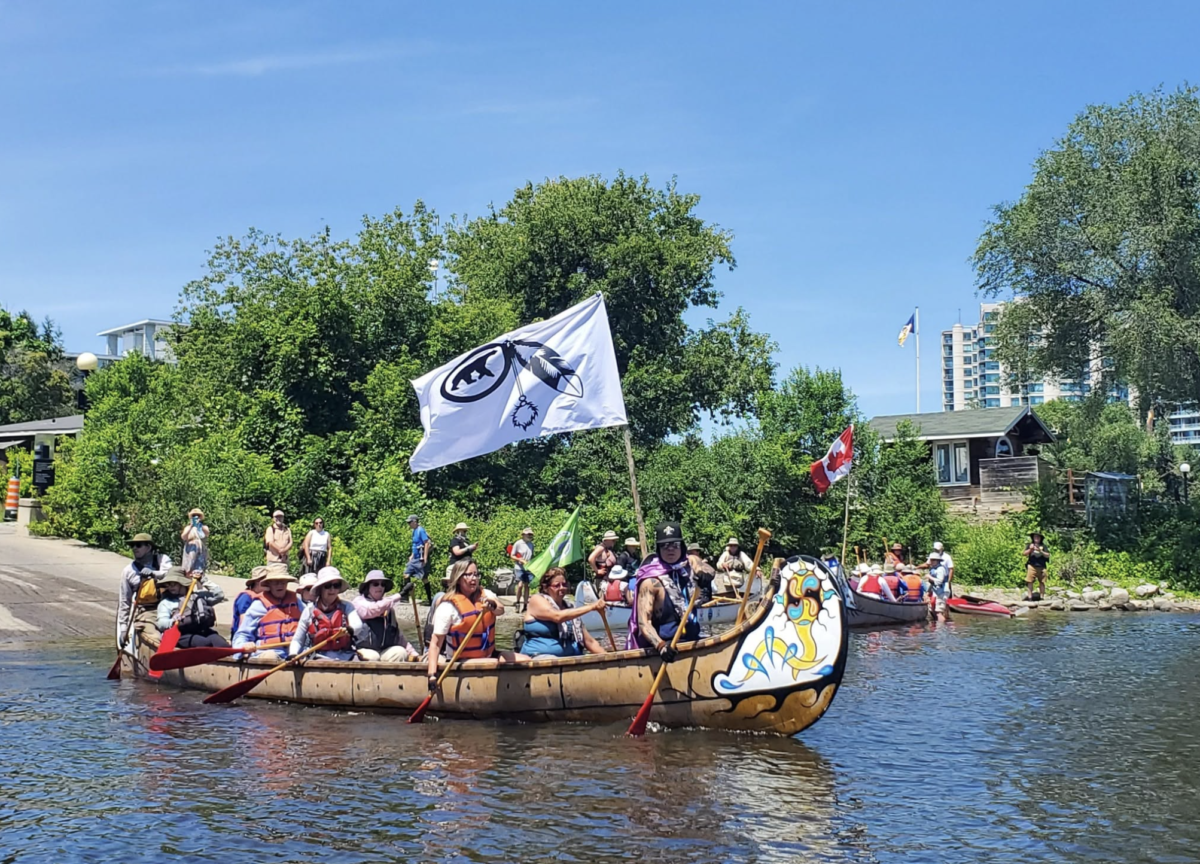
A group known as the Pinesi Paddlers landed in Kahnawake ahead of the annual Echoes of a Proud Nation Pow-wow last week, after a six-day journey that started in Gatineau.
The group is operated by Kichi Sibi Trails, an organization that aims to “revitalize the traditional Indigenous trails” connecting lands and waterways around Kichi Sibi (the Ottawa River).
The group is made up of Indigenous and non-Indigenous paddlers, including Jordan Two-Axe Kohoko, whose mother is from Kahnawake and father is Algonquin. He has been paddling with the group for three years and is the Native representative for Kichi Sibi Trails.
“I had a really good experience. I always have a great time when I’m out on the territory, or on the rivers and lakes,” he said. “The purpose of the trip is to get everyone together, it’s not just an Algonquin thing, it’s not just a Native thing, we’re doing this with Algonquin descendants and even settlers.”
He said that part of the goal is to retrace historical trade routes.
“Our ancestors used to travel and trade on those rivers, and we just want to relive that experience,” he said.
This time, the group was invited to land in Kahnawake by Mohawk Council of Kahnawake (MCK) chief David Diabo, who has known Wendy Jocko, a former Pikwakanagan First Nation chief who is president of the group’s board and was on the trip, for some time.

However, other nearby communities have taken issue with the group before – in the summer of 2024, their trip caused controversy in Kanesatake, after Longhouse members said they were uncomfortable with the visit.
Back then, the group had wanted to put down a plaque for the late Pikwakanagan grand chief Pierre-Louis Constant Pinesi in the graveyard in Kanesatake, and a representative for Kanesatake’s Longhouse had said that they didn’t have permission, feeling that the group had shared their schedule with the Mohawk Council of Kanesatake rather than asked permission from the Longhouse.
In an Eastern Door article at the time, representatives of the Mohawk Council of Kanesatake said they told the group to speak with the Longhouse, who were ultimately expecting more discussions before hearing that the group had set off from Oka Park on their journey.
Concerns back then included fears that the trip was being led by non-Indigenous paddlers including Peter Stockdale. One of Stockdale’s former colleagues, John Savage, who is Métis, had been a part of the founding of the group, but ultimately left after a disagreement about orchestrating funding requests.
Savage maintains that Stockdale has failed to properly consult with communities, and The Eastern Door’s reporting also saw Veldon Coburn, a McGill University professor and Pikwakanagan First Nation member describe Stockdale as “extractive.”
Savage told The Eastern Door this week that he feels Kichi Sibi Trails is a program based on misappropriated Indigenous history and culture, with the majority of organizers being non-Indigenous.
“Just because they are Indigenous and participate, doesn’t make it a legitimate Indigenous event, if the organizers are non-Indigenous and control things,” Savage said.


He said he feels Indigenous heritage is left in the hands of non-Indigenous organizers with Stockdale at the helm.
“I told (Stockdale) if we established an organization called Kichi Sibi Trails, it needed to be controlled by Indigenous people to comply with best practices and reinforced by the principles behind the Truth and Reconciliation Commission’s Calls to Action that stated Indigenous people must control their own historical narratives,” he said. “He ignored that piece of advice.”
Stockdale could not be reached for this article, but Jocko, who is president of the organization’s board, told The Eastern Door on behalf of the organization that the group doesn’t claim to be entirely Indigenous.
“We don’t represent any community, we’re a group of volunteers made up of people from all walks of life,” she said.
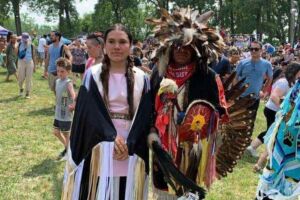
She declined to comment further on Savage’s allegations but emphasized the group had been personally invited by Diabo, and that she and other veterans were also invited to participate in grand entry at the powwow over the weekend alongside representatives of Kahnawake’s Legion Branch 219.
“If it wasn’t for Kichi Sibi Trails I wouldn’t know as much about my own Indigenous history as I do…it’s part and parcel of reconciliation as well, educating Canadian people about Indigenous history, and I think it’s wonderful,” she said.
Diabo categorized the past controversies brought up about the group as a “non-issue.”
Sign up for email updates from The Eastern Door
“I’m not going to address it, as far as I’m concerned, it’s a non-starter, I’m not giving it any airtime,” he said. “It had nothing to do with this event; it has nothing to do with Kahnawake or me inviting them to partake in and enjoy the powwow.”
He said that the paddlers’ visit was positive.
“I think it was a successful event, and I’m happy for them,” he said.
Two-Axe Kohoko feels connected to his fellow paddlers and to the land and water when he sets out with the group, and he wants more Indigenous and non-Indigenous people to paddle together.
“It just really brings people together, it’s a really positive experience,” he said. “We want to keep it going for younger generations…we want different backgrounds to join us.”