Funding boost for Oral History Project
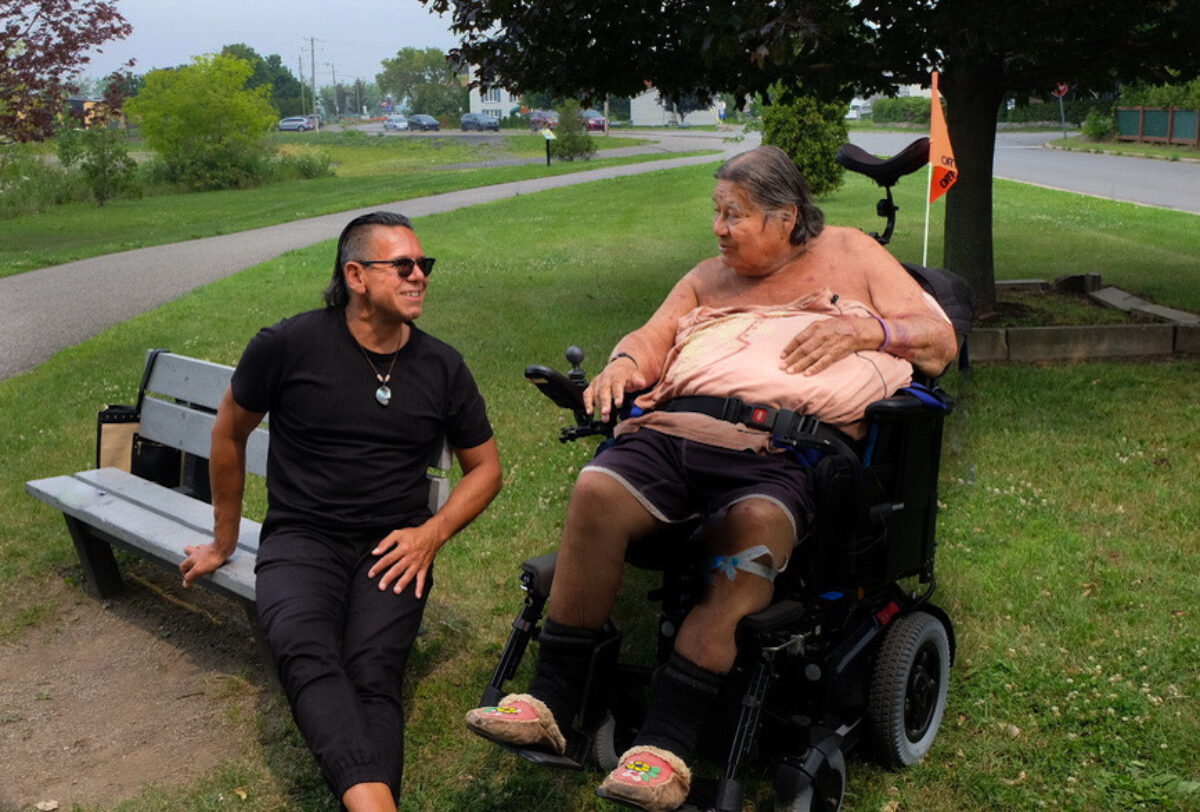
The late Billy Two Rivers with Gerald Taiaiake Alfred during the first phase of the Kahnawà:ke Oral History Project. File photo
A $50,000 donation from the Anglican Church will go towards helping Kahnawake archive its oral history, part of a project that coordinator Gerald Taiaiake Alfred says will ensure future generations of Kahnawa’kehró:non have access to easily forgotten information about the community.
“A lot of the records that we have are written records, and this gives the chance for the people that were a part of these organizations and history to fill in the gaps and address the mistakes that are embedded in historical records,” Alfred said. “To talk about it as opposed to us interpreting these written records will mean we can tell the story of the written records and really put them in context.”
The project, known as the Kahnawà:ke Oral History Project, started in 2022 with the gathering of stories from community elders in video form. That phase of the project culminated in a video called Resistance and Resilience: Stories and Remembrances of Our Elders which was shortlisted for the prestigious 2023 Governor General’s History Award for Excellence in Community Programming.
Back then, 25 elders were interviewed, including some who have now passed, like Billy Two Rivers. The project resulted in the gathering of many hours of video from elders beyond what was used in the film, but until now there’s been no clear solution for where that content would be stored - Alfred wanted the data to be accessible to the community, but he also wanted the community to have clear oversight and control over who else could access it.
The solution has come in the form of a collaboration with TheirStory, a platform specifically designed for archiving community oral histories, with the stated goal of supporting community control of data.
The platform was formed in collaboration with the people at Know History, who use it in their regular work, and with whom Alfred has collaborated on the first phase of the project.

“I have confidence in the platform and a lot of that comes from confidence in the relationship that we’ve had with Know History, in terms of the working relationship and in terms of the ethics of that group of people,” Alfred said.
“They use TheirStory for about half the work they do as a major historical research firm in Canada, and to me, that shows a lot of confidence in that their business is basically built on this platform.”
Know History undertook the first phase of the project pro-bono with the Mohawk Council of Kahnawake (MCK) and the Kanien’kehá:ka Onkwawén:na Raotitióhkwa Language and Cultural Center (KOR), and they will be providing their services for free again in the second phase, which signifies an in-kind contribution of approximately $40,000.
This additional $50,000 donation comes from the Anglican Church of Canada’s Reconciliation Land Tithe, an initiative that sees the organization donate 10 per cent of funds from the sale of diocesan real estate to support Indigenous communities in creating community-controlled projects focused on themes like culture, language, and self-determination.
The TheirStory platform will also continue to be free to access for the community for two years after the initial set up, a gesture from TheirStory.
“There are assurances built into this platform that all of the concerns we have in regards to data, sovereignty, and ownership of the material are all addressed,” Alfred said. “It’s a really simple matter, we own all of the material, we control how much is on there, how it’s used, whether it stays on there, who has access to it. Those are all our decisions, and that was important to me.”
The program itself looks like an online portal which catalogues content uploaded by project coordinators. It will mean that community members can search for specific pieces of information within longer clips, pull that information, and drop it into other places such as websites or galleries without having to wade through hours of footage.
To start, 30 hours of footage as well as the hours already recorded will be gathered for the platform, and Alfred is currently looking to speak with any community members who might have stories to tell around the theme of developing key organizations and institutions in the community.
“We want to capture that institutional memory of the people who built places like the Kahnawake Youth Center (KYC), the sports clubs, the band council, the Longhouses, all of the people that were there in the 70s and 80s,” he said.
He decided to focus this phase on charting that institutional history with the goal of providing youth in particular with an accurate resource to learn their own history.
“Everybody knows that it’s really hard to keep the younger people connected to their past. It’s an unfortunate fact of life today with the speed of life and culture and technology that these stories aren’t passed on the way they used to be,” Alfred said.
“We all used to have to sit around and listen to the stories of our elders whether we liked it or not, and whether we appreciated it or not at the time, there was a transmission of culture and knowledge through stories.”
Sign up for email updates from The Eastern Door
He said that it’s an identified problem that less knowledge transmission happens through oral storytelling, and projects like this will help bring that back - especially for people who might not have access to that information in their immediate family.
“We’re trying to address that gap by collecting these stories and offering the young people a chance to interact with these elders, whether they’re a part of their family or not, because they’re our community elders,” he said. “It’s like a memory bank and this is a source of wisdom for their community.”
Community members who are interested in participating in the project can reach out to Alfred directly at [email protected].