Visioning begins for Highway 30 lands

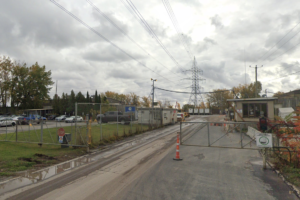
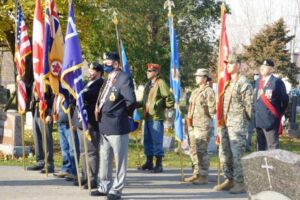
Consultations over how to best make use of over 500 acres of land straddling Highway 30 officially kicked off at a “Lands Summit” hosted this week at the Knights of Columbus.
The Mohawk Council of Kahnawake (MCK) officially gained title over the six separate parcels of land over 2017 and 2018 - land returned to it by Canada following an agreement it negotiated with Quebec back in 2007 in exchange for the construction of Highway 30.
Neil McComber has been hired to lead the consultations. The Council table didn’t tell him what they want or don’t want to see on the lands, he said. No unit at the MCK led him either.
“When I was contracted, I asked these questions, if there’s already designations, if there’s already decisions made, and I was told no, that they want to hear from the community first before making any decisions,” he said Tuesday while at the summit. “We’re here to ask people what they want without restricting them in any way, without leading them in any way.”
The consultation process is expected to last until the spring. Booths will be hosted around to solicit survey responses. Afterwards, a final report with recommendations will be made public, McComber said.
Of the six parcels of land, one sits in what was previously Chateauguay. The roughly 34-acre piece of land sits just by the rail line near Ile St. Bernard.

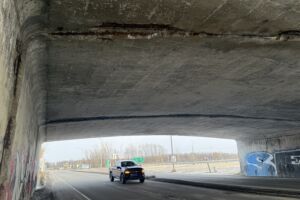
The five other parcels straddle Highway 30, from the Chateauguay border to Highway 132 on the east side.
Consultation only just recently began because the MCK first had to study the quality and archeological value of the lands. An ecosystem inventory study of the parcels, for instance, only wrapped up as recently as last year.
Printed-out maps of the parcels were made available to community members at the summit. Each noted the designation of each parcel, whether it could be used for agricultural or residential use, for instance.
Each also had space for attendees to draw what they’d like to see there, with a section set aside for them to leave notes too.
Doug Lahache said he hopes to see two of the parcels east of Route 207 turned into farmland. He and a few other community members already have formed a committee in the hope of creating a communal garden everyone can benefit from.
“As a society, we were planters and gatherers and hunters. We have zero land base as a community for planting. This is, in our mind, a perfect opportunity to start exercising our rights and our culture and planting and being able to feed our own people,” said Lahache, who’s now retired.
A nation is only as strong as it’s able to feed itself, he said.
“Historically, the Iroquois people had a food bank of seven years,” he said. “And now we don’t even know if it’s one month or two months’ worth of food that’d we have, if something were to happen.”
What he doesn’t want to see the land used for is anything that’s not aligned with his traditional values.
“I wouldn’t like to see big infrastructure put up,” he said. “Building a factory or anything else, a casino … it brings in money, but at the end of the day, you can’t eat money.”
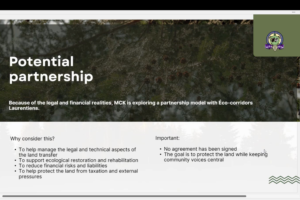
A remaining 211 acres of land is still owed to Kahnawake in exchange for the construction of Highway 30. Quebec has already offered up a parcel, but the MCK is still in the process of determining whether it’s worth accepting. Soil testing it wants to see carried out there can only happen in the spring.
The lands summit didn’t only revolve around the returned lands along Highway 30.
Sign up for email updates from The Eastern Door
While there, attendees were also able to weigh in on restoration and visioning projects currently underway by the Kahnawake Environment Protection Office (KEPO). Staff from Sports and Recreation were also there to answer questions about its recently launched recreation plan, which will largely revolve around the design of a new Kahnawake Youth Center (KYC) building.
Booths were also set up to educate community members about the longstanding Seigneury of Sault St. Louis land grievance, and the services offered by the MCK Lands Unit.
The summit ran over the course of two days. The first, on Tuesday, was aimed at youth and elders in town, with the second more geared toward the general public.
“(They’re) our knowledge keepers, who hold connections to the past. They are our teachers, advisors, and storytellers,” said Veronica Leborgne, the director of the Lands Unit, as she welcomed those in attendance that day. “Our youth also carry the important responsibility of being future stewards of the land.”
A 71-page report detailing the quality of the six parcels of land, and the studies carried out on them, is publicly available. Those interested in reading a copy can contact Leborgne at 450-638-8244.