Temporary border-crossing measures announced
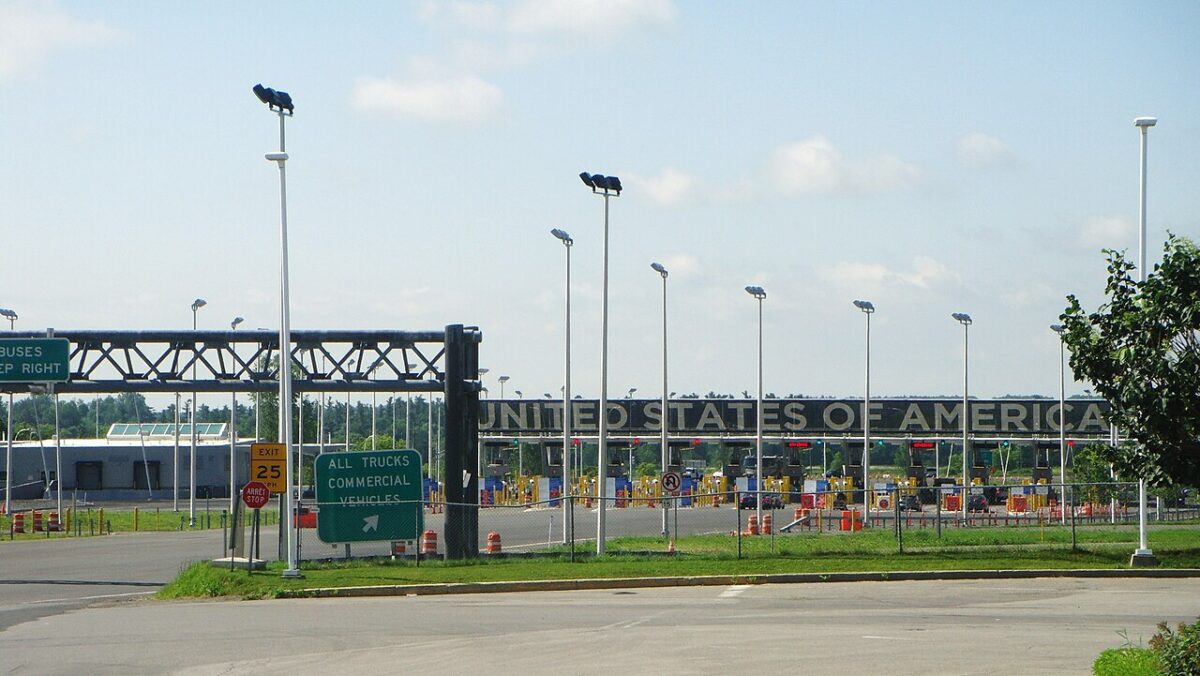
Interim measures aimed at reuniting Onkwehón:we with US citizenship with their families in Canada do little to change the status quo, Mohawk Council of Kahnawake (MCK) grand chief Cody Diabo said.
The measures were announced by federal immigration minister Marc Miller earlier this month and allow Onkwehón:we with Canadian citizenship to sponsor their family members south of the border. Under the new measures, those with U.S. citizenship will be able to extend their study and work permits in Canada, and to lengthen their stay for up to three years, all while waiving various fees.
“These interim measures are geared to try and help the process go a little bit smoother,” Diabo said. “For me, I feel it's kind of more or less the same.”
Applications must be submitted to benefit from the measures. But those from traditional lands spanning both sides of the border shouldn’t have to prove they have a right to movement, the MCK grand chief said.
“From my point of view, First Nations people, we have a connection to the land itself,” Diabo said. “So you're limiting people by saying you have to have family on the north side of the border in order to be able to come to Canada.”

What Diabo wants to see instead is legislation that would give American-born Onkwehón:we rights similar to those Canadian-born Onkwehón:we have in the U.S.
“It shouldn't be under Immigration, Refugees, and Citizenship, because we are not immigrants nor refugees, and we don't declare ourselves citizens of Canada,” the MCK grand chief said. “Make it similar to how we can travel into the United States. You don't need to apply with a form, you don't need to get any type of cards, or work permits, or anything like that.”
Diabo got to talk about the recently announced measures with minister Miller and Crown-Indigenous Relations minister Gary Anandasangaree earlier this week. They met at a meeting hosted in Ottawa on Monday by the Jay Treaty Border Alliance (JTBA).
The coalition of US-based tribal governments and First Nations communities has long advocated the protection of rights dating back from the 1794 Jay Treaty.
The treaty signed then between the United States and Great Britain maintained Indigenous people have the right to freely pass and trade between the boundary lines of both signatories. Its influence still informs much of America’s current immigration law.

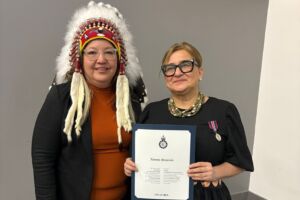

The meeting Monday at a hotel in Ottawa also included leadership like Abram Benedict, the Ontario regional chief with the Chiefs of Ontario (COO); Sherri-Lyn Hill, chief with the Six Nations of the Grand River Elected Council; as well as Victor Bonspille, grand chief of the Mohawk Council of Kanesatake (MCK), who attended remotely.
Federal public security minister Dominic LeBlanc also took part.
Like Diabo, Benedict agreed there needs to be standalone legislation recognizing the rights of American-born Onkwehón:we to live, work, and pass freely into Canada, but he said he’s also willing to compromise.
“Like the grand chief said, we don't want to be mentioned in the immigration act. But we also want immediate relief,” the Ontario regional chief said. “If we can get amendments that will alleviate things for our people immediately, we'll take it for now, and we'll continue to lobby for our own legislation.”
Ideally, some kind of legislative change could be adopted within the next two months, he said, before another election is called.
Sign up for email updates from The Eastern Door
“Time is of the essence, but we want to make sure that we've done the proper consultation of Indigenous peoples,” minister Miller told The Eastern Door.
He said he’s committed to pushing for a standalone law just like that, one that would likely be co-written with the ministers of Crown-Indigenous Relations and Public Safety.
“The consensus was that there was a need for a standalone piece of legislation that embodied these rights, and the operationalization and the putting into effect of the rights, as opposed to amendments to the Immigration Act,” Miller said. “Someone who has historic ties to Canada from an Indigenous group that has traditional lands that they hail from, probably doesn't want to be treated like an immigrant, right? So it's important to actually get the tone and the language right.”
Any proposed law would still have to be studied and go through three readings in the House of Commons after that, he added.