Taking action for Indigenous women
Courtesy Kahsennóktha George
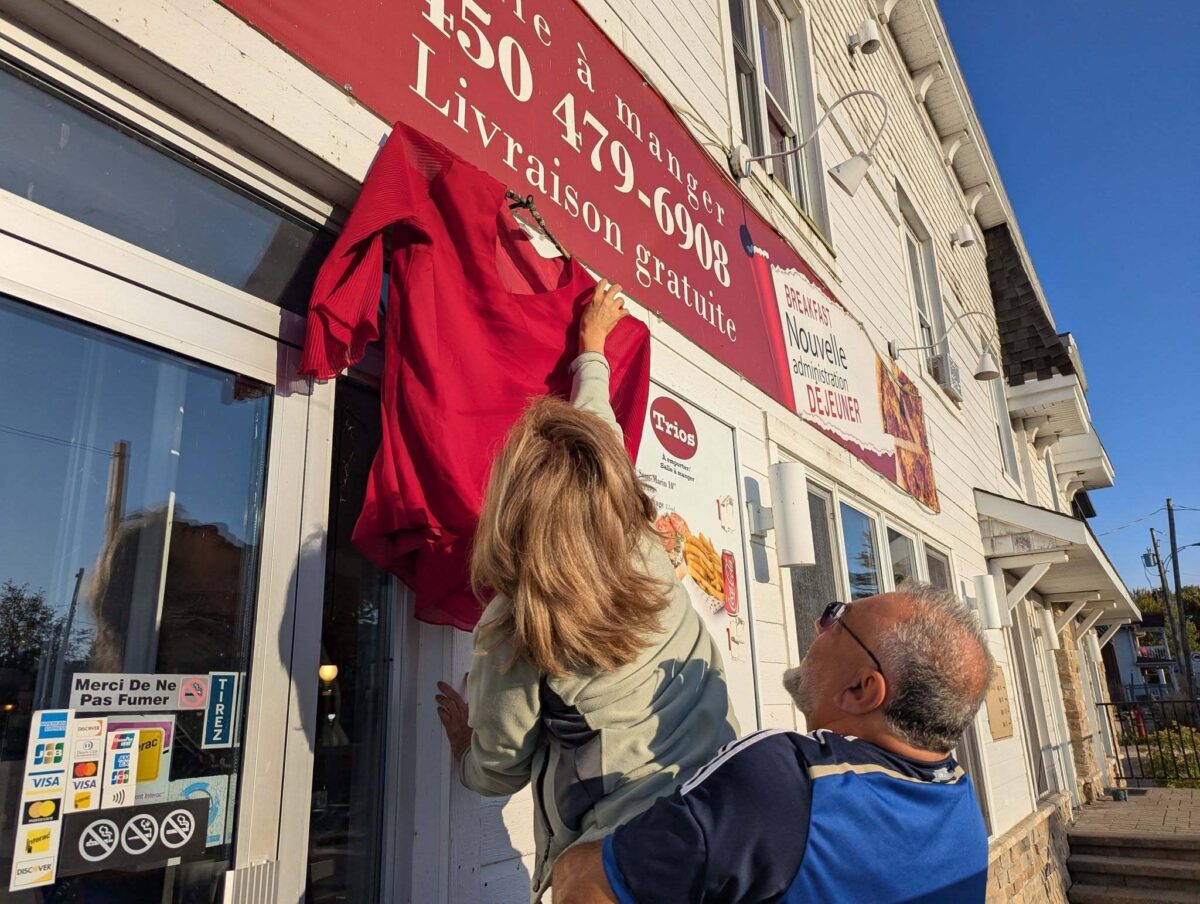
Mary Hannaburg and her daughter Kahsennóktha George were straining to reach a hook in the sign above the door of Pizza Greco, the red dress they wanted to hang there dangling from their hands.
As they struggled to place the garment, a symbol used to commemorate and raise awareness for missing and murdered Indigenous women and gender-diverse people (MMIWG2S+), a couple strolled by on the sidewalk. The couple - tourists, Hannaburg believes - didn’t hesitate. The man picked up the woman in his arms, and from that height she easily secured the red dress over the window.
Hanging red dresses in Kanesatake and beyond on October 4 - the National Day of Action for MMIWG2S+ - is something Hannaburg and George have done for seven or eight years with the support of other Kanehsata’kehró:non.
“Now we have people that are non-Native, not from the community, but they are also participating because it touched them. They understand the reason why,” said Hannaburg, who spends her birthday each year on the initiative.
But while she senses a growing awareness around the urgent issue, Hannaburg is disheartened to know how far Indigenous communities still have to go to in sounding the alarm about the distressing reality of MMIWG2S+ in Canada.
“I’m a mother, I’m a grandmother, and the concern is to bring awareness to this epidemic because people in the next community do not even know why those dresses are hanging,” said Hannaburg, noting how often residents of Oka and St. Placide take to Facebook to ask why they are seeing red dresses around their towns or when passing through Kanesatake.
“It’s put in the newspaper, and they’re looking for women and children, but it’s like it hasn’t resonated with them that we do have an issue here, and the violence against women and against Indigenous women is on the rise,” Hannaburg said.

However, as vexing as it can be to still have to educate people in 2025, the initiative is all about raising awareness, and Hannaburg takes it as an opportunity to respond to them with information about what this is all about, and she is seeing results.
“We’ve had people that are participating that you would never think would be interested in doing that, people that we thought they didn’t care, but they allow it, they’re open to it, because they understand what the significance of it is and they will not say no to it,” she said.
The dresses come from a non-profit thrift store in Oka that collects them all year for the initiative, La Maison du Partage, and then Hannaburg and George seek others to help them put the dresses up.
“Being of Indigenous descent, the Red Dress project was close to my heart; they symbolize missing, abused, and forgotten Indigenous women,” said Michelle Trottier, who was in charge of La Maison du Partage when the idea was proposed by Hannaburg.
“It warms my heart to have contributed to this project and to know that La Maison du Partage continues to collaborate on it,” Trottier added.
This year, dresses were hung at the Ratihén:te High School and across from it, Riverside Elders Home, the Pine Hill Cemetery, the solar panel on top of the hill in the Pines, and other locations.
While raising red dresses is typically associated with May 5, the National Day of Awareness for MMIWG2S+, also known as Red Dress Day, George doesn’t see any reason the practice shouldn’t also be associated with October 4.


“This is an action that we’re taking to commemorate and raise awareness of the ongoing epidemic of missing and murdered Indigenous folks,” said George, adding that these occasions are opportunities to take a step away from routine and highlight the systemic issues underlying such a grave injustice.
“Indigenous women, girls, and gender-diverse folk are targeted for trafficking and violence because of racism, gender discrimination, and discrimination based on sexual and gender diversity,” said George. She highlighted the importance of meaningful investigations when an Indigenous person goes missing and bolstering the fight against human trafficking in confronting the issue of MMIWG2S+.
The mother and daughter try to hang the dresses where they will be highly visible. “The point is for people to see them, to ask questions if they’re not aware, or for those that are aware that they’re reminded,” she said.
Hannaburg has no plans to slow down when it comes to leading this action every October 4.
“I know that there are sisters that are still, to this day, being taken, that have gone missing. The numbers have increased. We see it on social media all across, not only here, but the US as well,” she said.
She spoke of the tragedy of unresolved cases of missing women and girls in Quebec, including Tiffany Morrison, who disappeared at the age of 24 from Kahnawake in 2006, and Maisy Odjick and Shannon Alexander, who went missing from the Kitigan Zibi as teenagers in 2008.
“These are things that really hit home,” said Hannaburg.
Sign up for email updates from The Eastern Door
In 2019, the National Inquiry into Missing and Murder Indigenous Women and Girls reported that Indigenous women and girls are 12 times more likely to go missing or be murdered than those who are non-Indigenous.
An Assembly of First Nations (AFN) progress report in 2024 highlighted that only two of the National Inquiry’s 231 calls for justice had been fulfilled.
Marcus Bankuti, Local Journalism Initiative Reporter