McGill unveils redeveloped space

The central feature of McGill University’s redevelopment of the Y-Intersection is a mosaic designed to honour Turtle Island. Courtesy McGill University
At the heart of McGill University’s downtown campus is a spot known to students as the “Y-Intersection,” a site where main roads converge, meeting in front of the iconic Arts Building.
Now, that area bears a new name: Tsi Non:we Onkwatonhnhets, or “The place where our life force emerges from the earth,” according to the university’s translation of the Kanien’kéha words.
“To be able to see this space and walk by it, people can see we’ve come a long way, and see we’re committed to reconciliation and to supporting Indigenous folks who work and study on campus,” said McGill’s director of Indigenous initiatives Brittany Janvier, who is Dene from Cold Lake First Nation.
“It’s something big, I’m just so proud.”
The redevelopment of the area sprung out of McGill’s 52 Calls to Action, which were created in 2017 by the university’s Indigenous Studies and Indigenous Education task force. That group identified actions deemed necessary to advance truth and reconciliation in the university, with Call to Action #26 concerning Indigenous presence in public spaces at McGill.
The installation of the Tsi Non:we Onkwatonhnhets development is a direct response to that Call to Action.

“We really want to ensure that McGill’s public spaces reflect the university’s commitment to Indigenous education with the display of Indigenous art and culture on campus,” Janvier said. “It’s huge for McGill to have something this big in such a public space.”
The project features artwork by Oneida artist Alanah Jewell, who designed eight benches and a central mosaic with the title All in Ceremony: Giving Thanks.
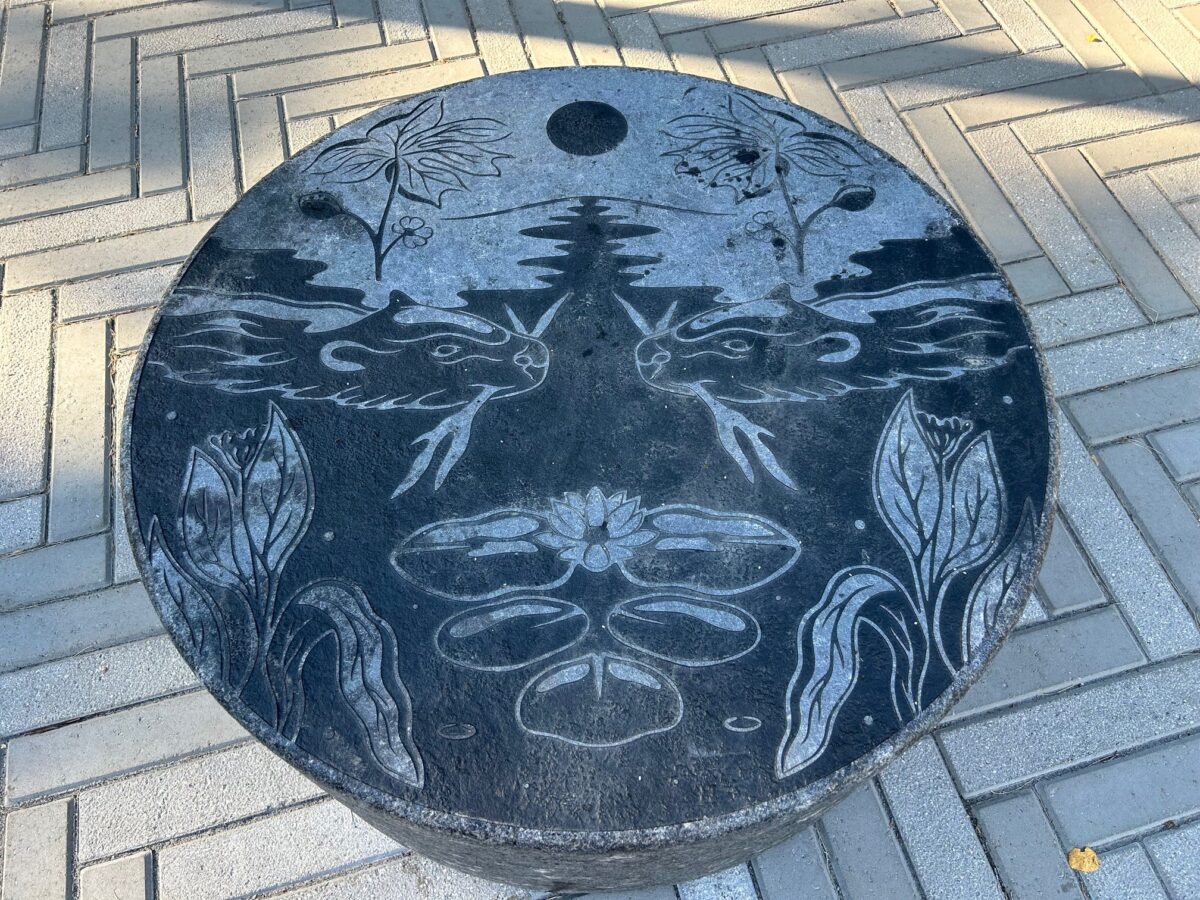
Eight benches around the mosaic honour flora and fauna native to the area. Courtesy McGill University
The mosaic is embedded in the central circle of the intersection, featuring 13 elements representing the themes of the Ohén:ton Karihwatéhkwen, designed to look like a turtle shell in acknowledgement of Turtle Island.
The work is designed to be viewed starting facing east and moving counter-clockwise, the direction moved in during ceremony.



Surrounding the mosaic are eight benches, each engraved with designs of species native to Montreal and the surrounding areas. The designs include an eastern screech own, a red fox, and a barn swallow.
While Jewell was contracted to provide the artwork for the project last year, the redevelopment of the area has been an ongoing project since 2022, in conjunction with McGill’s Indigenous Advisory Council, which includes Kahnawa’kehró:non Ka’nasohon Kevin Deer and Martin Loft.
During discussions within that group about how to bring more Indigenous art to public spaces at the university, Phillip White-Cree was contracted to consult for the project.
White-Cree, who is from Akwesasne, currently works at Clarkson University and has a degree in architecture, making him well-suited to determine what kind of installation could be possible on campus.
He worked on initial sketches which were used by designers to make renderings in preparation for the final installation.
“The Y-Intersection is a very well-known landmark, and one of the things we discussed really early was to view it almost like a plaza, a gathering space, where people could informally gather and have discussions, it’s part of the campus fabric,” White-Cree said. “We wanted to keep that human scale, and one thing I did to move forward with that plaza idea was include seating, making it a little bit more than just something on the ground.”
Sign up for email updates from The Eastern Door
He said it was important to consider feedback that had been gathered from multiple communities throughout the process - PlanIt had been contracted to conducted consultations with communities and stakeholders starting in 2022. That meant being open to ideas about different themes to represent in the finished work and considering how to achieve those goals while ensuring the piece could withstand harsh weather and daily wear and tear.
“There’s always been an openness, but Indigenous people are not a monolith, and I always say in my classes that there’s a lot of nuances and a lot of positionalities between individuals and communities and organizations,” he said. “It’s not as easy as saying, ‘Oh, there’s this one thing that represents everybody,’ it needs to always be viewed as a mosaic, there’s not one homogenous identity.”
Members of the McGill community were on campus on Thursday to officially celebrate the new space, with Mohawk Council of Kahnawake (MCK) grand chief Cody Diabo joining for the ceremony.
“To come together and work with other Indigenous people, to see Indigenous people be a part of the decision-making process is just amazing,” Janvier said. “I really enjoyed seeing it come to life.”