Slithering start for brown snake study
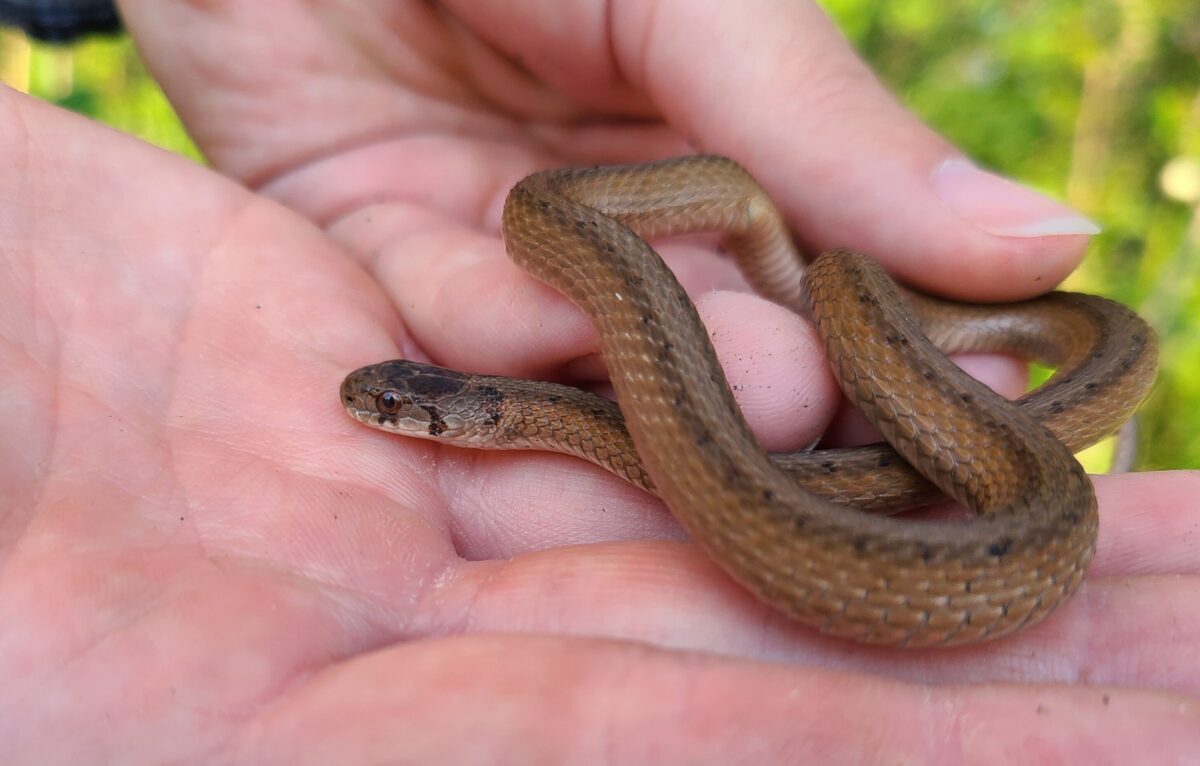
A brown snake gently held by a researcher during the ongoing inventory in Kahnawake’s greenspace. Courtesy Kenneth Canadian
Residents of Kahnawake may soon notice roofing shingles placed strategically in greenspaces near the Highway 132 west service road. But there’s no need to worry - these shingles are not part of a construction project gone wrong. Instead, they’re key tools in a critical brown snake inventory being conducted throughout September and October as part of the upcoming Greenspace Project.
The Mohawk Council of Kahnawake (MCK) has authorized the Jacques Cartier & Champlain Bridges Incorporated (JCCBI), in collaboration with their contractor Aecom and community engagement firm PlanIt, to carry out a study to confirm the presence of brown snakes in the area. While the Kahnawake Environment Protection Office (KEPO) is not leading the initiative, they are collaborating closely, drawing on their years of experience monitoring local reptile populations.
“This inventory is being conducted to confirm the presence of brown snakes and to identify the most suitable location for integrating a wildlife feature for them on that site as part of the upcoming Greenspace Project,” explained Kenneth Canadian, an environmental technologist representative at KEPO involved in the project.
The brown snake, as described by Canadian, is “a small (usually less than 30cm), light brown snake, with several rows of dark spots along its body and a faint stripe running down its back. They are shy and do not pose any danger to humans whatsoever.”
Although these snakes are small, they’re mighty.

“Because these snakes are quite small, they are often overlooked and their benefits not fully appreciated,” Canadian said. “Brown snakes eat a variety of known pest species that affect our gardens every year, including slugs, snails, and beetles that could otherwise go unchecked.”
Unlike other forms of wildlife monitoring, this inventory doesn’t involve trapping or removing the snakes. Instead, the method is simple and non-invasive.
Environmental technicians place roofing shingles on the ground across the study area. As cold-blooded creatures, brown snakes are attracted to the warmth retained by the shingles in the early morning, slithering under them for shelter.
“A researcher will simply check under each shingle in the study area each day and get a count of the number of snakes and species present,” said Canadian. This practice allows technicians to gather data without disturbing the animals or their habitat.
The inventory began this Monday and will continue until the end of October, with technicians working between 7 a.m. and 4 p.m. daily.




Brown snakes are designated as a threatened species, largely due to habitat loss from development and fragmentation. By understanding where these snakes live and how many are present, the project team hopes to support long-term conservation.
“It is good practice for any development on or near a known brown snake habitat to include mitigation measures that ensure the impact to the species is minimized,” Canadian said.
While an exact population count is not yet available, Canadian confirmed that they are present in Kahnawake, especially on Tekakwitha Island.
The public is asked to be mindful of the shingles and not to disturb them - the success of the study depends on minimizing human interference with the study materials.
“This is an excellent opportunity to learn more about these snakes and what we can do to help them,” Canadian said.
Sign up for email updates from The Eastern Door