Renewed questions about Diabo dismissal
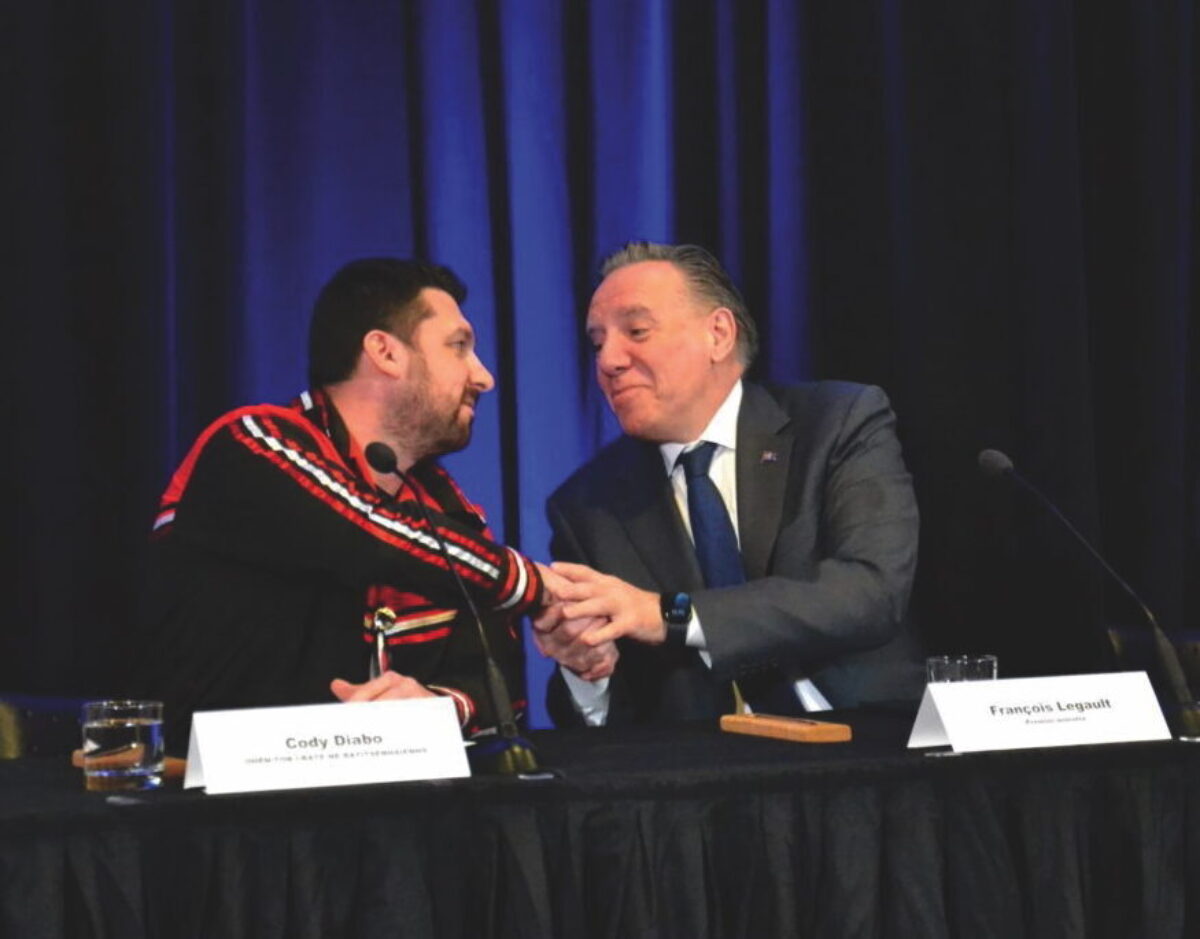
Mohawk Council of Kahnawake grand chief Cody Diabo shakes hands with Quebec premier François Legault at the signing of a “Statement of Understanding and Mutual Respect” between the MCK and the province. File photo
Mohawk Council of Kahnawake (MCK) grand chief Cody Diabo was once a Kahnawake Peacekeeper, but that came to an end in 2017 when he was terminated in an ethics scandal, a fact already known to the community - even as much remains hazy.
Diabo’s charges were dropped and his file sealed by a court order he subsequently obtained, but his co-accused, Landon Montour, pled guilty in 2018. Diabo went on to run for Council, winning a seat in the October 2019 by-election.
The debacle, which involved the men being accused of falsifying police records, was written about in The Eastern Door, but there is newfound attention on the situation – this time in mainstream media.
The scrutiny comes at a moment in which Diabo’s credibility is a crucial asset as he leads the MCK in working to redefine relationships with external governments at all levels.
“La Presse in itself has always painted Kahnawake and our people in a negative light. For me this is just another little tactic,” said Diabo.
He said he can’t get into specifics, citing the active lawsuit and the history of the situation.
“People know in the community I was a Peacekeeper and then I wasn’t. I did follow a process in the end. There’s no criminal record at the end of the day. I wouldn’t be where I am had there been any,” he said.
He doesn’t put much stock in reports like this from outside media, he said.
“To me it’s just noise from La Presse at the end of the day, similar to all the external media for certain things.”

A series of La Presse reports published this week based on the $220 million lawsuit launched against MCK and Diabo by the owners of Magic Palace, first broken by The Eastern Door, includes an article detailing revelations about the situation stemming from Diabo’s depositions in the case.
An element of the lawsuit, which nears 100 pages, is an allegation that Diabo acted inappropriately in copying the Peacekeepers on the letter terminating the royalty agreement with Magic Palace, needed to operate electronic gaming devices (EGDs) on the territory.
The closure of Magic Palace, in turn, involved several armed Peacekeepers, which Magic Palace’s lawyers argue gave the termination - pertaining to a “commercial dispute,” the suit reads - the veneer and weight of law enforcement.
To this end, excerpts of the deposition are included in the lawsuit that deliver insights into Diabo’s history with the force.
“They cited things in a transcript, but that’s their interpretation of it at the end of the day,” Diabo told The Eastern Door, saying he could not comment further since the lawsuit is before the courts.
However, Magic Palace’s lawyers present the context as a conflict of interest they argue amplifies his personal liability.
Meanwhile, the Peacekeepers deny there was anything untoward about their participation in the shuttering of the gaming facility.
“We were at Magic Palace on the day it was closed to ensure the process was peaceful and everyone on site was safe,” said Peacekeepers spokesperson Kyle Zachary.
Asked to expand on questions relating to the dismissal of Diabo, Zachary said the force does not comment on human resources matters.





In testimony of January of this year, Diabo often stated that he did not recall details about his history with the Peacekeepers and questioned the relevance of it.
Diabo was charged in 2018 with falsifying police records and obstructing justice. In his testimony, he said he’d never been formally charged but reversed this statement when asked about the specific timeframe and charges, according to the lawsuit. Although these charges were dropped, his termination stood, and according to his depositions, he has a settlement with the Peacekeepers.
“I have a non-disclosure agreement in place, so I don’t know what I can say or what I can’t say, and I choose not to say anything because I have something in place,” said Diabo when asked in the examinations whether he’d received compensation in the settlement.
Yet, despite this background, he confirmed in his testimony that he has not recused himself from dealing with the Peacekeepers as an elected official.
While Diabo acknowledged that he was charged in the case, he parried a question about whether the allegations were that he “had falsified police records to the benefit of a Peacekeeper employee.”
He was then asked the following by a lawyer for the plaintiffs: “The events in question concerned a Peacekeeper employee, (redacted), who was suspected of driving under the influence, correct?”
“That’s the person, yes,” he responded.
“That was also the factual context, correct?” continued the lawyer.
“Yes,” said Diabo.
Sign up for email updates from The Eastern Door
According to Magic Palace’s lawyers, Diabo was nominated to run as an MCK chief only a week after he obtained a court order sealing his court record, to which Diabo responded, “Correct.”
Going beyond what is available in the text of the lawsuit obtained by The Eastern Door, but which is said to arise from the transcripts, the La Presse report cites the examination of Diabo as revealing that the employee who was suspected of driving under the influence “is the daughter of one of the directors of the Kahnawake Peacekeepers.”
The Peacekeepers did not clarify whether this is true or whether it refers to a current director.
Marcus Bankuti, Local Journalism Initiative Reporter