Reacting to Bill S-2
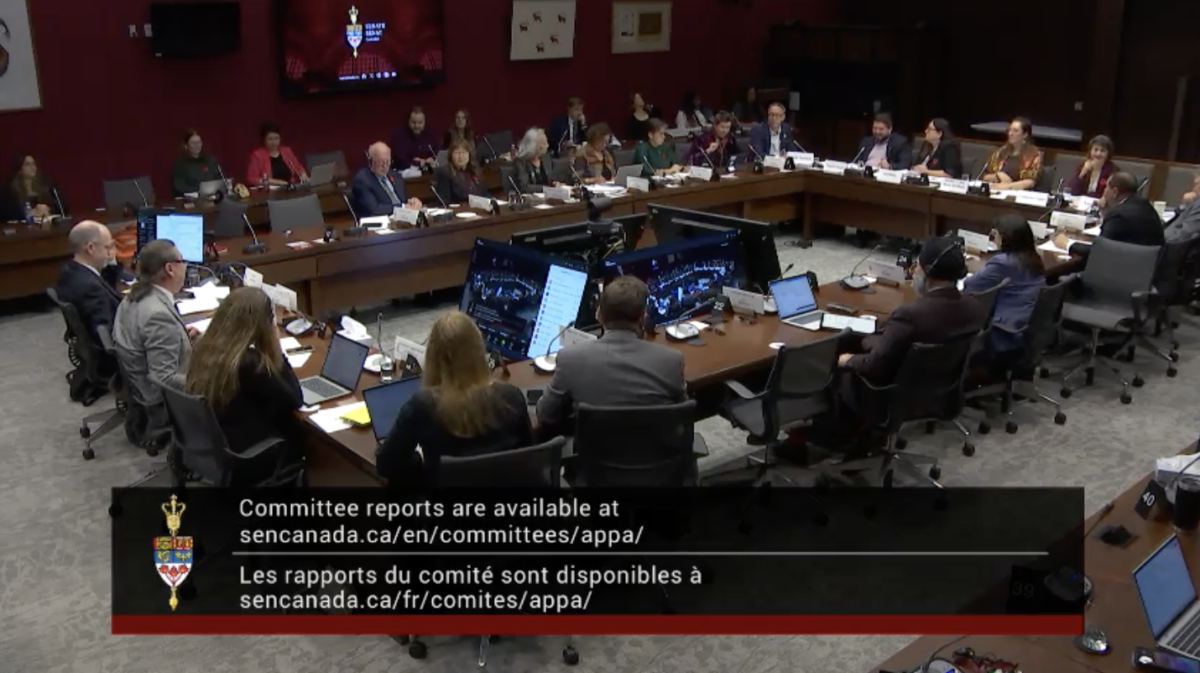
Senators discuss Bill S-2 at the Standing Senate Committee on Indigenous Peoples. Courtesy Senate of Canada
Kanehsata’kehró:non Mary Hannaburg has been at many tables over the years where the Indian Act was debated, but she believes recently passed amendments to Bill S-2, which would axe the second-generation cut-off rule, are more promising than ever before.
“It’s different because we have Indigenous senators sitting there, and they’ve brought forward so much,” said Hannaburg, who was previously the vice-president of Quebec Native Women (QNW). “I’ve seen those senators working really hard, putting every effort into making it move ahead.”
The second-generation cut-off rule means that status is lost if a family has two consecutive generations where only one parent has status. That would be replaced with the “one-parent rule” under the new amendments, which would mean a child can have status, and pass it on, if at least one parent does, regardless of how many generations of partnership there has been with non-status individuals.
Indigenous Services minister Mandy Gull-Masty had previously urged senators to pass the bill as-is, saying that making amendments such as getting rid of the second-generation cut-off needed more consultation before being implemented.
But amendments to end second-generation cut-off within the Indian Act passed 10-1, moving forward the bill to its next stages.
Hannaburg, who also spoke about her opinions on Bill S-2 with Reviving Kanehsatà:ke Radio (RKR) 101.7 FM, said that’s a step in the right direction, and that the move doesn’t mean communities won’t be consulted with.

“They’ve been sharing the testimonies from various witnesses who have been putting out concrete evidence of how this impacts them, and basically it needs to move. The moment is now,” Hannaburg said. “They can’t wait and wait and rely on promises that were made time and time again that inequalities would be removed from the Indian Act.”
Hannaburg’s mother, Aris’awe Elizabeth Etienne, was stripped of her status because she married a non-Indigenous man, an injustice that still sits with Hannaburg to this day.
“There was no consultation there. They just literally took all her rights away,” she said.
In 1985, Bill C-31 changed the law around Indigenous women marrying non-Indigenous men, allowing for status to be restored to women who had lost it as Etienne did - Kahnawa’kehró:non Mary Two-Axe Early was the first to have her status restored, after fighting for changes to the Indian Act.
“We’ve seen them try and divide and conquer and that’s what they try and do, to decimate our populations, to assimilate and control.”
When the bill and its amendments were being debated at the Standing Senate Committee on Indigenous Peoples, Mohawk Council of Kahnawake (MCK) chief Jeremiah Johnson had raised concerns about the potentially large number of individuals that may gain status as a result of the bill - as many as 3,500 individuals may gain or regain status as a result of the amendments.



He had argued that there needed to be further consultation to determine how to meaningfully axe the second-generation cut-off rule to avoid a sudden increase in the number of Indigenous people seeking to access services or gain residency in Indigenous communities, stating that there had been “no dialogue about how this influx could affect our housing, our services, our governance, or our laws.”
But Hannaburg doesn’t believe the increase in individuals with status would put a burden on the services they have a right to access, advocating for that to only be a motivator to push the government to do more to support communities.
“Some of these children are already in the communities. And we won’t see a rush of people coming to try to move into the reserves, because those people have gone on and built their lives outside. The ones that will are the ones that are in the community already that have no identity and no recognition, but they’re drawing on the little resources they have,” she said.
“Do we need more financing, absolutely. They need to increase and make that blanket bigger for housing, education, medical, but there’s not going to be an influx, some overwhelming epidemic of people invading. It’s not going to be like that.”
Hannaburg believes what needs to be prioritized are the current and future generations affected.
“It’s very damaging and it gives children the message that they’re second-class citizens, you’re not ‘part of,’” she said. “When we talk about reconciliation and all of these pretty words, and trying to help communities be proud and thrive, we need people to have the basic fundamental right to belong, the right to their recognition, the right to be ‘part of.’”
Sign up for email updates from The Eastern Door
In future, a world without the Indian Act would be ideal, Hannaburg said, but realistically change needs to be made now, and the process of abolishing it is currently untenable.
“Maybe there shouldn’t be an Indian Act, maybe they should find another mechanism, but right now, that Indian Act is what binds Canada and their fiduciary responsibility to the Native people. That’s the agreement we have, that’s what holds them responsible,” she said.
“They’re the ones that implemented that law, it’s a colonial framework, they created this mess, and they need to be the ones that fix it.”