Music in the age of artificial intelligence

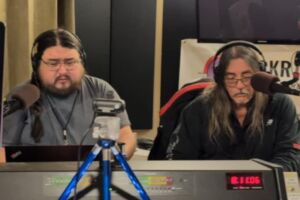
Sterling Mallette at the Reviving Kanehsatà:ke Radio (RKR) 101.7 FM station on February 19, 2026. Fern Marmont The Pines Reporter
Listeners of Reviving Kanehsatà:ke Radio (RKR) 101.7 FM may be surprised to learn two songs over the airwaves were generated by morning radio show host Sterling Mallette.
The two songs, generated on the artificial intelligence (AI) music platform Suno, are meant to be funny, light-hearted, and speak to lived experiences of the Kanehsata’kehró:non, said Mallette.
“I just want them to laugh and enjoy it and have a good time when they’re listening to it, and not take life so seriously,” said Mallette. “Because life is short and you better be happy while you get to live it right?”
Karahkóhare Syd Gaspé, president of Mohawk MultiMedia Inc., which oversees RKR, likes the way Mallette can showcase his personality by sharing the creations over the airwaves.
“Sterling, he’s more of the news guy right now on the radio, but he’s got that funny side to him and that good sense of humour,” said Gaspé. “This tool brings that out, and that’s a great thing.”
The songs are part of an ongoing effort to encourage more community involvement and inspire younger generations, said Mallette.
For future projects, Mallette would like to take recommendations from local listeners over topics and lyrics to generate more content and music based on the community’s experiences.
“I would like to do more community involvement,” said Mallette. “Just to have that interaction and fun with people.”
Gaspé supports Mallette’s intention to increase community involvement through songs.

“We want interaction,” said Gaspé. “Radio is an interactive medium.”
The first AI song Mallette made, entitled, “Where Have All the Chiefs Gone?” was generated after the Kanesatake election was cancelled in 2025.
“It was just to try and make people laugh, put a smile on people’s faces, because everybody was pretty intense,” said Mallette.
The second song is called “Indian Steak,” said Mallette. For both songs, he wrote some of the lyrics and prompted the AI platform to generate the rest.
“I pretty much wrote about your tóta, when you would have a hangover and wake up over at her house when you were a teenager, and she’d make you hangover soup and Indian steak, which is fried baloney,” he said.
Mallette has received requests to play the reggae-genre song from time to time on the radio.
This is the chorus from the song: Indian steak on a paper plate fried up golden/Ain’t no debate/When the night long and the drink was strong/Tóta got the cure/ That’s where you belong.





“It’s a throwback song,” said Mallette. “That was just me growing up and being at my grandmother’s house, but also other people too, around your other friends that I had, just growing up at tóta’s house.”
While AI is ushering in a new frontier in music creation and a novel way for people to express themselves, some experts warn there are also pitfalls when it comes to these new technologies.
AI can be beneficial for artists when used as a tool to complement the artist’s work, said Tanner Mirrlees, professor in the Faculty of Social Science and Humanities at the University of Ontario Institute of Technology. But one of the main issues within AI technology is that it is trained on music without the consent, credit, or compensation of the artists in the AI’s database, said Mirrlees.
This becomes especially an issue when making songs about or based on Indigenous culture with AI platforms.
One of the ways to mitigate these issues is to use AI platforms with conscious intentionality and to allow Indigenous people to check the accuracy of the language and culture, said Mirrlees.
“The best-case scenario would be Indigenous artists and musicians themselves finding creative and innovative ways to use these platforms to prompt sounds that are appropriate to and express their sense of their culture, their language, their way of life, and then gaining more recognition and visibility and maybe also monetary reward for that process too,” said Mirrlees.
Mallette took care to make the Kanien’kéha in the song accurate. He found it difficult to get the platform to accurately pronounce tóta. It took a few attempts, and he finally settled on the best version.
Sign up for email updates from The Eastern Door
Fans hoping for an album will have to keep on hoping. Mallette said for now, only singles will be released in the coming future.
But he hopes his efforts to generate music will result in more Indigenous content that can better represent the community and inspire younger Kanehsata’kehró:non to be involved in media and at RKR.
“Maybe their friends tune in and listen and be like, ‘hey, that’s our music,’” said Mallette. “It’s trying to get them involved in the radio station so we can have more community involvement, because eventually we’re all going to get old and we’re all going to be out of here, and then some kids are going to move up and take our places eventually.”
Hadassah Alencar, Local Journalism Initiative Reporter