‘Pressure conference’ demands June election
Marcus Bankuti The Eastern Door
The Mohawk Council of Kanesatake (MCK) is steadfast in its summer election plans, even as calls grow louder for a June election date to be respected.
A flurry of posts on social media accusing Council of ignoring the Custom Electoral Code have not been quelled by its confirmation of an August 2 election date, the first Saturday following four full years in office for the chiefs.
Leading the charge has been Amanda Simon, who was MCK’s former certified lands manager until her resignation last year, blaming a dysfunctional culture for her departure.
Simon, who confirmed Tuesday that she intends to run for a Council seat in the next election, has characterized the MCK’s failure to begin the process for a June 14 election as a power grab and a breach of the document that outlines local governance.
“We thank them for calling the election. Now we demand they make it a legitimate one,” said Simon. “Let me be clear, we’re not here today to stir more division. We’re here to restore order, respect, and rightful governance in our community.”
Her goal in holding a press conference on the subject this week was to ramp up the pressure on Council to reverse course and abide by the election code by calling a June 14 election, she said, referring to it as a “pressure conference.”
“I have called this press conference because the people of Kanesatake deserve transparency, accountability, and leadership that follows its own rules, not one that twists them behind closed doors,” said Simon at Tuesday’s event, boosted by a handful of community members.
This characterization has been rejected by Council members, who argue a June 14 date would constitute an early election.
At issue are two clauses that seem to contradict one another.
On the one hand, clause 12.22 indicates that elections shall be held the second Saturday of June, except in the case of an early election. In 2025, that equates to June 14, meaning a callout for a chief electoral officer would have needed to go out by March 22, 12 weeks earlier.
But the code also defines a Council term as four years long in clause 8.1, with an extension in the case of early elections, and that date doesn’t arrive until July 31; the 2021 Council elections were held late, on July 31, 2021, with the COVID-19 pandemic mainly cited as the justification at the time.
The MCK communique announcing an August 2 election date said this will follow a dissolution of Council on July 31, exactly four years following the previous election. Simon has characterized the August 2 date as an illegal overreach that extends Council’s mandate by a day.
According to the MCK, legal counsel advised that the four-year term took precedence over the June date given an absence of explicit protocol for late elections in the code, a conclusion Simon has rejected in her calls for action.
“It’s not the role of the legal counsel to act as judge and jury, to reinterpret the code or to decide that one clause takes precedence over another,” Simon said. “These clauses are not in conflict. They hold equal weight and must be read in harmony, not twisted for political convenience.”

Asked to explain how these clauses do not conflict with one another, Simon said it should have been up to the community, not lawyers, to sort out any perceived discrepancy.
“One doesn’t override another just because a lawyer says that it does. Those kinds of questions should be brought to the people, not to your lawyer who unilaterally decides that the date of the election doesn’t take precedence over another clause.”
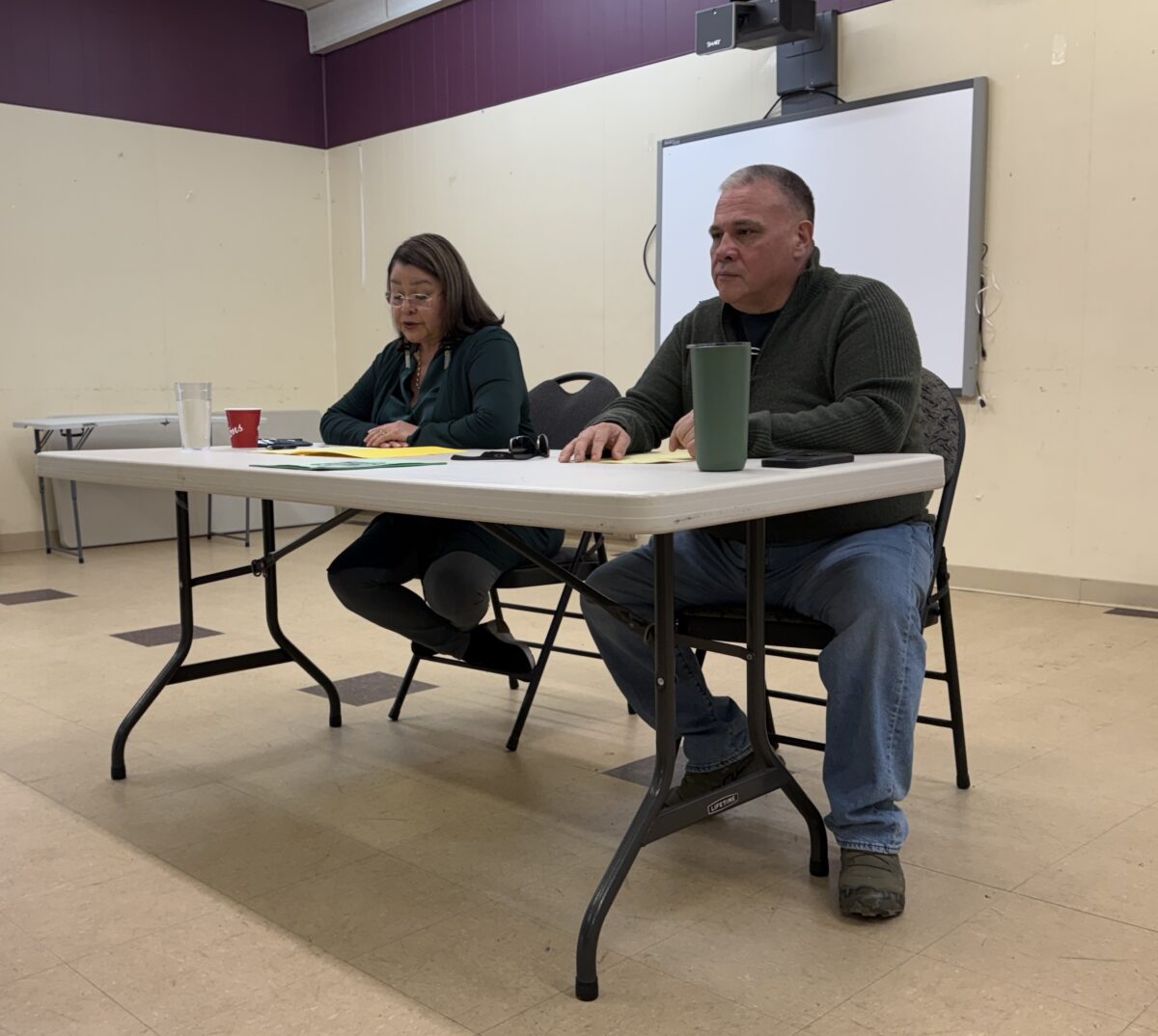
MCK chief Serge Otsi Simon dismissed claims that Council is clinging on to power.
“We’re going by the code, as imperfect as it might be,” said Serge.
“Honestly, I don’t care if the election is in June, July, or September. I don’t care as long as we have our election according to the code,” he said. “I have nothing to gain except what, a month and a half in that place, in the worst time of the year for our community, in the middle of summer? Give me a break.”
He suggested the proper recourse for the group opposing a summer election is the Federal Court.
“Take it to court and we’ll meet you there,” he said. “I’m sure the courts will want to hear us on an emergency basis. I’m confident this Council is going to walk away with a favorable decision that we did the right thing, and we did follow code.”
MCK chiefs Brant Etienne and Amy Beauvais both said they believe clause 12.22, “Election Day shall be on the second Saturday of June, as set by the Mohawk Council, unless an early general election is held pursuant to sub-para. 8.2, or a by-election is held,” shouldn’t be read in isolation, as 8.2 refers to 12.22.
Clause 8.1 dictates a four-year term unless 8.2 applies. Clause 8.2 reads, “Where the Mohawk Council of Kanesatake was elected pursuant to an early general election, the term of office is extended to the next Election Day set out in para. 12.22, unless another early election is called.”
Etienne said Council first sought legal guidance on the length of the mandate to gain a better understanding of their timeline to enact the Kanesatake Law-Making Process and pursue community laws.
He said he believes the emphasis on the June date flows from a biased interpretation of the code.
“I understand their argument, but I would say a lot of Amanda’s assertions are based on a reading of the electoral code with a particular motivation,” he said.
Beauvais said she objects to the way some people’s names have been included in Facebook posts, saying that the MCK communications staffer was harassed on platforms to the point of deactivating accounts.
“I understand (Amanda) did mention she doesn’t claim or condone any violence or any such actions of harm, however the very harassment and threats she claimed to disapprove of are what follow suit following her posts,” said Beauvais.




On social media, Amanda said she was simply pursuing transparency.
Amanda has acknowledged problems with the code, about the only thing all parties seem to agree on.
“I think I’ve said it before, the code is far from perfect,” said Amanda. “I refer to it as swiss cheese. I don’t believe it was vetted by a lawyer to close up the clauses in order for it to be a true document and something that would be standing up for the community of Kanesatake.”
She said she believes this election is likely to be in the hands of lawyers before all is said and done.
“Unfortunately, the Council members have been taught the colonial way. We’ve been well taught, haven’t we? We act just like them. So, it’s unfortunate, but it’s the truth,” she said.
Clifton Ariwakehte Nicholas, who co-hosted the press conference and has been advocating for elections alongside Amanda, read out several clauses he believes were breached by Council stemming from the election debacle, beginning with the code’s commitment to the will of the people.
“Fundamentally, it’s our authority that is the authority that is supposed to be followed in the community. We pick leaders that have to adhere to the code that we put out there,” Nicholas said before reading out clause 2.1: “The Participating Majority of adult Members are the final authority in all matters pertaining to all Kanehsata’kehró:non and their Territory.”
“Here we are almost on the verge of having a fight in our community on this issue, which is simply an issue of cooperation and listening to the people,” Nicholas said, accusing the chiefs of letting their positions get to their heads.
Community member Bernard Gabriel Ferland, who said he’s not a very political person, said he wanted to come out to participate and hear what others had to say.
“I’m in total agreement with everything that was said,” he said following the press conference.
“If no one’s going to say anything, the Council’s just going to continue to do what they want to do with zero accountability and zero having talked to the community,” he said. “We’re the ones that tell them what to do. We are the ones that should be in control of how the Council should be running. And they’re not doing that, they’re not talking to the people. They’re staying amongst their five and they’re all discussing amongst themselves. That’s not a census of what the community wants.
“I understand there were extenuating circumstances that they had to extend, but at the end of the day, that four-year term ends on June 14, or that’s supposed to happen. We can’t continue to extend it to fill their four-year gap so they can be eligible to run. It doesn’t work. They have to be out. They have to be gone now.”
A major consideration in the conflict is the rule, enacted in 2015 with the Custom Electoral Code, that only those who have served a full Council term can run as grand chief. Since this is defined as four years, that would seem to suggest first-term chiefs would not be eligible for the top job if an election were held June 14.
Sign up for email updates from The Eastern Door
Online voting
Council confirmed its intention to use OneFeather, an application already in use in other First Nations in Canada, to enable online voting in the upcoming MCK elections.
The Custom Electoral Code outlines voting procedures, including in person and mail-in ballots, but there is no mention of online voting in the code, a fact seized upon at this week’s press conference, during criticism of an online MCK public opinion survey on the matter after it was already announced.
“Let’s remind everyone online voting is not part of the 2015 electoral code. This is not consultation, it’s damage control,” Amanda said.
Etienne said he believes new voting mechanisms are in line with the code, even if not explicitly mentioned.
“In 2015, I don’t think anybody at that time would have even imagined online voting would be a thing, but it does fall within the spirit, which is that Kanehsata’kehró:non should be given every opportunity feasible to voice their opinion on who they want to sit in positions of governance. I think online voting serves that purpose,” he said.
“It’s not in the electoral code, but I think they’re just trying to modernize the election,” said Gabriel Ferland, adding that he feels it’s a way for Serge to garner votes from community members who live outside Kanesatake.
Serge said he has not decided whether he will run.
The signing of a contract with OneFeather was first reported by The Eastern Door in September.
Marcus Bankuti, Local Journalism Initiative Reporter