Montreal says Every Child Matters

Thousands of people took to the streets of Montreal on Monday, dressed in shades of orange to commemorate the lives of Indigenous children sent to Residential School.
“Today we’re creating a brighter future. Today, tomorrow, and every day,” said Jeremy Dutcher, who is from the Tobique First Nation, quoting a poem by Passamaquoddy elder Maggie Paul, translated in her language.
“Every child matters,” Dutcher said, looking towards two small children seated at the front of the crowd. “Including you.”
Dutcher then sang an honour song for the crowd, who were gathered in front of the George-Étienne Cartier monument in Montreal before the march kicked off on Monday morning.
The march was organized by the Native Women’s Shelter of Montreal and Resilience Montreal, in association with Pop Montreal and the David Suzuki Foundation. The David Suzuki Foundation had sent out letters to 80 Montreal schools in preparation for the event, and had offered to arrange for buses and snacks to encourage more youth from schools to attend.
But since the day was a mandatory attendance day in Quebec schools, it seemed that the Foundation’s offer wasn’t able to facilitate school-age children’s attendance. The Native Women’s Shelter told The Eastern Door after the march that they estimate around 2,000 people attended this year.

Na’kuset, the organization’s director, said that it’s disappointing to see dwindling attendance – the first year of the march had around 10,000 attendees – and that it’s imperative more people show up to make clear to the government that action needs to be taken.
“The fact that the government doesn’t actually implement the Truth and Reconciliation Committee (TRC) calls to action is really hurtful, but if we have enormous amounts of people to show up, that’s going to push the government to work on this,” Nakuset told The Eastern Door before the march. “If our generation can’t do it, I’m hoping that the next generation is going to pick up the fight.”
Kahnawa’kehró:non Kevin Deer, who also spoke before the rally, told The Eastern Door it’s essential that youth hear about the truth of Canadian history.
“The youth have got to be here as much as possible, so that people have an opportunity to hear, engage, and be a part of this,” he said. “It’s not just all of the atrocities that have happened, we’ve also got to talk about right now, and where we’re headed down the road. It’s up to us to figure out what we can do to make it better.”
Crowds marched down Park Avenue towards Sherbrooke, before turning and coming to a pause outside the front gates of McGill University.
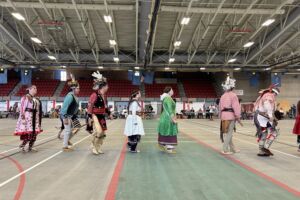
There, Alex McComber, Kahsennenhawe Sky-Deer, and Katsi’tsakwas Ellen Gabriel gave speeches, and community member Barbara Diabo performed a hoop dance.
“We need a solution, rather than the colonial laws that protect the genocidal maniacs that we have had to deal with as Indigenous people,” said Gabriel.
“We’re being left as a footnote in history in your children’s curriculum. And we’re not footnotes in history. We’re human beings, with a right to self-determination and a right to human rights.”
Sky-Deer said she was energized by the sea of orange filling the street.
“You feel in your heart the connectedness that we all have with each other as Onkwehón:we and our allies, our non-Indigenous brothers and sisters who are standing here with us because they want to see a difference in this country,” she said.
Elena Tresierra-Farbridge was one non-Indigenous attendee who said they were proud to continue attending the march year after year.
“I find that generally colonial countries want this stuff to go under the rug, they want it to be a big thing for just a second and then fade away,” they said. “I feel like it’s important as an individual, if you care, to keep showing up. It makes a huge difference that people see that it happens, see the orange shirts, see the numbers.”
Sign up for email updates from The Eastern Door
They said it’s especially important fellow Canadians realize the ongoing injustices faced by Indigenous people and acknowledge the recency of the residential school system.
“People forget that it might’ve been a shocking news story, yes, but it’s a real thing,” they said. “It’s real peoples’ lives, and it’s real children.”
Crowds were particularly moved by a speech from Noella Mckenzie, an Innu residential school survivor, who spoke in French.
“I’m proud to see so many of us come here to remember what we’ve lived through. The residential schools where we lived. And today, I also say to myself, I’m proud to be an Innu woman who wants to know her culture, who wants to know her language,” she said, adding that now she teaches in her language, and is proud to share it.
“We must always give hope to the children of the future, so they know what we’ve been through.”