Sacred items returned by Vatican

Representatives including Ka’nasohon Kevin Deer and MCK chief David Diabo were amongst those on the tarmac to welcome the arrival of sacred items from the Vatican. More than 60 items were returned, headed to other Indigenous communities. Courtesy Assembly of First Nations
A delegation of Indigenous community members and leadership stood shoulder to shoulder on the tarmac of Montreal’s Pierre Elliott Trudeau International Airport last Saturday, ready to welcome home more than 60 items being repatriated from the Vatican.
The items, which have been held in the Vatican museums and vaults for the last century, were transported to the Canadian Museum of History in Gatineau, escorted by Peacekeepers, where they will be formally examined, followed by a public ceremony for the items in January held by the Assembly of First Nations (AFN).
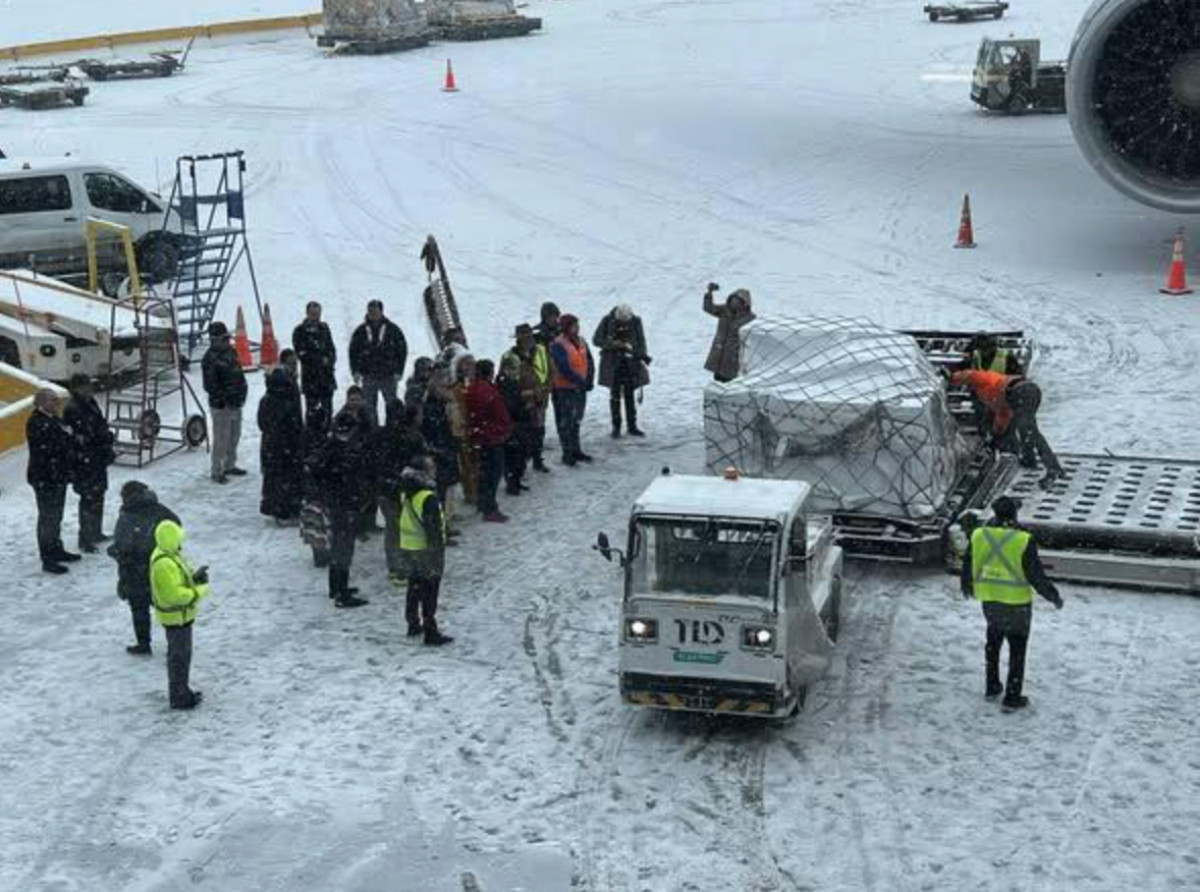
While none of the items are believed to be from Kahnawake, Kahnawa’kehró:non Ka’nasohon Kevin Deer and Mohawk Council of Kahnawake (MCK) chief David Diabo were part of the delegation present at the airport to receive the plane that had transported the items.
“This really is a historic moment. It’s a momentous occasion, this isn’t something that happens often,” said Diabo. “It was quite the event and everyone agreed that this is a historic moment that we really hope will be repeated in the future.”
While the exact stories of each item are not yet publicly known, at least 14 of the pieces are believed to be of Inuit origin, including a Inuvialuit kayak made of sealskin, sinew, and driftwood.

Diabo said Inuit Tapiriit Kanatami president Natan Obed told him at the event about how a museum was not yet finished that could one day store the kayak and other pieces in Nunavut, to which Diabo shared about Kahnawake’s soon to be ready Cultural Arts Centre, Kanatahkwèn:ke.
“I said, we have a brand new $56 million museum that could be a place to store it until they’re ready, and that we could consider that for them, and he was very interested in that,” Diabo said.
Due to the fragile nature of the pieces and the historical and cultural importance of them, it’s crucial that they be stored in strictly controlled environments, with special attention paid to environmental concerns like temperature and moisture.
The museum component of the Cultural Arts Centre will include a specially designed 600-square-foot collections room, which should make it possible for the community to preserve sacred items like the ones being returned from the Vatican.
“There’s artifacts that were stolen from First Nations, some were bought, some were traded, these things ended up all over the place, and now we can start to see if there’s some way to return some of these artifacts,” Diabo said.
Those present for the arrival of the items welcomed them with the laying of tobacco, words in their communities’ languages, and songs. Deer was one of the delegation who spoke and sung, welcoming the pieces to the territory in Kanien’kéha.


“To me, this is only the beginning, because there’s so many other artifacts at the Vatican and so many at museums all over the world that were essentially stolen, and they’re all going to start to come back to their rightful owners,” Deer said.
He said it was a profound moment to see the pieces unloaded from the plane.
“All of those things in my view have a spirit. You could acknowledge the love that people had to make those things, and some of them are 100 years old, so you think about what knowledge they carry, how they were crafted and made,” Deer said.
“It was history that was being made, and I looked at it as something to be proud of.”
The Canadian Conference of Catholic Bishops said that the return of the 62 items was a wish of Pope Francis before his passing in April of this year. It was under Pope Francis that the Catholic Church apologized in 2022 for the trauma inflicted through the residential school system.
Archbishop Richard Smith, a member of the organization, categorized the repatriation as “an act of reconciliation,” calling it “a sign of renewed relationship and mutual respect between the Church and Indigenous Peoples.”
Sign up for email updates from The Eastern Door
AFN national chief Cindy Woodhouse said she hopes the return from the church can set an example of how to respectfully repatriate Indigenous items.
“Our relatives are finally home. For First Nations, these are not only artifacts. They are sacred, living items. My thoughts are with all the Elders and First Nations that have made the efforts to bring them back to our traditional territories,” she said. “Today is an important moment, but it is far from the end.”