Mohawk Mothers sound alarm
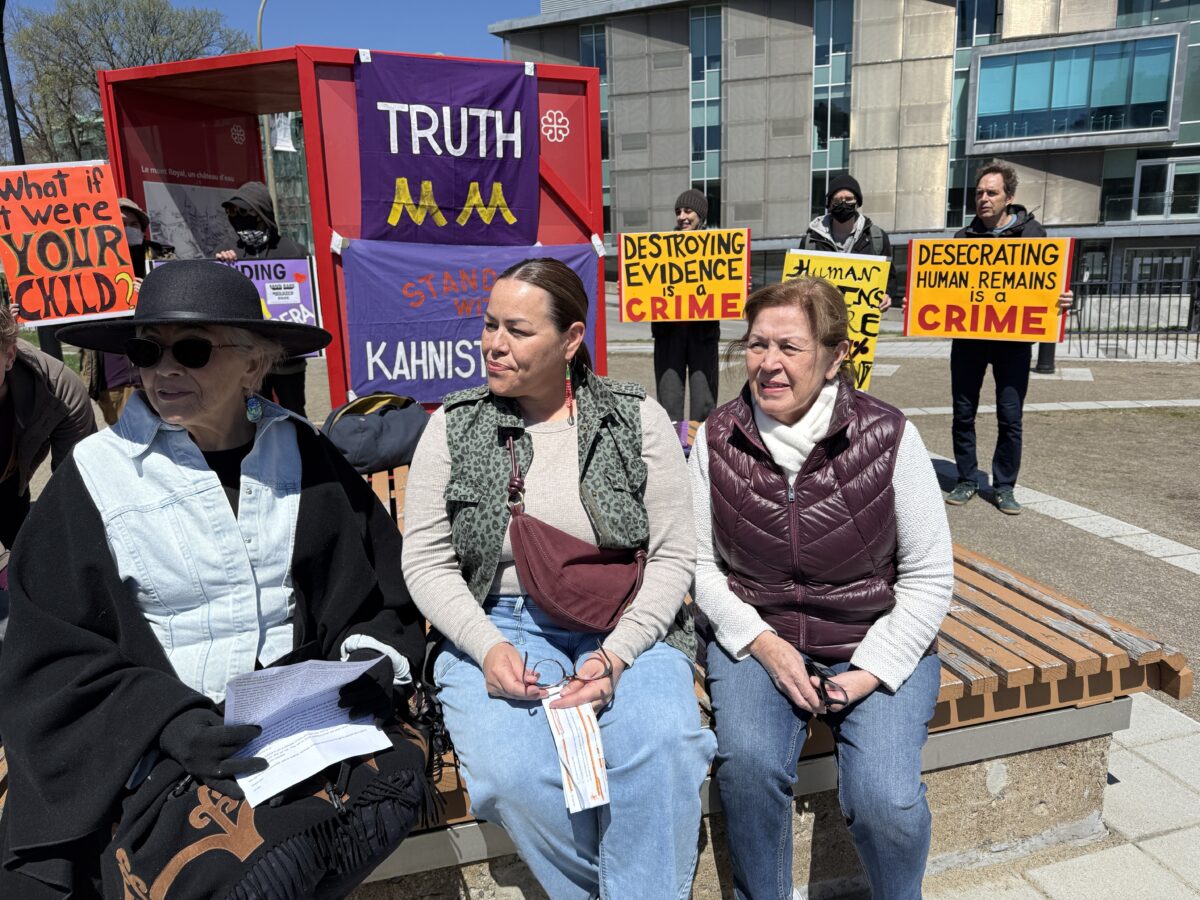
The Kanien’kehá:ka Kahnistensera, also known as the Mohawk Mothers, continued to fight against McGill University, despite setbacks in the courtroom. Marcus Bankuti The Eastern Door
Following setbacks in court, the Kanien’kehá:ka Kahnistensera are seeking help from the Coroner’s office in their fight against McGill University after obtaining a report they say reveals new evidence of human remains around the former Royal Victoria Hospital site.
According to the Kahnistensera, also known as the Mohawk Mothers, an S4 Subterra Grey probe has supported the presence of human remains at the one location where it was used, near the Allan Memorial Institute, combining with two other lines of evidence to create a compelling case for a more exhaustive search of the grounds.
“Despite what McGill has been stating publicly since the beginning of this investigation, in a denialist attempt to hide their history of criminal experiments and abuse against our people, we have been informed that undeniable evidence of human remains has now been discovered,” said Kahentinetha, one of the Kahnistensera, at a press conference held Wednesday afternoon in sight of a towering orange crane at the former Royal Vic site.
The archaeological report that is said to be the source of this information, commissioned by the Societe quebecoise des infrastructures (SQI), was completed February 2025 and was not provided by the university or the SQI to the Kahnistensera, who decried the colonial organizations for not announcing the findings.
However, in response to an inquiry from The Eastern Door, the SQI insisted there is nothing that changes the status quo.
“To date, there is no evidence to confirm the presence of burials, despite research conducted in all the areas of interest identified in the archaeological research plan,” said Anne-Marie Gagnon, spokesperson for the SQI. “The implementation of the archaeological plan is therefore continuing, in accordance with the recommendations of the Panel of Archaeological Experts.”
The Eastern Door has not viewed the report, which the Mothers said was produced by Askîhk Research Services, an archeological firm specializing in culturally-safe searches for unmarked burials of Indigenous children.
Since that report was finalized, construction work has continued on the New Vic project, an $850 million revitalization of the site, which once housed the Allan Memorial Institute psychiatric facility.
According to McGill, the New Vic project represents less than 15 percent of the site and the report in question pertains to a portion under the purview of the SQI, a provincial entity tasked with the “adaptive reuse” of the former Royal Victoria Hospital.
In the 1950s and 1960s, the Allan Memorial Institute psychiatric facility was used for human experimentation, including on Indigenous patients, as part of a US Central Intelligence Agency (CIA) mind control project known as MK-Ultra. A survivor of the facility, Lana Ponting, has testified to abuses against Onkwehón:we there and expressed her belief that there are Indigenous victims buried at the site.

Marcus Bankuti The Eastern Door
McGill has repeatedly argued it is conducting investigations according to a settlement agreement with the Kahnistensera, even as it has fought the group in court every step of the way, securing the right to continue excavations and most recently winning an appeal that squashed a ruling regarding the enforceability of the settlement agreement, a decision the Supreme Court of Canada declined to revisit.
“We’re being handled in a manner that is not just,” said Kwetiio, one of the Kahnistensera.
The Mothers said their observers have watched helplessly, the smell of decomposition hanging in the air, as excavations at the site destroyed evidence in areas identified by human remains detection dogs, desecrating bone fragments that were never analyzed.
“McGill and SQI let the piles of soil rot under the sun and the rain for three months before putting the soil in trucks to move it out of the way of their development project,” said Kahentinetha. “They ended up sifting the piles with a huge mechanical machine used for mining and which is never used in archeology.”
She said the bone fragments found, more than 100 of them, were deemed too small by the university to identify their origin visually and were not examined at a lab.
A press release from the Mothers cites Kanien’kehá:ka archeologist Lloyd Benedict in asserting that damage and destruction of bones would have ensued from the operation.
“I think in the very, very beginning of us putting our hand to paper and making our voices heard, before it’s too late, before the shovel hit bones, we need to make sure this site is properly honoured and this investigation goes to plan,” said Kwetiio, arguing the university has spurned an agreed upon protocol.
The report obtained by the Kahnistensera pulls together the combined results of human remains detection dogs, ground-penetrating radar, and, most recently, the S4 Subterra Grey probe, they said. According to the Mothers, the conclusion of the report reads “the combination of three separate lines of evidence supports the presence of human remains” near the Allan Memorial Institute.
Further, they said, the report asserts that because the potential burials are likely less than a century old, the situation requires forensic investigation.


This is the basis of their outreach to Quebec’s Office of the Coroner, specifically in a letter this week to the deputy chief coroner of Montreal, Géhane Kamel, whose report on the death of Joyce Echaquan identified systemic racism as a contributing factor.
The Legault government has continuously refused to acknowledge systemic racism in Quebec, even amid the fallout after the death of Echaquan, an Atikamekw woman who livestreamed her racist treatment from nurses at a Joliette hospital in the moments before she died in 2020, sending shockwaves throughout the province.
“There is a duty for any person to report to the coroner when human remains are discovered that resulted from violent or unknown circumstances,” said Philippe Blouin, an anthropologist who has long assisted the Mothers in their fight.
“So this is the avenue that is taken now because this coroner in particular has worked with Indigenous folks in the Joyce Echaquan case and has shown sensitivity to collaboration and to issues of systemic racism.”
Blouin said the Mothers requested that a joint team be tasked with the work, with Kanien’kehá:ka experts taking part.
“The hope is to have a credible investigation, objective, that is not just pressured by construction work, by financial interests, but that seeks the causes of the death of the human remains that are present on the site,” said Blouin, who expressed hope this strategy could yield justice in a way the courts have been unable to do.
“There are huge gaps in the law to protect forensic sites like this, and this has been experienced from the start. Even if all the facts are in place and you show it, you can win, but then lose for another reason that’s unforeseen, that’s purely technical, that does not have a bearing on the actual needs on the ground. Here it’s an emergency situation where there could be anytime excavation in that zone, and it has to be protected forensically,” he said.
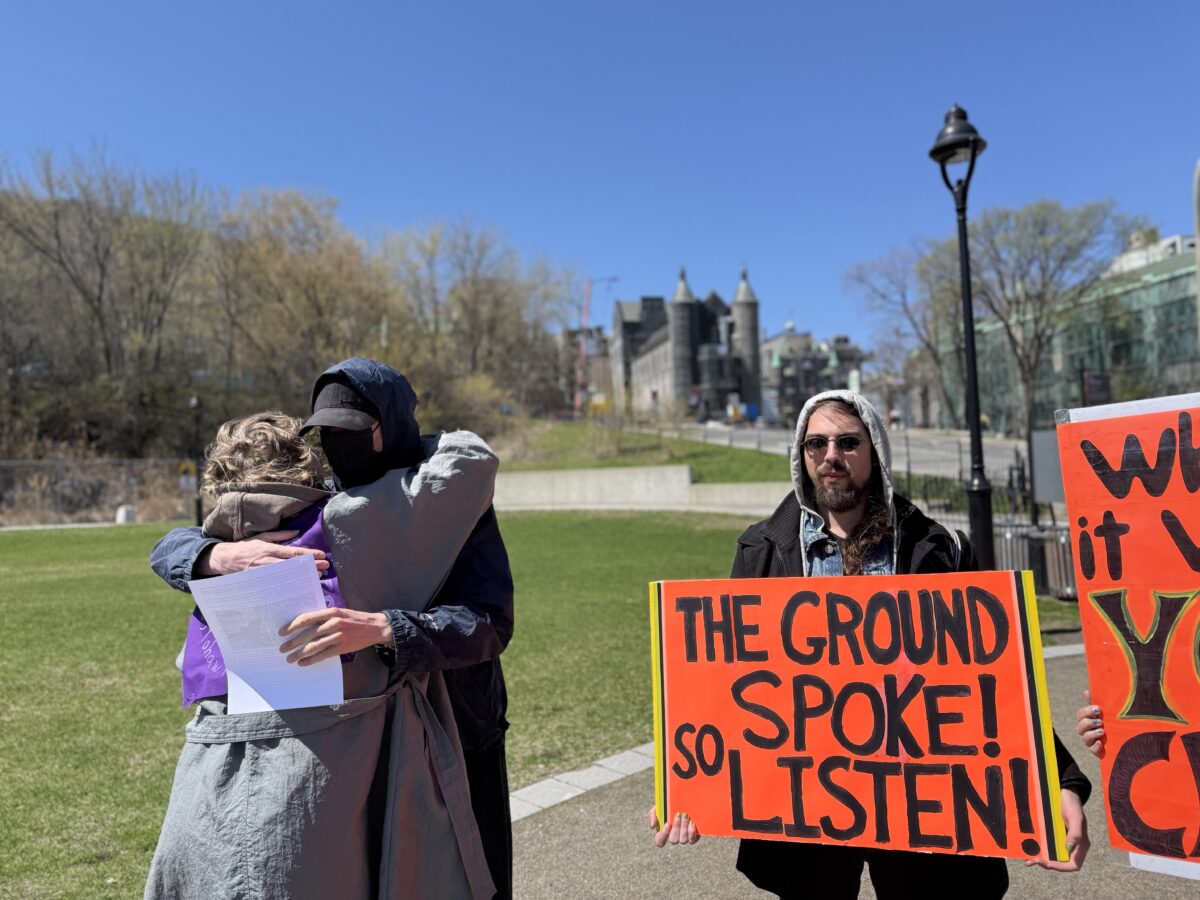
The press conference was flanked by a handful of supporters carrying signs. McGill students were among those who turned out in support.
“I think as McGill students, it’s really important to recognize that the land McGill is built on is unceded land, and they’re not recognizing that in their actions as an everyday university and also in their actions with the New Vic project,” said Tamara Ghandour, a third-year science student at the university.
Ghandour also objected to McGill’s decision to fight the Mothers in court and said it has been difficult to witness their university continue to perform work at the contested site.
Sign up for email updates from The Eastern Door
“It’s really horrifying,” they said. “I walked by here very often last year. Someone had taped up an outline of the word truth on the gate. Every time I passed by it, it made me really emotional because that’s literally what McGill is doing, hiding the truth.”
The university’s comments, which were to be attributed only to McGill University itself, echo those of the SQI.
“Since work on the New Vic project has been launched, no human remains, or unmarked grave indicators of any sort have been found,” said McGill.
“As we move forward with our project, McGill University will continue to follow and abide by the Settlement Agreement of 2022. The settlement provided a framework for McGill, the Societe quebecoise des infrastructures, the Mohawk Mothers, and other parties to monitor archeological work on the old Royal Victoria Hospital site. McGill has respected the spirit and the letter of the agreement since its inception.”
The Kahnistensera disagree.
“This is to be Indigenous led, and we’ve been left out of the investigation,” Kwetiio told The Eastern Door. “I think they thought we were just going to be happy having a presence and watching them dig. No, that’s not enough. That’s just a show. That’s all they wanted from their part.”
According to Blouin, the Kahnistensera are continuing to pursue elements of a fight against McGill in the courts, with case management coming up in June.
Marcus Bankuti, Local Journalism Initiative Reporter