Minister pledges plan on crime surge

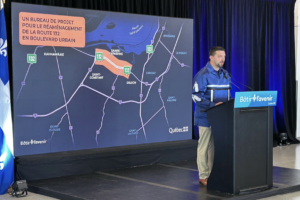
Indigenous relations minister Ian Lafrenière, who is now also the minister of public security, speaking at a press conference in 2023. File photo
The province will soon announce a strategy that is set to help confront organized crime that has taken root in First Nations, Quebec’s minister of public security and Indigenous affairs told The Pines Reporter.
While the minister, Ian Lafrenière, assured these plans will be revealed in the coming weeks, he provided few details about what the strategy will entail. However, he signalled he is well aware that Kanesatake is facing an increasingly challenging public safety situation.
“I do understand community members, why they’re writing me, asking that we do something, because I can’t imagine raising my kids in an environment like that. This is not easy,” said Lafrenière.
Just in the past couple months, The Eastern Door has documented the shooting of a local man in his own home and the subsequent arson of his garage, an attack in the parking lot of Triple 7 Casino that resulted in the arrest of two teenagers, shots fired at the facade of Jackpot Casino, and the arson of a car on Center Road.
As the community knows too well, these issues are nothing new. After all, it has already been nearly three years since an anonymous group of Kanehsata’kehró:non sounded the alarm on a countrywide scale about an icy climate of fear pervading Kanesatake.
Lafrenière, a former police officer, spoke out at that time in a previous interview with The Eastern Door, telling readers he worried that organized crime could seize on political turmoil in Kanesatake - something like the cancelled August 2025 election, which is yet to be resolved at Federal Court, only contributes to difficulties, he suggested.
“I’ll be honest, it’s hard to do anything because of this instability,” Lafrenière said.

However, First Nations across Quebec are being targeted, especially since the COVID-19 pandemic, and a province-wide solution is what’s needed, the minister said.
“I’ve been speaking out loud for three years, at least, that organized crime was coming. Because of my police knowledge, I noticed that bikers were present in different communities, doing PR, being just present. This is normally the path, investing and being present in communities,” said Lafrenière.
“Unfortunately, I was right. We do see this now. This is a very problematic situation for a community like Kanesatake. I do understand people fearing for different reasons. I receive messages myself.”
He said organized crime groups try to attract people and entice communities with investment before turning the screws.
“Just lately, Côte-Nord - Sept-Îles, Baie-Comeau - we saw a huge presence because of the control of narcotics and also for extortion in businesses. Yes, this is a situation that we see across the province, and specifically in Indigenous communities,” said the minister.
Lafrenière is a familiar face for First Nations in Quebec, serving as the Indigenous relations minister since 2020. In 2025, he was also put in charge of the Ministry of Public Security, which he has cast as an opportunity to advance the work he’s been doing for years.
“I’m already quite involved with Kanesatake and now as the minister in charge of public safety, I get the two hats, so this is the perfect situation to do things differently,” he said.




Late last year, Lafrenière convened a gathering of leaders from several Innu communities to talk about how to confront organized crime. He also recently sponsored Bill 13, which, among other things, would make it illegal to display logos or patches associated with organized crime groups, such as that of the Hell’s Angels.
“Soon, I’m talking about weeks now, I will do another public announcement about a strategy that will be put in place because, as you know, yes, Kanesatake is a target for organized crime, but this is not the only community. All communities now are targeted by organized crime,” he said.
He noted that work is being done by police even when it’s not evident - often in Kanesatake, cases are closed before they even begin, with police citing uncooperative victims who don’t want to file complaints. This was recently the case when shots were fired at Jackpot Casino.
“We gather a lot of intelligence. It’s not because you don’t see the police presence that police are not doing anything about it and that we’re not gathering intelligence and doing investigations,” Lafrenière assured.
However, with organized crime already entrenched in many First Nations in the province, any solution will take time, he said.
“You’re going to see a good scenario that’s going to be helpful. But again, let’s be honest, it’s not going to be over in one night like that. It’s going to be a lot of work, a lot of effort, because it’s a tough situation,” he said.
Despite the challenges, he suggested there is reason to be optimistic.
Sign up for email updates from The Eastern Door
“We’re going to put in place the right tools to start changing the wheel that is going the wrong way now,” he said.
Marcus Bankuti, Local Journalism Initiative Reporter