Former land manager under investigation
File photo
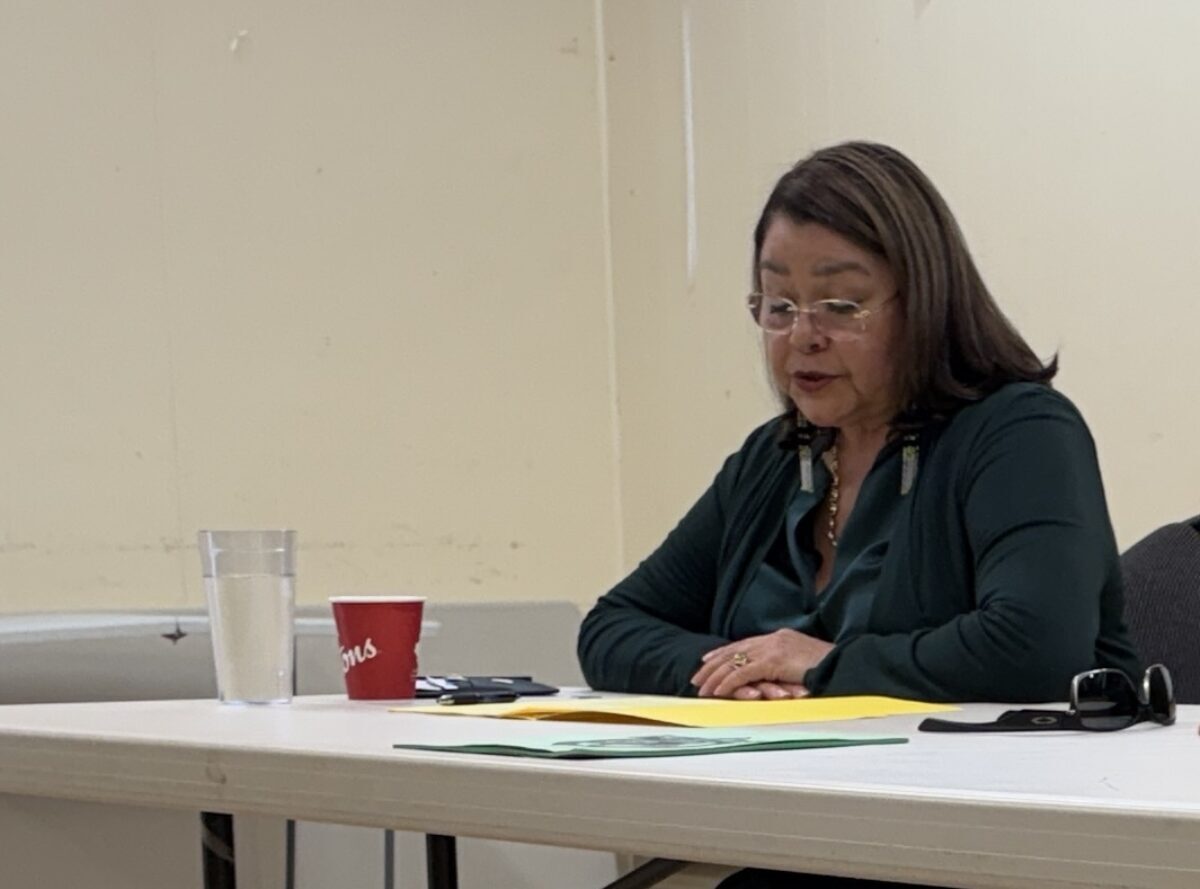
The former Mohawk Council of Kanesatake (MCK) land manager, who has positioned herself as the candidate of ethics and transparency in the stalled MCK elections, has come under fire after an anonymous letter detailed allegations that she abused her office for personal gain.
The Eastern Door has learned that a criminal complaint pertaining to practices at the MCK Lands Office under her tenure is expected to be submitted by Surete du Quebec (SQ) investigators to the office of the director of criminal and penal prosecutions (DPCP), which will analyze the case and consider whether charges will be filed.
Many community members have privately wondered whether the anonymous letter mailed out a couple of weeks ago levelling allegations against Amanda Simon, who held the post of land manager for about 15 years until she resigned in 2024, has merit.
The mysterious document was mailed to local addresses, some reportedly outdated, and delineated 16 land transactions involving Simon and/or her son Jake Guindon, some of which touched on related lots. It also includes email excerpts to back up an allegation that Simon orchestrated a rigged auction in April 2023.
Simon has publicly dismissed the letter as baseless, pivoting to what she characterized as a breach of personal information entrusted to the band office.
“Obviously it’s an inside job where somebody has access to the mailing list, and it’s obvious somebody had access to emails,” Simon told The Eastern Door.
“I’m not participating in a smear campaign where I did absolutely nothing wrong, and if their only aim is to get me off the ballot, I wish them luck.”
She emphasized in a statement, as she did publicly, that all agreements she entered into were with willing sellers.
However, Simon seemingly admitted in a call with The Eastern Door to the letter’s central revelation that, as certified land manager, she apparently facilitated a private auction for two pairs of two lots on Kanesatake Mohawk Territory in Oka Village, then owned by Eric Nelson, and used knowledge of these bids to acquire the properties for herself.
Asked who was informed to be able to participate, Simon said it was “the regular suspects of who can afford that kind of land.”
In a written comment to The Eastern Door in the days following this interview, Simon continued to argue that nothing untoward was done.
“The allegation that I manipulated bids in land sales is patently false. The bidding process for the so-called ‘Indian village’ lots was not administered by me - it was called and run by the property owner, Eric Nelson. I had no authority over that process. To mischaracterize those sales as misconduct is both misleading and defamatory,” she wrote.
Emails included in the anonymous letter demonstrate that Deborah Rennie and Russell Denis bid a combined $135,000 for the lots - $115,000 for one set and $20,000 for the other - in an email addressed to Amanda Simon, with Simon’s assistant at the time, Paige O’Brien, and incumbent portfolio chief Brant Etienne in copy.
Simon subsequently sent an email requesting that her matching bid be accepted. This email appears to be sent in a reply to Rennie with the same people in copy and then forwarded to Nelson, the properties’ owner at the time.
Simon objected to a premise in one of The Eastern Door’s questions in the call that if she were conducting an auction by virtue of her job, that her purchase was, owing to her knowledge of the bids, secured at the best possible price.
“It wasn’t the best possible price,” she interjected. “If you want to talk to anybody, I paid very good money for that, and I doubt anybody in this community would have been able to do the same.”
Challenged about whether using the information in the auction would not be a conflict of interest in acquiring lands privately, she said, “I didn’t think so. It wasn’t my intention at the time.”

She repeatedly denied that this situation represented a conflict of interest.
“It was done on the up and up. There’s absolutely no conflict of interest at all. At the end of the day, it’s between the seller and the buyer,” she said.
She later said, “If I had wanted to buy those lands outright from the very beginning, even before putting it on auction, I would have done that. The only thing that I was doing was proving to the guy that I was giving him a really, really good price.”
She later transferred the lots to Guindon, her son. The transfers cited in the document are backed up by public records that have been verified by The Eastern Door.
Simon is among those in the community named most frequently on parcel abstract reports. While some of the lots she has possessed, as she pointed out in a restrained public response, were passed down by family, there were other transactions that occurred while Simon was land manager.
The acquisition of lands, of course, is not illegal. However, aggressive land purchasing and questions about whether her office was used inappropriately to advance her own family’s holdings have raised concerns in Kanesatake, where virtually every issue can be boiled down to the land and its scarcity after hundreds of years of colonial land theft.
“I started looking to purchase a lot to build a house on (over a decade ago) because we have access to a subsidy to help out,” said a single parent, who spoke on condition of anonymity and will be referred to by the pseudonym of Alex.
Alex said they occasionally inquired about the availability of land to Simon. “During that time, I was always told that there was no land for sale,” Alex said.
They moved their family around to multiple residences within the postal code that is shared by Kanesatake and Oka.
“Having to move four times is extremely taxing and stressful and anxiety-inducing,” Alex said. “Being a single parent, and my children are younger, I had to hire movers. It was super expensive.”
Eventually, Alex made the hard choice to give up on settling on the territory. When their kids were younger, they attended community gatherings and were exposed to the language, but things changed with distance.
“As we moved further and further away, that slipped,” Alex said.
The children became more interested in life off the territory, with their non-Indigenous friends, than being close to Kanesatake.
“Had it been a lot and our house that we built, it would have been a different story,” Alex said.
As for people’s feelings that they have been locked out of purchasing lands because of their scarcity and a lack of opportunity to participate in buying them, Simon said that’s the way it’s always been.
“That’s life, and it’s been that way since the beginning of time,” she said. “There’s nothing new there, and that’s why we have people like Joshua Gabriel (who owns Big Chiefs), who puts in neon lights that he’s willing to buy any land, anytime, anywhere.”
Contacted by The Eastern Door, Gabriel said he only had positive dealings with Simon when she was in the position of land manager.




“I’ve got nothing bad to say about her. She’s always been an upstanding person to me,” Gabriel said.
“I’ve had dealings with her myself, and she’s always been professional with me, so I don’t know what to tell you about anybody else’s statements,” he said.
Gabriel acquired land from Simon a few years ago that had been in her family for many years and obtained other land while Simon was in her position, and he told The Eastern Door she would alert him to potential land available to buy.
He said that while he saw her as representing an extension of the federal government in her band council role, whereas he sees himself as traditional, she’s always been respectful and professional in his experience.
Simon objects to the characterization of her conduct as land manager as underhanded.
“There has never been a finding, judgment, or ruling by any court, commission, or authority to support these accusations,” wrote Simon in a comment to The Eastern Door. “No complaint with legal merit has ever been filed against me. This is why I say the letter has no legal foundation - it exists only as rumour and innuendo, spread anonymously because those behind it know it would not withstand scrutiny in any legitimate forum.”
Asked to explain the professional standards for First Nations land managers when it comes to the acquisition of lands or the facilitation of purchases, Leona Irons, the executive director of the National Aboriginal Lands Managers Association (NALMA), was reticent to comment, although she did say it is common for land managers to help their community members by connecting buyers and sellers.
“The land manager code of ethics is like any other profession, and that’s all I can say, and if there’s no proper policies and procedures in place for all employees working (at a band office), that’s the fault of the leadership to make sure to have those kinds of things in place,” she said. “Sometimes that just doesn’t happen in a lot of cases.”
The Mohawks of Kanesatake Land Governance Code addresses conflicts of interest for members of the MCK, including not only elected chiefs but also directors of programs; Simon managed the small lands department.
Section six of this code outlines that in the performance of their duties, these officials must avoid conflicts between their personal interest, whether financial or otherwise, and their duties.
The anonymous letter points to the Criminal Code, which establishes in Section 122 that a breach of trust in the course of a public official’s duties is an offence, even if the action would not be an offence if it were committed in relation to a private person.
It is unclear whether this section is applicable to the allegations at issue. However, the Department of Justice confirmed that it would be up to a judge’s discretion to determine whether this section of the Criminal Code could apply to band councils, including department heads, depending on the specifics of the case.
A criminal complaint against Simon has been lodged by the Mohawk Council of Kanesatake, incumbent Council chief Brant Etienne confirmed.
According to Etienne, the decision to pursue a criminal complaint was made last year following Simon’s resignation. The decision was voted upon and logged in the minutes of a Council meeting, he said, although he said he does not currently have access to Council resources to access these due to the ongoing governance issues following the cancellation of the August 2 election.
However, The Eastern Door has learned independently that this file is slated to be sent to the DPCP.
“It was very clear there was an issue there. It was very clear that something was wrong,” said Etienne, who said the auction situation raised alarm bells at the time, but that it took time to get clear answers on how to deal with it, especially at a tumultuous time for Council.
“This has been known for a long time by us in Council,” said Etienne.
Sign up for email updates from The Eastern Door
He said they have heard from community members who felt cheated by Simon’s aggressive lands practices.
“I think this is the opportunity for all those people to come forward and put it down as evidence to be investigated,” said Etienne.
The Eastern Door spoke with multiple people who also reported feeling cheated, but who refused, out of fear, to be quoted, even anonymously.
Simon has positioned herself politically in opposition to the incumbent Council chiefs known as the “quorum” - even holding a “pressure conference” in the spring to demand an election on the date outlined in the electoral code rather than at the end of the four-year term, also outlined in the code.
She has also been among the most prominent voices accusing the incumbent Council chiefs of a power grab for their insistence that they are a de facto government until a new election can be held.
She castigated the Council in an interview with The Eastern Door when she resigned from her position, saying she was offended by Etienne’s demand for a mandatory meeting and characterizing her salary throughout most of her tenure as unfairly low.
Etienne said Council was taking Human Resources action against her for a range of issues, and that Simon resigned rather than cooperate. This is part of the origin of the alleged debt that almost saw Simon removed from the ballot, which she has cast as a politically motivated attempt to nullify her candidacy.
In the days following the cancellation of the election, Graeme Drew, who had been tasked with administering the contest as chief electoral officer, told The Eastern Door that he continued to believe Simon’s name did not belong on the ballot based on evidence he has seen.
“I am not intimidated,” wrote Simon following a call with The Eastern Door this week. “First came a fabricated debt. Then a chief electoral officer publicly declaring I had no chance of returning to the ballot. Now an anonymous smear. Every attempt only reinforces the strength of my campaign for true governance in Kanesatake,” she said.
“I will not be silenced. I will not be intimidated. And I will not be removed by those who lack the courage to sign their own names.”
The election, which was cancelled on August 1 on the eve of election day, has not yet been rescheduled. A filing in Federal Court this week may provide further clarity, the subject of another story in this week’s issue of The Eastern Door.
Marcus Bankuti, Local Journalism Initiative Reporter