Lead found in Survival School sap
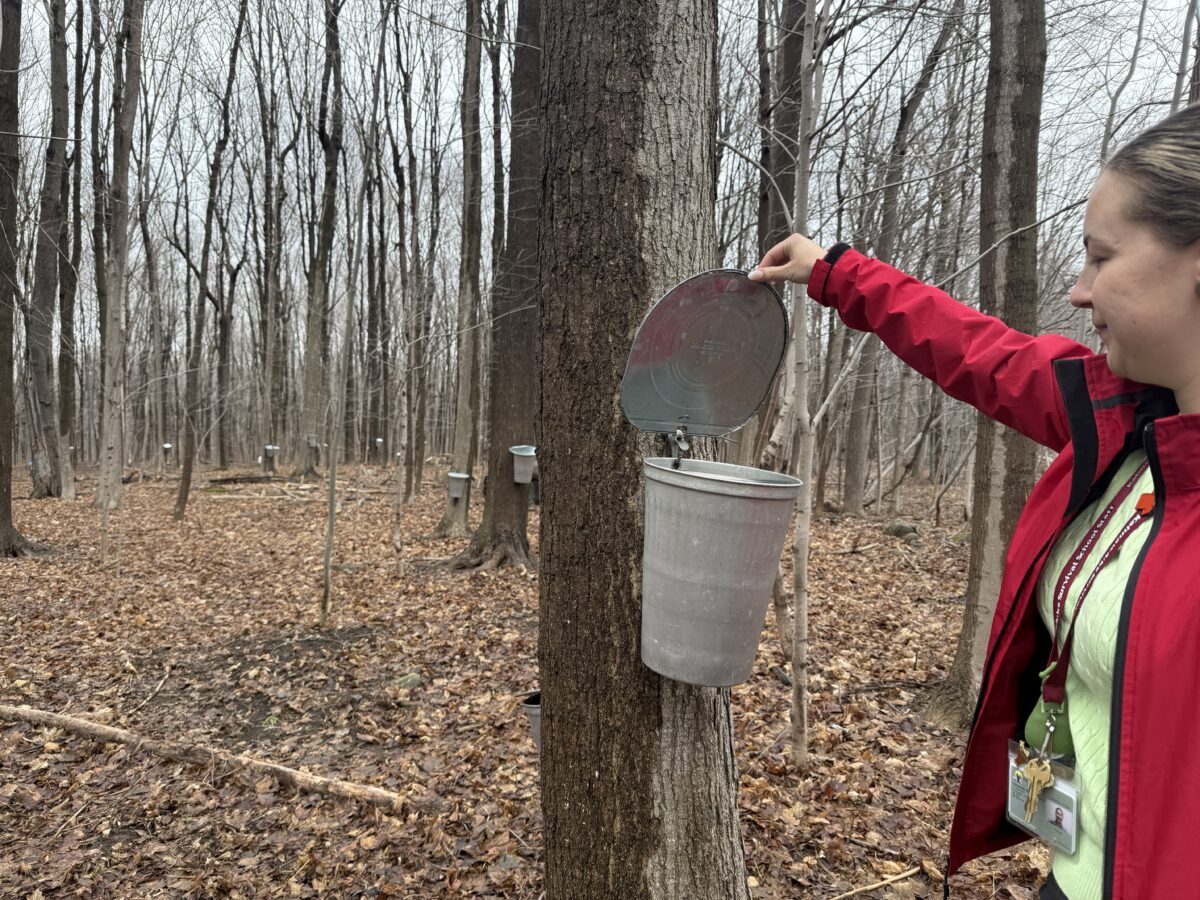
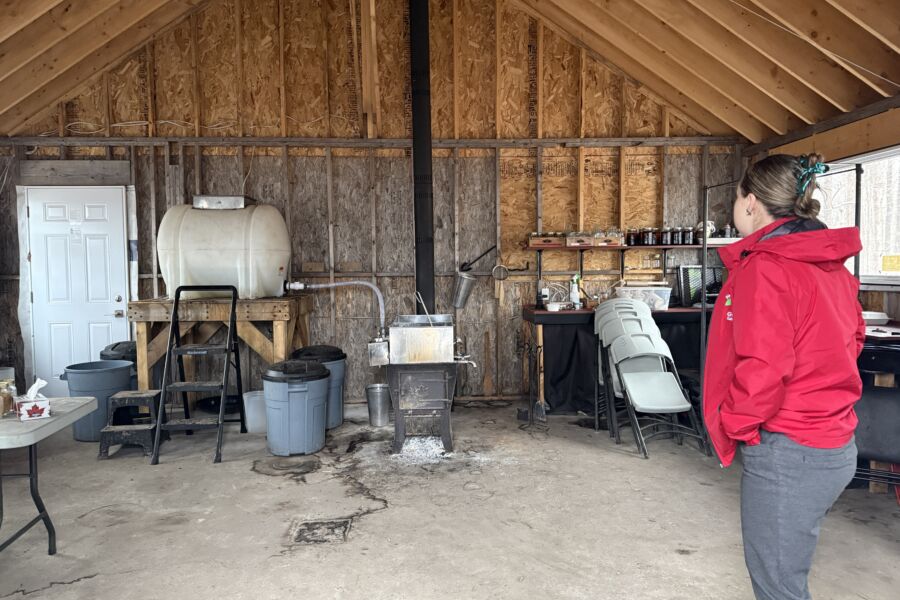
Kahnawake Survival School principal Sha’teiohserí:io Patton showed The Eastern Door the sugar shack and maple bush, following findings of lead contamination that prompted the shuttering of the school’s maple program. Marcus Bankuti The Eastern Door
As winter gives way to spring, members of the Mohawk Trail Longhouse express gratitude in ceremony for the maple trees - the Wáhta – that are so fundamental to Kanien’kehá:ka culture, a source of nourishment and medicine.
Just a 10-minute walk away, Kahnawake Survival School (KSS) students spend their weeks exploring their own school’s sugar bush, a serene maple forest in which the youth tap trees, collect sap, boil it down into syrup, and learn about the culture that binds them as a people. Kanien’kéha teachers lead classes through the same woods, teaching them the words that describe the wonders of the natural world.
“Sometimes, when the kids come out, they’ll go all the way down, and you can’t even see them - they’re just little dots,” said KSS principal Sha’teiohserí:io Patton. One of her favourite things is to watch students figure it out - tap the trees for the first time, work with the tools, try to get the spout in.
Last year’s students even made and sold their own maple candy to help fund their prom.
Everything changed last week, however, when the program screeched to a halt after alarming levels of lead were discovered in the sap that students harvest - and consume.
The maple program, in many ways, has been a manifestation of the school’s unique mission. It offers an opportunity for educators to combine cultural teachings with vocational skills, encapsulating the school’s drive to fortify Onkwehón:we values in the next generation, anchoring the students as they prepare to confront modern challenges. While the cause of the contamination is still unknown, to many the closure of the maple program is just the latest example of environmental turmoil and colonial interference disrupting Kahnawake’s efforts to fortify traditional practices.
“Historically, Kahnawake and a lot of other Native territories have always been placed strategically to be this environmental dumping ground,” said Patton.
“We have to come up with solutions when we’re the ones having this done to us. It’s very frustrating, but it also encourages me to inform and be transparent with the students, with the parents about that reality, about how there are opportunities in the future to move forward right and to combat the oppression and racism we face environmentally.”
With the announcement of the contaminated sap, parents are left not only to worry about the health of their children, but reminded when KSS had to be moved due to heavy metal contamination in the ground, for which the same industrial park in Ste. Catherine has been blamed.
The testing by the Kahnawake Environment Protection Office (KEPO) was undertaken due to increased fears of environmental contamination following the news that the Terrapure battery recycling plant, less than a kilometre from the high school, has been charged dozens of times under the Fisheries Act for allegedly dumping toxic water into the St. Lawrence River, followed by revelations about potential lead exposure at the plant.
The saga has led Mohawk Council of Kahnawake (MCK) grand chief Cody Diabo to call for the halt of all industrial activity near Kahnawake’s current boundary, and even on the entire Seigneury of Sault St. Louis, encompassing the community’s ongoing land grievance area.
“You have an entire industrial sector there that clearly Quebec doesn’t have a handle on, but even elsewhere, too. They just keep issuing permits like they’re candy at this moment,” said Diabo.
Terrapure’s permit was most recently renewed in 2025. The company did not provide comment on the maple sap finding, saying it has not received direct details, but that Terrapure takes environmental protection and community wellbeing seriously, adding it is committed to maintaining open dialogue with Kahnawake.
Environment Canada has still not agreed to meet the MCK directly, according to Diabo. The ministry did not provide comment by deadline.
“Right now, the feds and the province have been a little bit silent. We’re going to be pushing hard now, especially in light of this new evidence that people need to get back to the table,” Diabo said.

Ste. Catherine, which has also been charged under the Fisheries Act in relation to the Terrapure file, has called for government agencies to work together following reports of alleged lead toxicity concerns at the plant; the maple sap results have already been shared with it, the city said in a statement to The Eastern Door that pledged active monitoring and close communication with Kahnawake.
Diabo said that it is too early to draw conclusions from the maple sap results but said KEPO will continue testing in the area and playing a key role in liaising with other agencies.
“We just want to let the community know that we plan on monitoring this over the long-term,” said Patrick Ragaz, director of KEPO. “As the news cycle changes, we’ll still be there trying to get to the bottom of what’s happening.”
There were two batches of samples returned so far. The first, which were received by KEPO on Friday, March 20, but not examined until the following Monday, after a March 22 sugar shack event at KSS was held, showed elevated but less urgent results of between 3.1 and 3.5 micrograms per litre of lead in the sap. By comparison, five micrograms are accepted in drinking water.
That’s when KEPO recommended sap and syrup from the sugar shack not be consumed.
The second round of results, coming in soon after, was much worse, with 10 micrograms of lead per litre detected in a sample from a plastic bucket and 40 micrograms from the metal bucket sample.
“Especially 40 micrograms, but even 10 micrograms in the sap is certainly concerning,” said Tim Rademacher, who is director of scientific research at the Proctor Maple Research Center and an assistant professor at the University of Vermont.
He said it takes 40 litres of sap to make just one litre of maple syrup, which is the same concentration outlined on the whiteboard inside the KSS sugar shack. Thus, 10 micrograms of lead in the sap would become 400 micrograms per litre of syrup. The 40 microgram sample would become 1,600. This would be well over the threshold of 250 micrograms that is the accepted limit for syrup in many jurisdictions, according to Rademacher. Health Canada identifies 500 micrograms in syrup as a maximum tolerable limit.
Rademacher said lead has been heavily researched in the maple syrup industry over the past three decades, given limits introduced by California that would have precluded a lot of syrup from entering the market.
So how did the lead get into the sap?
“There is no evidence the trees themselves take up lead from the ground,” Rademacher said.
“The contamination normally happens after the sap comes out of the tree. There could be multiple sources for that.”
A frequent cause is contamination from the equipment itself, including lead in the solder of metal buckets, which can seep into the slightly acidic sap, said Rademacher.
According to Ragaz, some of the lower results came from metal buckets as well. The MCK press release also makes clear that the equipment being used is relatively new, and therefore not believed to be a likely source of lead contamination.
“If you had these kinds of levels in your sap, it’s more likely it was introduced to the sap after it came out of the tree, which means an air pollution source nearby could be part of that story,” said Rademacher, especially if new equipment is being used.
This can often happen to sap near busy highways - when the buckets are uncovered. Yet the buckets at KSS are currently covered, which would seem to sufficiently protect the sap from the road.



“I don’t see how just having left the lid of a bucket open for a short period of time could have introduced that much lead unless there’s really a very strong source somewhere close by,” he said.
“I’ve heard stories in the past where producers had a sap tank near the road and the sap tank wasn’t covered, didn’t have a roof over it, and that’s how it got introduced. Without knowing more about the exact process and the exact processing, that would be my intuition, initially. That said, those are fairly high levels,” he said, adding that if the samples were from buckets directly, that would also seem to be disqualified as the reason.
“The problem with this afterwards, it’s very difficult to say whether it’s the highway that’s going through or it’s coming from an industrial park that’s close by. That’s another step that’s actually quite difficult to disentangle, unless you really have emissions data on what comes out of that industrial complex.”
According to a statement provided to The Eastern Door by Quebec’s environment ministry, emissions reports from Terrapure in 2023 and 2024 accorded with regulations and were verified by the province.
KEPO, for its part, will be setting up a new air quality detector within weeks that will be equipped to measure lead particles in the air, according to Ragaz, which will be an important new source of data.
Given the cultural importance of maple production in Kahnawake, Rademacher said he would be open to visiting the site himself to see if there is anything he can spot in the operation that could help remedy the problem so it can continue.
Al Jones, the father of grade 8 KSS student Oriah Jones and recent graduate Darris Jones, is disappointed about the potential loss of the maple program.
He said it’s important for students to be able to learn things like which trees should be tapped, allowing the medicine to flow. He saw how much Darris got out of the program. And like many others, he’s also concerned about the health implications.
“It’s definitely in the back of my mind, how much these kids have ingested. We kind of don’t really know, but hopefully it hasn’t put a big impact on them. You can only hope for the best, really,” Al said.
“I think it’s really sad that these natural gifts that are given to us are just being ruined. It’s really a sign that things need to be changed in this world.”
His concerns are shared by others in the community. “I imagine all the heartbreak that the people went through who built the sugar shack and maintained the trees there and all that. It’s an integral part of Kanien’kehá:ka culture,” said Joel Jacobs, who attended the sugar shack brunch at KSS on March 22 with his three-year-old grandson.
He hopes if the program cannot reopen at KSS, another sugar bush will be used.
“We don’t know what the future brings now, how contaminated it is. What, if anything, can be done about it,” he said.
The concerns are longstanding.
“My mom used to be a teacher at Survival School when it was started, and she used to talk about how sometimes there was that stench in the air,” said Ka’nahsohon Kevin Deer, a faithkeeper at the Mohawk Trail Longhouse.
“Moving along, it wasn’t too surprising, because if you look at the way that we even live today, the vehicles that we use, our lifestyle, all of these things are starting to accumulate. It’s just a matter of time where these things now are going to start to show more of an impact as a result of this lifestyle and this so-called progress.”
Sign up for email updates from The Eastern Door
He spoke of the importance of wáhta to Kanien’kehá:ka, describing the ceremonies that are done at the Longhouse.
Two weeks ago, at Mohawk Trail, the sap was harvested - he is told the harvest has been affected over the decades, with climate change affecting the freeze-thaw cycle - and put in the centre of the Longhouse.
“We danced around it and then it was passed around,” he said. “Everybody, before they drank it, offered their thanksgiving.”
As principal, Patton is focused on turning heartbreak around the maple program into a learning opportunity rather than a raw detriment.
“We’re thinking about how we can integrate this whole ordeal into our class curriculum for the rest of the year, having the kids test the lead levels in the sap for part of their science class, looking at this as a cross-curricular with social studies,” said Patton.
“Why not have some students go and burn tobacco out there for the trees? Why not ask the Earth to help with toxins, that we’re here to help? I think that something, an opportunity this is also giving us, is actually to have the kids reconnect with the Earth.
“I do think it is an opportunity for us to re-evaluate our relationship with the natural world as a school, as students, as families, as Kahnawake, as a community.”
Patton, who also goes to the Mohawk Trail Longhouse, reflected on the wáhta ceremonies that are so central to traditional Kanien’kehá:ka beliefs.
“What we really do is just acknowledge that the sap is still flowing,” she said.
Maybe the future of the maple program is on school grounds, maybe elsewhere in Kahnawake, she said.
Maybe the students could work with the sap and not consume it, she suggested, so they can still adopt the lessons that wáhta teaches as they harvest the sap.
“Just because it’s contaminated with lead right now - it’s still flowing, it’s still there. The trees are still giving us that medicine, that power that they have.
“They’re still working in tandem with humanity, in tandem with the Earth.”
Marcus Bankuti, Local Journalism Initiative Reporter