Finding the language again

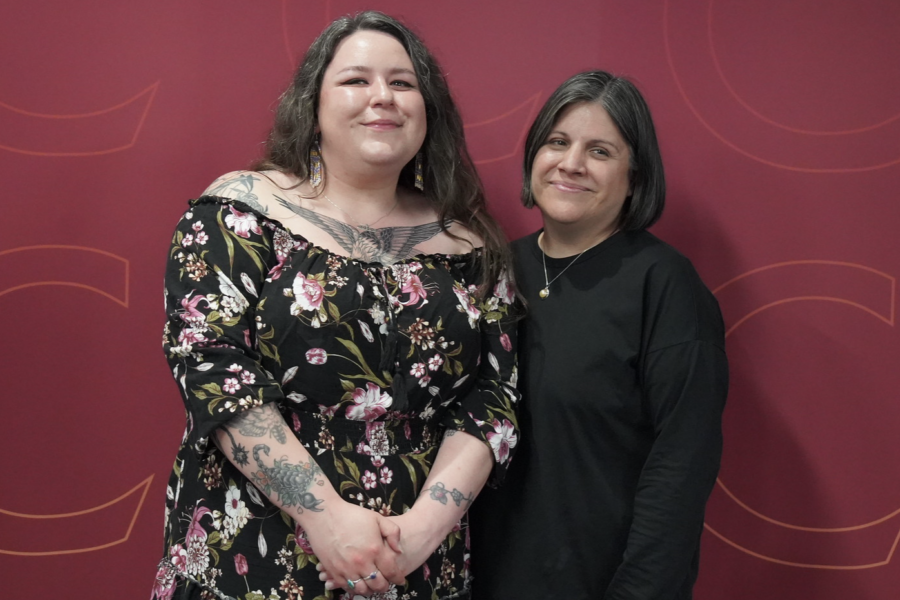
Tahothorátie’ Cross (left) and his partner, Teiotenharò:se’ Stacey (right), who is also a graduate of the Kanien’kéha Ratiwennahní:rats Adult Immersion Program. The two met thanks to the program. Courtesy Tahothorátie’ Cross
When Tahothorátie’ Cross was a little boy, he attended Karihwanó:ron, growing up in an immersion environment until he reached grade four.
But after that, his ability to speak Kanien’kéha began to fade. Over the years, he spoke in the language less and less, and English soon became his default tongue.
“I had this shame, this disappointment that I had lost what I once had,” Cross said.
It’s been a complex journey to unpack that shame throughout the years, but Cross felt a good chunk of it melt away recently, as he this month celebrated his graduation from the Kanien’kéha Ratiwennahní:rats Adult Immersion Program offered by the Kanien’kehá:ka Onkwawén:na Raotitióhkwa Language and Cultural Center (KOR).
For the past two years, he and the 2025 Ratiwennahní:rats cohort have been dedicating themselves to the language, plunging themselves back into the immersion style of learning that Cross had begun to so badly crave over the years.
“Part of the reason I wanted to do this was to regain that knowledge, to be able to be a speaker again,” Cross said. “It was my driving force.”

The program has been life-changing, Cross said, with a huge part of that being thanks to the closeness of his cohort. Throughout the two years, the group has become what most Ratiwennahní:rats say of their classmates: “like family.”
“It became apparent right off the bat that we were a good class and that we were all going to be friends, we felt that right away, we all had that really good connection,” he said.
Being vulnerable about the struggles of language-learning was a key part of everybody’s success, Cross said.
“It definitely helped if somebody brought up a struggle they were having because it validated what you were going through too,” he said. “Everyone is just doing so well, they’re advancing so much, and so you don’t always realize that they’re going home and experiencing the same struggles that you are.”
There was one classmate in particular that Cross bonded with: Teiotenharò:se’ Stacey, Cross’ girlfriend, whom he met during the program. Stacey graduated with Cross earlier this month.
“Having her there every day, was the biggest thing,” he said. “I could go to her when I had any struggles, and she’s really good with the language, she understands a lot of the grammar rules, so it was emotional support, but it was academic too.”



Support comes from outside of the program too. Cross’s parents were behind him the whole way and attended his graduation.
“His father and I couldn’t be prouder of our son,” said Cross’ mother, Tracy Diabo.
“His commitment to learning and sharing the language with his family and community is truly inspiring,” she said. “I have no doubt that he’ll achieve great things.”
After entering the program feeling rusty, Cross said that he’s blown away by the sheer amount of Kanien’kéha he now knows. While it sometimes feels like he’s been studying forever, he also said that Ratiwennahní:rats passed in the blink of an eye, particularly in the second year of study, when the class took things to a more advanced level.
“Everything just went so, so fast. All of a sudden you realize ‘Oh, we only have three months left,’ and then it’s one month, and then all of a sudden you’re standing there at your graduation,” he said. “It’s emotional moving on from the program and realizing you’re not going to be able to see your classmates and teachers every day, these people you build strong connections with.”
Cross said that he wants to continue applying himself in the community and beyond, and is considering a career in education, a big passion of his, having proudly served on the Kahnawà:ke Combined Schools Committee for six years.
Sign up for email updates from The Eastern Door
He’s hoping that he can be a role model for more generations of language-learners, having himself looked up to speakers that inspired him in the past.
“Sometimes you’d go out into the world, and you hear speakers and you think ‘Wow, that’s so cool that you can still hear the language out in the world,” Cross said. “It’s really empowering and exciting to know that we can now be those people that the community hears speaking out wherever we are.”
As Cross reflected on his journey during graduation, he felt an emotion that’s quite the opposite of the shame he once associated with his knowledge of the language.
“It was pride,” he said. “I felt a strong, strong sense of pride.”