Damning final report lists obligations
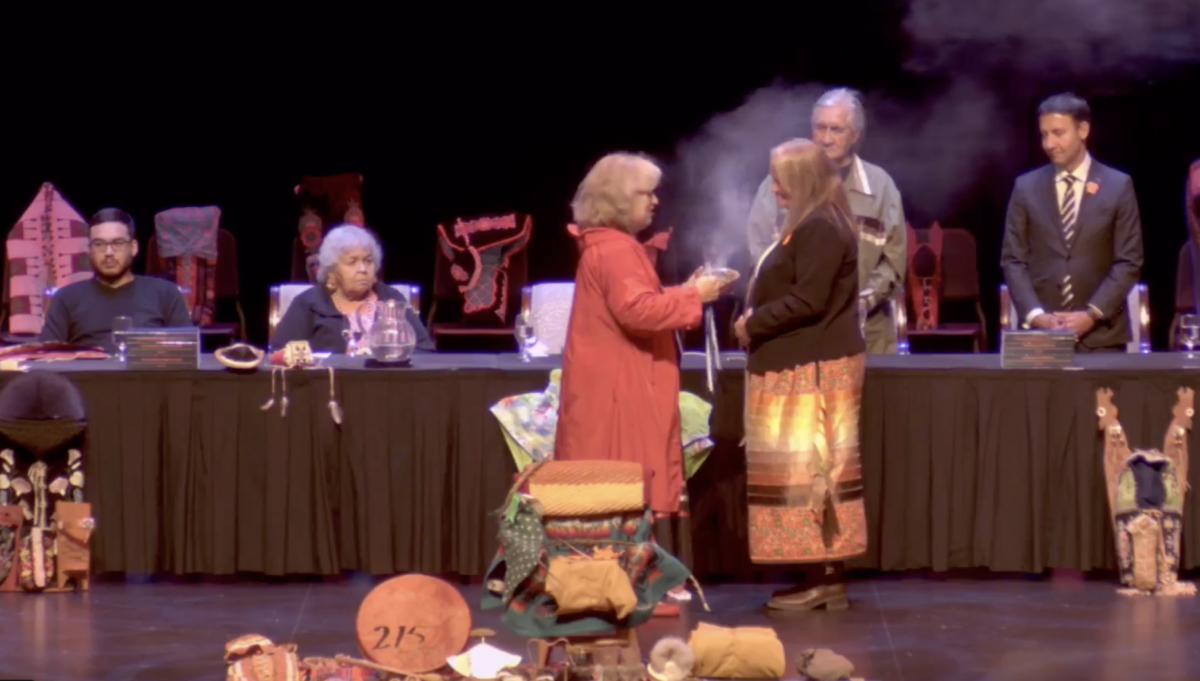
The federal point person for missing children and unmarked graves this week said that Canada must shift from “a culture of amnesty and impunity to a culture of accountability and justice,” with the release of a two-volume final report marking the end of her mandate.
The report from Kanehsata’kehró:non Kimberly Murray, who has been the special interlocutor for missing children and unmarked graves and burial sites associated with Indian residential schools since 2022, details 42 obligations that governments and institutions must meet to meaningfully implement reconciliation.
The final report includes a 256-page document titled Sites of Truth, Sites of Conscience: Tracing the Missing and Disappeared Indigenous Children in Canada, as well as a two-volume report titled Upholding Sacred Obligations: Reparations for Missing and Disappeared Indigenous Children and Unmarked Burials in Canada and an executive summary.
The findings were officially released at the seventh National Gathering in Gatineau on Tuesday, and the report was formally presented to the federal minister of justice and attorney general of Canada, Arif Virani.
“This is the culmination of two years of tireless and emotional work to address the incredibly harmful legacy of residential schools in our country,” Virani said. “Ms. Murray’s task was daunting in its scope and daunting in its time frame.”
The 42 obligations are considered “legal, moral, and ethical obligations” of governments, churches, and other institutions such as sanitoriums.
The obligations include the establishment of an Indigenous-led commission of investigation into missing and disappeared Indigenous children and unmarked burials, and the obligation for the federal government to provide full reparations, including compensation, to families of missing and disappeared children – including their descendants.

Murray said the use of the term “disappeared” throughout the report is intentional.
“The term ‘missing’ may be accurate in a literal sense and properly describes the longing of families for their loved ones. It fails, however, to reflect the government’s culpability and responsibility for the fact that children died and went missing,” she said. “Not because of the children’s choices or actions, but because of purposeful state violence, action, and force. They were not disappeared by accident.”
The report focuses on accountability and lays out how the Canadian government has worked to protect the perpetrators of the residential school system.
“The Canadian state has embraced a culture of settler amnesia and willful forgetting, a systemic impunity,” said Murray.
That impunity is described in the report as “settler amnesty” which is amnesty granted implicitly by the government to those most responsible for the crimes against Indigenous children.
“It is a blanket amnesty which, outside of a small number of prosecutions, covers all individuals involved, irrespective of their role, their seniority, and the responsibility of the crimes and severity of the crimes committed,” she said. “It’s an unconditional amnesty.”
The report includes an obligation for federal, provincial, territorial, and municipal governments and other entities to enact a moratorium or prohibition on the destruction of records containing information related to the death of children in residential schools and associated institutions. It also includes an obligation for the federal government to create an inventory of records that have already been destroyed and provide the dates of and reasons for their destruction.

“The right to truth is a powerful potential antidote to the effect of the unconditional blanket de facto amnesty and the culture of impunity that the federal government has actively created and cultivated in Canada,” Murray said.
Part of that right to truth also includes combatting residential school denialism, which is included in obligations concerning the rewriting of Canada’s history. In the report, Murray states that the government must fight denialism by amending the Criminal Code to make it an offence to “willfully promote hatred against Indigenous Peoples by condoning, denying, downplaying, or justifying the Indian Residential School System or by misrepresenting facts related to it.”
“While it may be tempting for Canadians to believe a mythical and idolized version of national history, denying the painful truths of survivors and of the missing and disappeared children and their families is a barrier to advancing reconciliation,” Murray said. “Collectively, Canadians can no longer be bystanders to reconciliation.”
Fred McGregor, a member of the Kitigan Zibi Anishinabeg First Nation who was a cultural advisor on the report, also spoke at the gathering. He acknowledged the work of Indigenous people who participated in national gatherings throughout Murray’s mandate, who shared often traumatic family histories at the events.
“I applaud every one of you that had the strength to do that. When you first started you were shaky, you cried, you remembered,” he said.
“One of the things that you did is you gave those children, our children, that voice to say what happened to them. You gave them that voice.”
He said that the first year he met Murray, he imagined her putting on a metaphorical cradleboard and standing upright. Throughout the years, he has seen the weight of the work bear down on her back, while she and her team have continued to plow forward with their work.
Sign up for email updates from The Eastern Door
“Now they can stand upright and take it off, because you’ve done your responsibility,” he said. “We absolve her of her responsibilities because she told the next levels of the stories.”
Since Murray’s mandate as special interlocutor has come to an end, she is starting a new role as a national scholar in Indigenous legal studies at Queen’s University.
The full report, and all past reports from national gatherings, can be accessed via the website for the special interlocutor, at www.osi-bis.ca.