Council report cards mostly missing
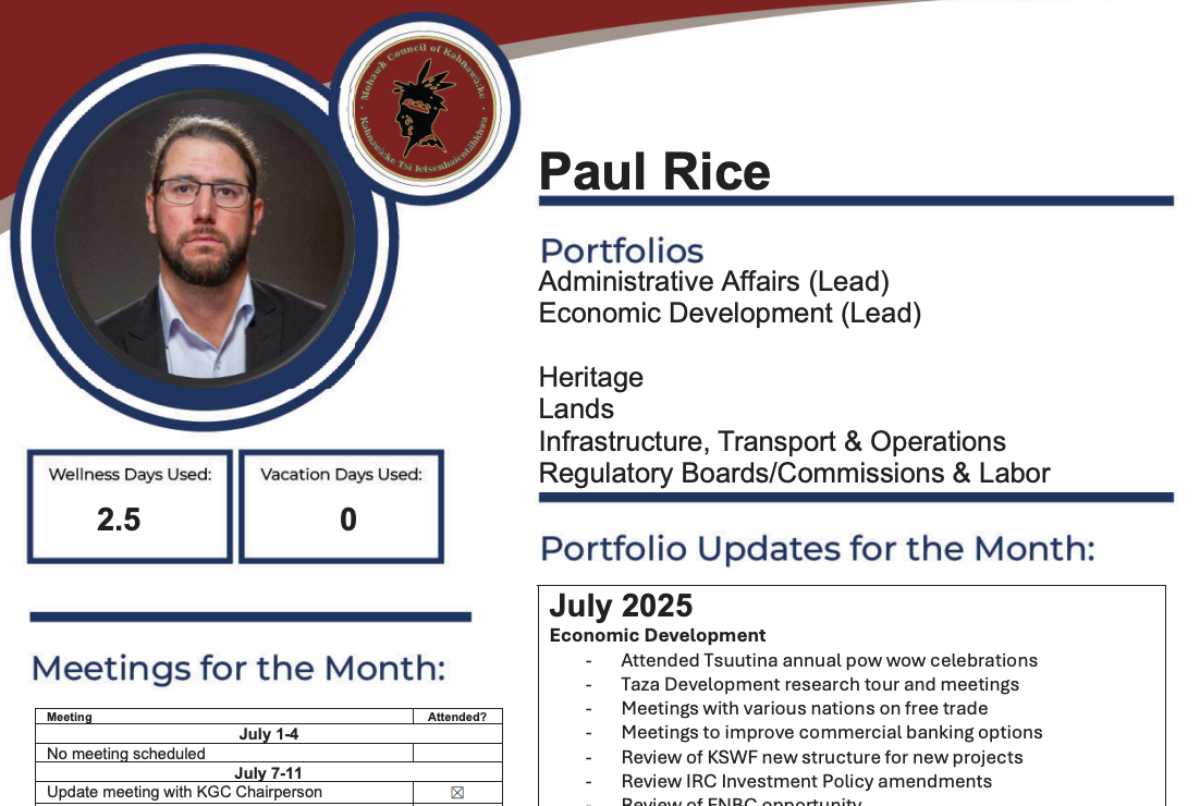
A snapshot of one of this month’s report – each report is stylized to look like a school report card, giving information about ongoing projects and absences. Courtesy Mohawk Council of Kahnawake
The Mohawk Council of Kahnawake (MCK) this week released July report cards, with only two at the Council table submitting reports of their activities and progress for the month.
The monthly reporting initiative was intended to bring greater transparency and accountability to Council operations, though each month, a declining number of MCK chiefs have completed reports.
“We’ve made it clear if you don’t submit your report by the deadline, it just doesn’t get posted,” said MCK grand chief Cody Diabo. “Even on my end, I haven’t always been able to get it in on time. But that’s the expectation.”
While Diabo supports the concept, he admitted that vacation schedules, tight deadlines, and heavy workloads are affecting the consistency of reporting. “It’s not something you can do in five minutes,” he said. “People are in back-to-back meetings. We have monthly community meetings, talk shows, and more. But this is still an important tool.”
MCK chiefs Arnold Boyer and Paul Rice were the only two who submitted reports for July.

“The community wants to know what we’re doing,” said Boyer. “We’re providing information on the meetings we’ve had. That matters.”
“We implemented this last year. In the beginning, I think it was being done a little more frequently,” Diabo admitted.
“Everyone has different schedules, and each chief has their own way of doing things,” Rice added.
Rice emphasized the importance of maintaining transparency with the community.
“My platform was primarily on economic independence and financial self-sufficiency,” Rice said. “We’re developing own-source revenue opportunities to reduce dependency on federal transfers. Our most recent financial results showed the highest own-source revenue in our history.”



His July report includes highlights like reviewing solar energy proposals, discussions with commercial developers, and meetings related to regional tourism. Rice also mentioned upcoming projects like the launch of a Community Emissions Fund to support environmental and emergency funding gaps.
But Rice also expressed concern about the delays and inconsistencies. “The template comes out near the end of the month. We usually have a week to submit. But if people miss the deadline, it just gets skipped,” he said.
For Boyer, top priorities in July included collaborations on health-related initiatives and progress on dialysis treatment access in the community. “It’s extremely important,” he said. “And I’ve just been making sure I complete the reports even if I’ve been busy with meetings.”
Diabo acknowledged that perhaps monthly reports may not be sustainable given the workload and other forms of communication already in place.
“Maybe we need to reassess,” said Diabo. “Maybe quarterly reports would give us time to reflect more and provide fuller updates.”
Sign up for email updates from The Eastern Door
“These reports were meant to show the day-to-day work of Council members, especially the stuff that doesn’t get picked up by the media or press releases,” said Diabo. “If someone’s not reporting, they should be ready to explain why when community members ask.”