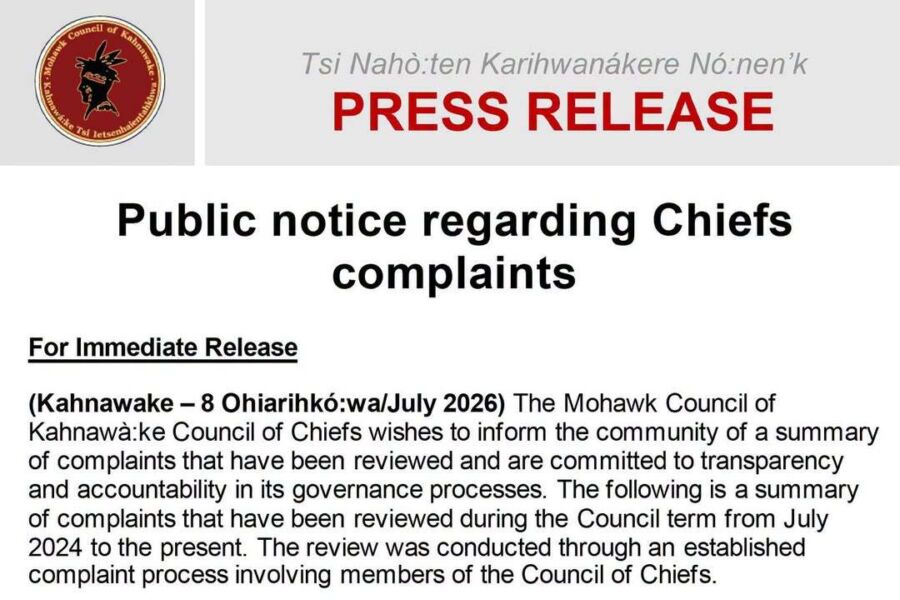
Council passes law-making authority
The Mohawk Council of Kanesatake (MCK) voted Wednesday to approve a process for the creation of laws, with that framework itself becoming the community’s first official legislation.
According to MCK chief Brant Etienne, Council voted 4-0 to pass the band council resolution that ushered in the Kanesatake Law-Making Process, which was followed by the signing of the new law. Etienne and MCK chiefs Amy Beauvais, John Canatonquin, and Serge Otsi Simon voted in favour of the law-making process, while MCK chief Denise David abstained.
“As long as we don’t have laws taking over our jurisdiction for things like environmental protection of our lands, justice, and everything like that, we’re stuck relying on the provinces or the federal jurisdiction,” said Etienne.
“We know that’s not what the community wants. That’s not what any of us want. We want to be in control of our own lives, and this is one way that we do it.”
Etienne said Council did not receive any comments from community members during a mandated 21-day period between the process being brought to the Council table in January and its passage this week, and it has basically been enacted in its existing form.

The law-making process had previously been presented to community members at sessions online and in person that were led by First Peoples Law. According to the process, the community approval phase for draft laws can take the form of community meetings, workshops, or secret ballot, depending on Council’s discretion.
MCK grand chief Victor Bonspille, who has scarcely attended Council meetings this term, was not notified of the meeting at which the law-making process was passed, Etienne acknowledged.
Etienne pointed to the Custom Electoral Code, which dictates that a chief or grand chief who misses three Council meetings without a valid reason has vacated their seat. Bonspille, who has taken the position that Council meetings he does not call are illegitimate, did not respond to a request for comment for this article. He has publicly opposed the Council majority’s efforts to enact a law-making process.
Indigenous Services Canada (ISC) has previously confirmed to The Eastern Door that a Council quorum has the authority to make decisions, however.
Now that the law-making process has been passed, the Council majority plans to forge ahead with four key laws: a Land Protection Law, a State of Emergency Law, a Trespass Law, and a Code of Ethics. First Peoples Law has worked on drafting these proposed laws, which the MCK intends to pass before the end of the current electoral mandate.



“We’re going to do our best to address the biggest concerns the community has been bringing up even before our mandate,” said Etienne, who indicated the drafts of these laws will soon be made available to the community for feedback, according to Etienne.
He said it will be incumbent on the next Council to continue to make use of the law-making process to address the community’s needs.
The law-making authority claimed by the legislation that was passed this week cites multiple sources, including inherent rights, the United Nations Declaration on the Rights of Indigenous Peoples (UNDRIP), the Indian Act, and, notably, the controversial 2001 Kanesatake Interim Land Base Governance Act, widely known as S-24.
“It goes without saying there are people that have probably already made up their mind one way or another. We’re probably going to hear from them,” Etienne said. “But I think the majority of the community knows what we’re doing is there to fix the clear problems that we’re facing.”
The final version of the Kanesatake Law-Making Process will be publicized to the community on the MCK website and in the First Nations Gazette. The day it is published, it will officially come into force, according to the draft version of the process.
Sign up for email updates from The Eastern Door
Marcus Bankuti, Local Journalism Initiative Reporter